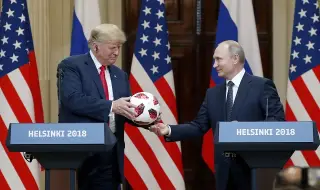
Russia's reaction to the American "gunner diplomacy" in Venezuela was relatively restrained by Kremlin standards and had a rather formal character, writes "Politico".
The Foreign Ministry came up with standard rhetoric, making statements about "blatant neocolonial threats and external armed aggression".
It undoubtedly demanded that the US release the captured Nicolas Maduro, and the Deputy Chairman of the Russian Security Council Dmitry Medvedev called the whole operation "illegal" - but there was also a note of admiration in his words. Medvedev spoke about the consistency of US President Donald Trump and how he openly defends America’s national interests.
It is also telling that Russian President Vladimir Putin has yet to comment directly on the kidnapping of his former ally. Nor has the Kremlin hesitated to endorse former Vice President Delcy Rodriguez as Venezuela’s interim leader, doing so just two days after Maduro was taken to a New York prison cell. In general, one would have expected a much stronger reaction.
After all, Putin’s alliance with Venezuela dates back to 2005, when he embraced Maduro’s boss — Hugo Chavez. The two countries signed a series of cooperation agreements in 2018; Russia has sold Venezuela billions of dollars in military equipment; and relations have warmed with provocative joint military exercises.
"The unipolar world is disintegrating and ending in all aspects, and the alliance with Russia is part of this effort to build a multipolar world," Maduro declared at the time. From 2006 to 2019, Moscow provided $17 billion in loans and credits to Venezuela.
So what accounts for the current rhetorical restraint? It seems like it might all be a bargain—at least for the Kremlin.
Moscow is likely to have no desire to rock the boat with Washington over Venezuela while it actively competes with Kiev for Trump's favor. It would be better for the American leader to lose patience with Ukrainian President Volodymyr Zelensky and throw him overboard than for Putin to do so.
Furthermore, Russia probably has no interest in promoting its so-far successful armed intervention in Ukraine, which would only highlight its own impotence in Latin America and its inability to protect its erstwhile ally.
Indeed, there is reason to suspect that the Kremlin found the surgically precise removal of Maduro and the stunning display of US hard power quite irritating. Russian ultranationalists and hard-line militarists certainly saw it that way: "All of Russia is asking why we don't treat our enemies in a similar way," wrote the neo-imperialist philosopher Alexander Dugin, advising Russia to do it "like Trump, do it better than Trump. And faster." Even Kremlin spokeswoman Margarita Simonyan admitted there was reason for "envy".
From Russia's perspective, this is an understandable sentiment - especially considering that Putin's "special military operation" in Ukraine was likely conceived as a quick beheading mission aimed at removing Zelensky and installing a pro-Kremlin satrap in his place. But four years later, there is no end in sight.
This is essentially a demonstration of America's military power that highlights the limits of Russia's military effectiveness. So why pay attention to it?
According to Bobo Lo - former deputy head of the Australian mission in Moscow and author of "Russia and the New World Disorder" - there are other explanations for the rhetorical restraint. "The removal of Maduro is quite disturbing, but, let's be honest, Latin America is the least important area for Russian foreign policy," he noted.
Furthermore, the US operation has "a number of unintended but generally positive consequences for the Kremlin. It diverts attention from the conflict in Ukraine and reduces the pressure on Putin to make any concessions. It legitimizes the use of force in pursuit of vital national interests or spheres of influence. And it delegitimizes the liberal idea of a rules-based international order," he explained.
Fiona Hill, a Russia expert at the Brookings Institution who was in charge of European and Russian affairs in the White House for part of Trump's first term, supports this reasoning: "Russia will simply take advantage of Trump's use of force in Venezuela - and his determination to rule the country from afar - to argue that if America can be aggressive in its backyard, the same goes for Russia in its "near abroad."
In fact, as early as 2019, Hill said that the Kremlin had signaled that when it came to Venezuela and Ukraine, it would be ready for a swap.
This all sounds like two mafia bosses indirectly bargaining for the division of territory through their subordinates and actions.
For the Kremlin, the key outcome of Venezuela is "not the loss of an ally, but the consolidation of a new logic in US foreign policy under the Trump administration - one that prioritizes power and national interests over international law," said the Center for New Eurasian Strategies of long-time Putin opponent Mikhail Khodorkovsky. "Despite all the reputational damage and some minor immediate economic losses, the Kremlin has reason, on the whole, to be pleased with recent developments - by his actions, Trump has effectively endorsed a model of world order in which force takes precedence over international law".
And since Maduro’s ouster, Trump’s aides have only made that clearer. While explaining why the US should own Greenland, regardless of what the Greenlanders, Denmark or anyone else think, the influential White House deputy chief of staff, Stephen Miller, declared: "We live in a world that is ruled by force, that is ruled by coercion, that is ruled by might".
Now that’s a language Putin understands. Let the bargaining begin - starting with Iran.