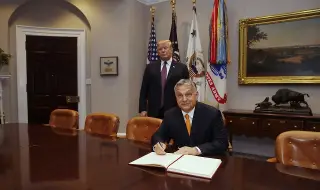
From his loyal ally Viktor Orbán to Giorgia Meloni, who is trying to mediate between Brussels and Washington: Trump has his friends in Europe. Who are they?
After the Munich Security Conference, US Secretary of State Marco Rubio visited Slovakia and Hungary. This is no coincidence - the governments of these countries are close to Trump because of their critical positions on the European Union, migration and climate policies.
The US president has other allies in Europe, although his aggressive rhetoric on Greenland has alienated some of them. Who are Trump's friends in Europe?
"Brother in spirit": Hungarian Prime Minister Viktor Orbán
Viktor Orbán has been in office since 2015 - even before Donald Trump's first term. Orbán calls him an ideological "brother in spirit". This applies to practically all areas of their policy.
While former US President Joe Biden accused Orbán of seeking to impose a dictatorship because he suppresses independent media and fights against LGBTI rights, Trump recently praised him as a "true friend, fighter and winner". Trump and Rubio support Orbán - especially now in the election campaign for the parliamentary elections in April, which he could lose.
Orbán also supports Trump's course of significantly reducing and even ending military aid to Ukraine - unlike, for example, Italian Prime Minister Giorgia Meloni. Like Trump, Orbán has no qualms about meeting Putin and is not willing to blame Russia for its war in Ukraine.
In the EU, Orbán is an outsider. He maintains good contacts with the German party "Alternative for Germany" (AfD), which has been partially declared an extremist organization by the Office for the Protection of the Constitution. A year ago, Orbán received the party leader Alice Weidel at his residence and declared that "the future belongs to the AfD".
On the issue of Greenland, Orbán refrained. He avoided direct condemnation of Trump and stated that the problem should be resolved within the framework of NATO.
Robert Fico: A Controversial Figure
Immediately after participating in the Munich Security Conference, US Secretary of State Marco Rubio visited Slovak Prime Minister Robert Fico. In the capital Bratislava, he said that under President Trump's leadership, the US "will make not only Slovakia but all of Central Europe a central part of our engagement on the continent and in the world." However, no further details followed.
Along with Orbán, Fico is considered one of Donald Trump's closest allies in the EU. Fico has a tough anti-migration policy. In 2016, he declared: "Islam has no place in Slovakia." He stopped arms supplies to Ukraine and called Ukrainians attacked by Russia "Nazis and fascists."
But Fico's policy towards the US is contradictory. During his first term from 2006 to 2010, he sought closeness with Russia, China, Venezuela and Cuba, which are far from Washington's greatest friends. At the end of January 2026, the magazine "Politico" wrote, citing European diplomats, that on the sidelines of the EU summit, Fico had commented that Trump had "lost his mind". Subsequently, both Fico and the White House denied the information, describing it as "a lie" and "fake news".
Chances for the rejected Alice Weidel from the AfD
A year has passed since US Vice President J.D. Vance criticized the Europeans at the Munich Security Conference for suppressing freedom of speech and allowing destructive migration that the European population did not want. After that, Vance carried out another huge provocation towards the political center parties in Germany: he demonstratively met with the co-chair of the "Alternative for Germany" Alice Weidel, but completely ignored the then German Chancellor Olaf Scholz. This was something that should have greatly increased the prestige of the party, which has been partly declared extremist and with which all other parties in the Bundestag refuse to work.
Trump and Weidel have a lot in common on the topics of immigration, climate and nationalism. The fact that Trump is apparently ready to make major concessions to the aggressor Russia in the name of peace in Ukraine is also the position of the "Alternative for Germany". Things got a little complicated when Trump decided that he wanted Greenland, i.e. the territory of a NATO ally. Since then, the party has slightly distanced itself from the American president in its rhetoric.
Giorgia Meloni as a mediator
Giorgia Meloni from the post-fascist "Brothers of Italy" party is the first woman to head a government in the country. Ideologically, she is close to Donald Trump and has long sought his closeness. And this provides the Prime Minister of the third largest economy in the EU with an important mediating role in the disputes between the EU and the US.
And there are quite a few of them - in the customs dispute last year, she exerted her influence, and in the dispute over Greenland she again offered her services. However, her role as a mediator is very limited, given that both sides take her seriously. She described Trump's request for Greenland as a "mistake", and according to a large part of the Italian public, Trump has gone too far. That is why she went on the offensive and said: "There are many things on which I disagree with Trump. When I disagree, I tell him."
Melony also maintains her position on the issue of Ukraine, which she has always supported.
Farage - Trump's British hope
For some time now, all polls in Britain have predicted an election victory for the right-wing populist party "Reform UK". Its leader, Nigel Farage, could then become prime minister.
Farage, the nightmare of the British elite, played a crucial role in the Brexit campaign, which was in the spirit of Donald Trump. The two have been close allies for many years. Farage was also invited to the exclusive party for the elections on November 5, 2024, at Trump's Mar-a-Lago estate in Florida. However, he described Trump's ambitions for Greenland as "obtrusive".
The disappointed Karol Nawrocki
There is a reason why politicians from "Law and Justice" (PiS) see themselves as Donald Trump's model students in Europe. For their national-conservative governments, issues related to order and the fight against migration were important. They were not shy about sharing their skepticism towards the EU and close relations with the US.
Poland today spends the most on defense as a percentage of GDP in NATO, even more than the US. Although the liberal and pro-European Donald Tusk is currently in power in Warsaw, the conservative Karol Nawrocki was elected president, having been promoted by PiS and demonstratively welcomed by Donald Trump at the White House during the election campaign.
However, Trump admirer Nawrocki must be very disappointed with him - although he has not said so openly so far. Because Trump is raising increasingly strong doubts about whether the US would really defend its NATO allies - for example, Poland - in the event of Russian aggression against it. Moreover, in Poland itself, which is one of Ukraine's closest allies, Trump's pro-Russian position is very poorly received.
Marine Le Pen keeps her distance
France is France. It does not need to offer itself as an ally to anyone. This is the impression created by President Emmanuel Macron. The same seems to be true for Marine Le Pen of the far-right National Rally party, which wants to succeed Macron after the 2027 elections. She described Trump's first victory in the 2016 elections as "good news for France" and praised his focus on national sovereignty, the fight against globalization and his restrictive immigration policy.
Since his return to the White House a year ago, however, Le Pen has seemed quite restrained: she called his decision to stop military aid to Ukraine "cruel" and has been trying for some time to give her party a more acceptable image to the general public.
Whether Le Pen will even be able to run in the next election is questionable, since a court decision has deprived her of the right to hold public office. However, she is appealing. The alternative candidate, the leader of the "National Assembly" Jordan Bardella, has a similar attitude towards Trump: he initially applauded him, but later decided that Trump's threats regarding tariffs and Greenland were "unacceptable" and even described his re-election as "bad news for the interests of France".
Bardella regularly emphasizes that Trump "is not his model" and that he only follows French examples. At the end of last year, the leader of the National Assembly even stated the following: "I don't need a big brother like Trump".