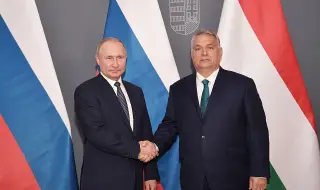
Viktor Orban's pro-Russian orientation has a long tradition. Now the Kremlin is clearly helping Orban get re-elected. The parliamentary elections in Hungary are also a vote on the country's direction - towards the EU and towards Russia.
The small black memorial plaque on the facade of a house with number 99 on the majestic Andrássy Boulevard in Budapest reminds us of an episode in history that took place at this location in November 1956. Then Soviet troops invaded Hungary and brutally crushed the anti-communist revolution. Some Soviet soldiers, however, refused to participate in the bloodshed against the Hungarian freedom fighters and were shot.
The memorial plaque probably did not please the neighbors in the palace directly opposite. It was there that the Soviet embassy was once located - and there the executions took place. Today, the palace houses the embassy of the Russian Federation in Hungary. Some Russian officials still view the Hungarian revolution of 1956 as a "fascist uprising". Russia, which in many ways considers itself the successor of the Soviet Union, has never apologized for the events of 1956.
Nearly seventy years later, it seems as if the embassy building is once again playing a sad role. The Russian diplomatic mission in Budapest is currently considered a kind of command center for Moscow in the Hungarian election campaign. In unison with Hungarian Prime Minister Viktor Orbán, his government and his party "Fidesz", smear campaigns are being organized from here against the opposition candidate Péter Magyar. This is evidenced by information from various investigative journalists, as well as leaked data from a session in the Hungarian parliament.
"Political technologists" in Budapest?
It has been clear for months that the parliamentary elections on April 12 will also be a referendum on Hungary's further orientation towards the East or the West. But recent events have exacerbated the situation even more: Russian President Vladimir Putin's public statements about Hungary, as well as Russia's hidden influence, show that the Hungarian elections have finally become a European and geopolitical issue. It is about Hungary's belonging to Europe and the West or to Russia.
Last week, Hungarian investigative journalist Szabolcs Pani from the Vsquare portal, citing sources from European intelligence services, reported that a team of three "political technologists" had arrived in Hungary to help Orban win the parliamentary elections on April 12. "Political technologists" are the name given in Russia to those political advisors who have been organizing Putin's election victories for decades.
An army of trolls, manipulated algorithms
Pani is known for his reliable investigative reporting. He told DW that he received information on the case from three independent sources from European intelligence services. Pani says that the Russian team is led by Sergei Kiriyenko, deputy head of the Russian president's administration. And his task is to organize a social media campaign against Péter Magyar and his party "Tisa".
"So far, the Orbán government's social media narratives have been weak and unsuccessful", explains the Hungarian journalist. "The Russians want to help Orbán with their army of trolls, manipulated algorithms and fear-mongering content to take the campaign to a new level."
Western intelligence services warn
Shortly after Pani's publication, Hungarian media reported that the National Security Committee of the Hungarian Parliament had discussed the warning of Western intelligence services about Russian political technologists sent to Budapest. The government, however, assures that no such presence could be established.
This week, the "Financial Times" reported that the Kremlin had commissioned the Moscow IT firm "Agency for Social Design" (ASP) to support Orban in his election campaign. The agency is known in Russia for its disinformation campaigns and is subject to sanctions by the EU, the US and other international organizations.
Russian ambassador enters into controversy with Magyar
After the information became known, the Russian embassy in Budapest further fueled speculation. They said that they knew the journalist Pani well, and that "he quite openly spreads disinformation". There was no delegation working at the embassy under the leadership of Kiriyenko.
In addition, the embassy's press service, as well as the Russian ambassador to Budapest, Evgeny Stanislavov, personally entered into a polemic against the Hungarian opposition leader - he was accused of spreading false information.
Peter Magyar, for his part, sharply criticized Russian interference in the elections and wrote to the ambassador: "We, the Hungarians, are the heirs of the freedom fighters of 1956. No one can threaten and blackmail us."
According to Magyar, on April 12, the majority of Hungarians will show with their votes that Hungary's place is in the European Union. The opposition leader called on Prime Minister Orban to convene the National Security Council and "explain to the people of Hungary what is happening".
Putin's reliable partners
Orban and his government, as well as the Kremlin, categorically deny that Russia is influencing the Hungarian election campaign. On the other hand, Orban's government maintains very close political relations with the Kremlin. Since Orban came to power in 2010, he and Putin have met almost every year. Despite all the EU and US sanctions against Moscow, the Hungarian prime minister has steadfastly adhered to Russian oil and gas supplies and to cooperation with Russia in the field of nuclear energy.
Late last year, Putin praised Orban as a "leader who defends national interests" and said that with politicians like him, Europe would "be reborn". In early March, Hungarian Foreign Minister Péter Szijjártó visited Moscow, where Putin - as a sign of friendship - handed over to him two Ukrainian prisoners of war of Hungarian origin, who had previously expressed pro-Russian sentiments in Russian propaganda videos, also broadcast on Hungarian state media. Last week, Putin threatened to cut off energy supplies to Europe, but he clarified that this did not apply to reliable partners such as Hungary and Slovakia.
Investigative journalist Szabolcs Pany sees this threat as Putin's campaign arm for Orbán. "He is telling Hungarians that gas stations will dry up and the economy will freeze if they do not vote for his comrade," Pany says.