Bulgaria has been subjected to severe humiliation with the "Peace Council" saga, to which it was condemned by parties and politicians dependent on Peevski. National interest and geopolitics turn out to be the prey of a private interest. By V. Stoynev.
The decision of the Bulgarian Parliament to oblige the cabinet to prepare the ratification of Bulgaria's accession to Donald Trump's Peace Council is so senseless that it did not receive any news response in the international media on the day it was voted on. However, this does not mean that it will not reinforce the unfortunate impression that our country created in international political circles with the act of signing the Charter of the Peace Council by Rosen Zhelyazkov in his last days as the Prime Minister in resignation.
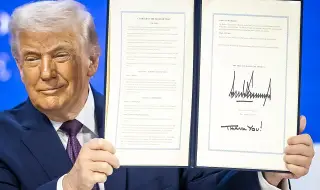
Bulgaria's joining the Trump initiative was extremely surprising. The government decision, which authorized the Prime Minister and was taken under force majeure "upon signature" by the ministers, was not announced in advance on the cabinet agenda. It was only after Zhelyazkov's signature, placed at the official ceremony in Davos, became known.
Yesterday's decision by the parliament, adopted with the votes of GERB, DPS, ITN and independents, as well as with the complicated absence of one third of the deputies of "Vazrazhdane", all of the APS, more than half of the BSP and almost all of the MECH and "Velicie", is legally and practically untenable.
The parliament cannot seize functions of the government
Legally it is untenable because it violates the constitutional principle of separation of powers and turns the parliament into a convention that seizes powers from the executive branch and turns it into its technical executor. The National Assembly cannot dictate to the Council of Ministers, which, according to the constitution, guides and implements the domestic and foreign policy of the state and has the right to legislative initiative with bills and decisions. The role of the parliament is to approve or reject them - in this case, to ratify an international treaty, but only after it has been proposed to it by the government.
A separate question is whether this Peace Council is an international organization or a private initiative of Donald Trump in his personal capacity, since he is a lifetime president with the authority to appoint his successor and invite and exclude members. It is also unclear to what extent the subject of activity extends to the Gaza problem or more broadly to the Middle East in the context of the war in Iran. So, in terms of content, this document on the Peace Council, for which there is no official translation, is open to attack for constitutionality.
The government can wait for the next parliament
From a practical point of view, the parliament's decision is meaningless, because the 51st National Assembly is leaving very soon. And since the cabinet, as announced by the acting Prime Minister Andrey Gyurov, has referred its constitutionality to the Constitutional Court, it has every justification not only not to rush to implement it, but not to do it at all until the court has ruled. 5 years ago, it ruled in a case on the parliamentary moratorium that it is inadmissible to suspend the implementation of the powers of constitutional bodies, including the Council of Ministers, by a decision of the National Assembly. Now the logic is the same - the parliament limits the powers and seizes the functions of the government.
The 52nd parliament can overturn the decision of the 51st on the Peace Council even before the Constitutional Court has ruled, or if it rules in favor of the 51st. So the official cabinet is practically not bound to fulfill the parliamentary order to submit ratification for Bulgaria's accession to this strange organization created by Trump.
Bulgaria as a hostage of a person sanctioned under Magnitsky
There is no doubt about the motivation of Delyan Peevski, who forced Prime Minister Zhelyazkov to sign the Charter, as well as the decision of the National Assembly for ratification. He wants the US to lift his sanctions under Magnitsky. The question is why GERB and the rest of the parliamentary "coalition of the willing" joined his bandwagon. The ITN was a conservative party, related to the Republican Party in the US – this is as convincing a reason as a skit. Half of the BSP group, which the new leader Krum Zarkov threw out of the electoral lists due to dependence on the "Peevski" model, remains loyal to the new beginning, because it is apparently not even given the opportunity for its own beliefs. Those independent deputies who cast their votes are clearly of a similar dependence. And APS, MECH and "Velichye", at the most innocent assumption, may have a split identity.
Silence and clear political argumentation are also lacking from the largest parliamentary force - GERB. Rosen Zhelyazkov, who signed the Charter, did not even appear in parliament, and leader Boyko Borisov invented pre-election tours around the country and commented from there that his group would vote for Peevski's proposal not because of him, but because of Zhelyazkov and the elected High Representative for Gaza.
But Borisov had announced in February to the leader of the EPP Manfred Weber during a meeting of the European parliamentary group that Bulgaria would not ratify the document, and the then Foreign Minister and now an active participant in the parliamentary decision for ratification, Georg Georgiev, had stated at the end of January that the next National Assembly and possibly the next regular cabinet would be able to ratify it, if at all.
How GERB shot itself because of Peevski
This poses serious questions for the GERB party about its identity and reputation - both in Bulgaria and before its international partners. Because there is not only unacceptable vacillation on key foreign policy issues, but also because it is not even the result of political hesitation, indecision and incompetence, but of the most direct dependence on Peevski. Otherwise, Zhelyazkov, who started with a great public credit of trust as prime minister, would not have ended up in his post as a courier for emergency deliveries and finally hide from parliament in a cowardly way, while Borisov would explain like in kindergarten that Trump does not know who Peevski is, but he knows him, because they sat together in front of the fireplace in the White House.
Bulgarian society and Bulgaria as a country are subjected to severe humiliation with the "Peace Council" saga, to which the parties and politicians dependent on Peevski condemned it. And it is not even over yet.
What is more terrible than the humiliation is that the national interest and the geopolitical situation of the country turn out to be easy prey for a private interest. Corruption and addictions have crossed all limits and the only weapon is in the hands of citizens, who have the chance to hold their political representatives accountable in the elections on April 19.
***
This text expresses the opinion of the author and may not coincide with the positions of the Bulgarian editorial office and the State Gazette as a whole.