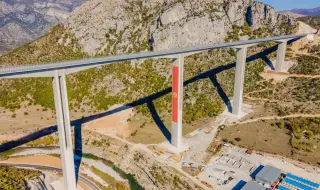
The highway project, which is supposed to connect the port city of Bar on the Adriatic coast with the Serbian border, has been underway since 2014 and has so far reached Mateševo - 101 out of a total of 177 kilometers have been built.
At the end of February, the state highway operator in Montenegro, Monteput, commissioned the construction of another section of the highway - the 23-kilometer section from Mateševo to Andrievica. The construction contract worth 694 million euros was awarded to the Chinese state-owned concern Powerchina and its subsidiary Stecol.
This project is considered a symbol of China's "debt trap diplomacy", writes the German "Frankfurter Allgemeine Zeitung" (FAZ) in an article titled "Montenegro's Scandalous Highway". The publication recalls that from the very beginning the EU doubted the economic feasibility of this very expensive construction project - because of the many bridges and tunnels in the mountainous region. However, Beijing readily agreed to fulfill the desire of the government in Podgorica to implement the prestigious project, the FAC adds.
An unbearable financial burden
Not only was the contractor - the state-owned construction company China Road and Bridge Corporation (CRBC) - Chinese, but also the lender in the person of the Chinese Foreign Trade Bank Exim-Bank, which agreed to provide a loan of over $ 1 billion for the construction of the highway. However, the first installments on the loan became due even before the first stage of construction was completed. This happened only a year later, in 2022, after many delays and cost increases.
For the budget of the small Adriatic country with a population of 630,000, this was a very heavy burden. Mainly because of the highway loan, Montenegro's public debt exceeded the country's GDP in 2020, and according to the German foreign trade organization GTAI, debt repayments are still weighing on Montenegro's state budget today.
For Montenegro, this meant that there was a risk that the country would fall into a situation of heavy dependence on China. Thus, this model, known from Africa, also manifested itself in Europe, according to the FAC.
However, the China-critical NGO Choise believes that Montenegro has not reached the debt trap scenario, in which China turns economic dependence into political gains. The case rather illustrates the expansion of Chinese influence in a region where various diplomatic influences and external support play a decisive role.
This time the money comes from Europe
Now the government in Podgorica continues to build the highway criticized by environmentalists. And it is doing it again with Chinese contractors. But there is one big difference - not only in terms of the transparency of the tender, as Monteput CEO Milan Ljiljanić emphasizes: this time the money comes from Europe.
The EU is subsidizing the construction with 150 million euros, and the European Bank for Reconstruction and Development (EBRD) is providing a loan of 200 million euros. The rest will come from the Montenegrin state budget. This marks a 180-degree turn in EU policy, which once categorically rejected the project.
According to Choise, the change in Brussels' attitude cannot be explained solely by the possible upcoming accession of Montenegro to the EU (it is speculated that this could happen in 2028). For the EU, it is about more than just preventing Montenegro from going bankrupt: "The highway is part of the larger European transport corridor XI, which connects Bari in Italy with Bucharest in Romania", Choise says. In addition, the aim is to limit the influence of China and Russia in the region.
"Strong stimulus" or "highway to nowhere"?
For the government in Podgorica, the completion of the motorway, which critics call "highway to nowhere", is a central infrastructure project. But it is more than just a transport artery, says Milan Ljiljanić, who sees it above all as "a strong stimulus for the development of Northern Montenegro".
Work on the new section, which includes the digging of two 4-kilometer tunnels, should begin by May at the latest. The implementation should be completed in five years. After that, two more sections remain for the completion of the 177-kilometer highway.
This is not the first case in which Chinese companies have won major tenders, financed, among other things, with European funds. The "Pelešac" bridge in southern Croatia, opened four years ago, was also built by China Road and Bridge Corporation. It had also bid for the extension of the A1 motorway in Montenegro, but lost the tender.
Powerchina, which won the tender, is no stranger to the Western Balkans. In Serbia and Bosnia and Herzegovina, the Chinese state-owned company is building roads and wind farms. And in the Serbian capital Belgrade, Powerchina is participating as a leading partner in the construction of the first metro line, which costs several billion euros, writes FAC.