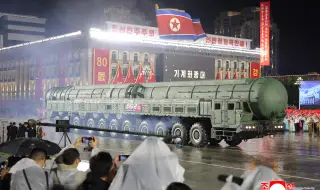
North Korea immediately condemned the military strikes against Iran, its long-time ally in the Middle East, and analysts suggest that Pyongyang will try to expose potential military, diplomatic and tactical mistakes made by Washington.
One of the most valuable lessons is that possessing nuclear weapons is crucial to the survival of a regime like Kim Jong-un's. Pyongyang could use the threat of its nuclear arsenal, along with its advances in ballistic missile technology, not only as a means of pressure in negotiations but also to ensure that the United States would have to risk nuclear war if it wanted to overthrow the regime.
In February, Kim said that "North Korea's status as a nuclear-weapon state plays an important role in deterring potential threats from enemies and maintaining regional stability," the state news agency KCNA reported at the time. Kim is convinced that Pyongyang's nuclear arsenal is a "guarantee" for the regime's security.
End of North Korean nuclear talks
Andrey Lankov, a professor of history and international relations at Kookmin University in Seoul, said that from the US-Israeli attack that quickly eliminated the leadership of the Islamic Republic, North Korea can learn that nuclear deterrence works.
“The rest of the world can say goodbye to any hopes that Pyongyang will give up its nuclear weapons, as North Korea simply will not participate in any negotiations on any issue related to them“, Lankov told DW. “The attacks on Iran are the final nail in the coffin of this hope“, he added.
A report published by the Analytical Center for North Korea “38 North“ lists eight conclusions that the North Korean leadership has probably drawn from recent events in the Middle East. First and foremost is that nuclear weapons provide real protection. In this regard, it is not logical that Kim Jong-un would ever agree to negotiations to give up his nuclear arsenal, the report states. Other key conclusions are the need to increase the stockpile of missiles and develop more unmanned aerial vehicles, while maintaining readiness to protect key facilities from enemy drones.
However, the think tank adds that North Korea has been able to develop its nuclear program, deterring the United States from attacking its nuclear research facilities in 1994 thanks to “Pyongyang's ability to inflict massive damage on the nearby South Korean capital, Seoul, with conventional artillery and chemical weapons“. However, the threat of Iranian retaliation has never been as serious as Pyongyang's threat to South Korea. North Korea conducted its first nuclear test in 2006.
“The Axis“ North Korea-Iran
North Korea and Iran have developed close ties since the Islamic Revolution in 1979, including in the areas of nuclear technology and weapons. As early as the 1980s, North Korea brokered arms deals with other communist bloc countries and sold its missile systems to Tehran. North Korea has also provided military instructors to train Iranian forces.
The ties were so close that in 2002, President George W. Bush called North Korea and Iraq an "axis of evil" in his State of the Union address. Both Pyongyang and Tehran are still designated as state sponsors of terrorism.
Last week, North Korea condemned the US-Israeli attack on Iran as "destroying the foundations of regional peace and increasing instability throughout the world."
Regime Survival
As the war enters its third week, the Iranian regime is still clinging to power, despite the loss of key leadership figures. In this regard, another lesson for the Kim regime is that the leadership must be protected and have backup options ready in case the ruler is eliminated, the report by „38 North“ states.
Nevertheless, North Korea will be encouraged by how well Iran has held up so far against a far more powerful military force, said Kim Sang-woo, a former politician with the left-leaning South Korean party „Congress for New Politics“.
„I think Pyongyang is watching everything very closely and may be pleased with the results. Iran managed to put the US in a difficult position - they thought they would finish the job quickly, like they did in Venezuela, but now they seem to be bogged down and under pressure both domestically and internationally,“ he told DW.
“North Korea knows that giving up its nuclear advantage would be very foolish. So that is now an impossible dream for us in South Korea,“ the observer adds.
Author: Julian Ryall