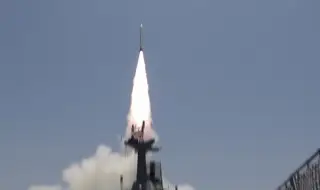
8,000 drones and up to 6,000 ballistic missiles - according to experts, this was Iran's military capacity before the war began. But what is left of them nearly four weeks later?
The US-Israeli war with Iran is entering its fourth week, and Iranian missiles continue to strike targets in Israel and the Gulf states, despite Donald Trump and Benjamin Netanyahu claiming to have destroyed Tehran's stockpile.
On March 14, the White House said that "Iran's ballistic missile capability has been functionally destroyed," but 10 days later Iran carried out a series of strikes, showing that its stockpile is not depleted.
Iran has launched hundreds of missiles and thousands of drones
"Missile launch capacity has been reduced, but not depleted," Middle East security analyst Burcu Özçelik told DW. east at the Royal United Services Institute, a defense and security think tank.
The strikes on Iranian military launch sites and depots have had limited effect, says Kelly Grieco of the US-based "Stimson Center". The reason is that Iran has made an "operational shift": "In the early days of the war, Iran launched over 500 ballistic missiles and over 2,000 drones with a very low success rate - less than 5% of the targets were hit. Over the next two weeks, the frequency of launches dropped by over 90%, but something somewhat unexpected happened - the percentage of successful hits began to rise. Iran launched fewer missiles and drones, but they were much more accurate."
It is very difficult to assess the military power of Iran after more than three weeks of war. Here's what is known:
What missiles does Iran have?
Iran has never disclosed anything about its missile stockpile, but the Israeli military estimates that Tehran possessed about 2,500 missiles before the start of the current conflict. Independent experts estimate the number to be as high as 6,000.
Before the war, Iran certainly had the largest and most extensive missile arsenal in the entire Middle East, according to US intelligence. According to the Center for Strategic and International Studies (CSIS), this arsenal includes the following ballistic missiles: "Sejil", "Ghadr" and "Khoramshahr" with a range of 2,000 kilometers, "Emad" - 1,700 km, "Shahab-3" - 1,300 km, and "Hoveize" - 1,350 km. The two missiles launched a few days ago against the British and US military base on the Indian Ocean island of Diego Garcia, located almost 4,000 km from Iran, however, show that Iran also has missiles with a longer range than previously thought.
In addition to being devastating weapons in their own right, ballistic missiles can serve as carriers of nuclear warheads, although Tehran denies that it is seeking to acquire nuclear weapons.
What is left of Iran's stockpile?
Naturally, the launch of many of these missiles in the past few weeks and during the conflict with Israel in 2025 has reduced the stockpile, as have US-Israeli attacks on weapons production facilities. But no one outside the inner circle of Iran's political and military leadership knows how much that missile arsenal has been reduced.
The Revolutionary Guard continues to carry out attacks and effectively keeps the Strait of Hormuz, the Iranian regime's main weapon of influence, closed. "It is likely that not all of Iran's ballistic missile program will be eliminated in this phase of the US-Israeli operation," Burcu Özçelik said.
There is little concrete information about how many weapons facilities the US and Israel have damaged or destroyed. Last week, Israeli Prime Minister Benjamin Netanyahu said that as a result of the attacks, Iran's ability to launch missiles and drones had been "significantly weakened." Despite the heavy strikes by the US and Israel, the Islamic Republic clearly still has the capacity to counterattack. Photo: Morteza Nikoubazl/NurPhoto/picture alliance What is Iran's drone capability? Matthew Powell, a lecturer at the University of Portsmouth in England, told DW that Iran had an estimated 80,000 Shahed drones as of early February. However, he added that it was very difficult to determine how many of them had been used in the ongoing war. Drones are extremely important to Iran's military power. "They allow Iran to strike key infrastructure in hostile countries because of the nature of this weapon system. The Shahed-136 in particular is more difficult to destroy than larger ballistic missiles," Powell said.
He also points out that taking down Iranian drones is significantly more expensive than the drones themselves. In this regard, the lecturer from Portsmouth recalls that the US is spending approximately $ 1 billion a day on the war in Iran.
Can Iran replenish its stocks?
Another advantage of the drone war for Iran is that the country has the ability to quickly replace the drones - at least in a lull. "The expected productivity is about 10,000 "Shahed" drones per month in peacetime," says Powell. However, it is not clear to what extent the war has affected production capacities.
While drones are relatively easy to replace, missiles are much more complicated. Nevertheless, Iran seems capable of recovering. The Islamic Republic has the capacity to rearm, even though Iran accounts for just 0.05% of global arms imports, according to the Stockholm International Peace Research Institute for the period 2021-2025.
Last week, General Ali Mohammad Naini, a spokesman for the Islamic Revolutionary Guard Corps, told the state news agency IRNA that the country produces missiles "even in wartime and has no particular problems with stockpiling." Shortly after making the statement, Naini was killed in an air strike.
The real question is whether Iran can produce them quickly enough to replace those lost to launches or attacks by the United States and Israel. Alex Plitzas, a former Pentagon official, told Canada's CBC that at the beginning of the war, Iran could produce about 300 missiles per month, but that capacity has now dropped to about 40 per month, or "a day's firing."
While the US and Israel appear confident that they have hit their respective above-ground targets, it is widely reported that there are at least five underground "missile cities" in various Iranian provinces, including Kermanshah and Semnan, as well as near the Persian Gulf region, that have survived. So the US and Israel's cherished goal of completely neutralizing Iran militarily is clearly still a long way off.