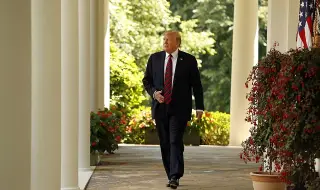
Donald Trump does not think strategically. Nor does he think historically, geographically, or even rationally. He does not connect the actions he takes in one day to events that occur weeks later. He does not think about how his behavior in one place will change the behavior of other people in other places.
He does not consider the broader consequences of his decisions. He does not take responsibility when those decisions turn out to be wrong. Instead, he acts on whim and impulse, and when he changes his mind—when new whims and impulses take over—he simply lies about what he said or did before.
In the past 14 months, few foreign leaders have managed to admit that someone without any strategy could actually be president of the United States. Of course, foreign policy analysts whispered, Trump is thinking beyond the immediate moment. Of course, foreign statesmen whispered, he is adhering to some ideology, some model, some plan. Various terms—isolationism, imperialism—have been thrown around in an attempt to put Trump’s actions in historical context. There have been solemn articles about the supposed importance of Greenland, for example, as if Trump’s interest in the Arctic island did not stem entirely from the fact that it looks very large on the Mercator projection.
This week, however, something broke, writes the American-Polish journalist Anne Applebaum in an article for the American magazine The Atlantic. Trump may not understand the connection between the past and the present, but others do. They can see that the Strait of Hormuz is blocked by Iranian mines and drones as a result of decisions Trump has made but cannot explain. They see oil prices rising around the world and understand that the US Navy is facing a difficult and dangerous situation. They also hear the president, as he has done many times before, trying to force others to take responsibility by threatening them if they do not.
NATO faces a "very bad" future if it does not help clear the strait, Trump told the Financial Times, apparently forgetting that the United States founded the organization and has led it since its inception in 1949. He also said that he was not asking, but ordering, seven countries to help. He did not specify which ones. "I demand that these countries step in and protect their own territory, because this is their territory," Trump told reporters aboard Air Force One en route from Florida to Washington. "This is where they get their energy." In reality, this is not their territory, and it is his fault that their energy is being blocked.
But in Trump's mind, these threats are justified: he has a problem now, so he wants other countries to solve it. He doesn't seem to remember or care what he said to their leaders last month or last year, and he has no idea how his past decisions have affected public opinion in their countries or harmed their interests. But they remember, they care, and they know.
Specifically, they remember that for 14 months, the American president imposed tariffs on their goods, mocked their security concerns, and repeatedly insulted them. As early as January 2020, Trump told several European officials, "If Europe is attacked, we will never come to your aid and support you." In February 2025, he told Ukrainian President Volodymyr Zelensky that he too had no right to expect support because "he doesn't have any cards." Trump mocked Canada, calling it the "51st state," and called both the current and former Canadian prime ministers "governors." He falsely claimed that allied troops in Afghanistan were “a little behind, a little off the front lines,” causing great offense to the families of soldiers killed in battle after NATO invoked Article 5 of the organization’s treaty on behalf of the United States, the only time it has done so.
He called the British “our once-great ally” after they refused to participate in the initial offensive against Iran. When the idea of sending aircraft carriers to the Gulf conflict zone was mooted earlier this month, he mocked it on social media: “We don’t need people going to a war we’ve already won!”
Sometimes the ugly talk escalated into something even worse. Before his second inauguration, Trump began suggesting that he would not rule out using force to annex Greenland, a territory of Denmark, a close NATO ally. At first, it seemed like trolling or a joke; by January 2026, his public and private comments had convinced Danes to prepare for an American invasion. Danish leaders had to consider whether their military would shoot down American planes, kill American soldiers, and be killed by them—an ordeal so harrowing that some have yet to recover.
In Copenhagen a few weeks ago, I was shown a Danish app that tells consumers which products are American so they know not to buy them. At the time, it was the most popular app in the country.
Economic damage is not trolling either. In 2025, Trump imposed tariffs on Europe, the United Kingdom, Japan, and South Korea, often at random—or, again, on a whim—and without considering the consequences. He raised tariffs on Switzerland because he disliked the Swiss president, but then lowered them after a Swiss business delegation brought him gifts, including a gold bar and a Rolex watch. He threatened to impose 100 percent tariffs on Canada if it dared to strike a trade deal with China. Unconcerned about potential conflicts of interest, he held trade talks with Vietnam even as his son, Eric Trump, began construction on a $1.5 billion golf course there.
The Europeans might have swallowed the insults and even the trade damage if it weren’t for the real threat Trump now poses to their security. For 14 months, he has, despite talk of peace, encouraged Russian aggression. He has stopped sending military and financial aid to Ukraine, giving Vladimir Putin new hope for victory. His envoy, Steve Witkoff, has begun openly negotiating business deals between the United States and Russia, even though the war is not over and the Russians have never agreed to a ceasefire.
Witkoff presents himself to European leaders as a neutral figure, somewhere between NATO and Russia—as if, again, the United States is not the founder and leader of NATO and as if European security is not of particular concern to Americans. Trump himself continues to attack Zelensky and lie about American support for Ukraine, which he repeatedly describes as worth $300 billion or more. The real figure is closer to $50 billion over three years. At the current rate, Trump will spend that much in three months in the Middle East, starting a war rather than trying to prevent one.
As a result, Canadian Prime Minister Mark Carney has said that Canada will not participate in "Israeli and American offensive operations and never will." German Defense Minister Boris Pistorius says, "This is not our war and we did not start it." The Spanish prime minister has refused to allow the United States to use bases at the start of a war. Britain and France may send a few ships to protect their bases or allies in the Persian Gulf, but neither country will commit its soldiers or sailors to offensive operations launched without their consent.
This is not cowardice. This is calculation: if allied leaders believed that their sacrifice would mean something to Washington, they might have acted differently. But most have stopped trying to figure out the hidden logic behind Trump's actions and understand that any contribution they make will mean nothing. In a few days or weeks, Trump won't even remember it happened.