Comment by Georgi Lozanov:
In Bulgaria, the fight against the oligarchic model has become like a folk tale: the heroes who threaten to defeat it still fail, and the people are waiting for the next hero... He has already been chosen - in the person of Rumen Radev, who claims that he will destroy the oligarchs, but without naming specific names. And during this time they gloat: "Everyone is fighting us, but in the end they rely on us".
At the end of 2025, citizens filled the squares in the country (as happens on average every six to seven years) to give impetus to the battle against this model, labeling it directly with the names of Delyan Peevski and Boyko Borisov. However, in order to have a result, it must be clear what exactly the model in question is and how it arose, and not be satisfied with general talk, innuendo and incantations.
Where does the oligarchic model come from?
It is paradoxical that its clearest definition so far belongs not to its critic, but to its supporter, such as the former chairman of the MRF Ahmed Dogan. He had stated that each party has its "ring of companies" and he is "the instrument in power that distributes the portions". This definition of his was in fact a form of self-confession for organizing a corruption scheme, but "he didn't care", because impunity is also an obligatory part of the model. At that time, in Bulgarian politics, Dogan was "the leader of non-coupism", as I had named an article about him in the "24 Chasa" newspaper some time ago.
He had told the truth only to some extent, just enough to demonstrate his own power. At the depth of the phenomenon is the installation of a parallel power in the state, more influential than the official one – power over power, which follows the totalitarian model from the time of communism. According to this model, everywhere - from the smallest enterprise to the Council of Ministers, in parallel with the administrative leadership, party action is taken, headed by a party secretary who has the last word. More or less, the director, the rector, the minister, etc. are just a facade of party decisions. The power hierarchy during communism was not even double, but triple, because state entities (there were no private ones) were subordinate to the local communist party, and it to the Soviet one. Moreover, the mockery was complete and this party power, parallel to the official one, was also official – under the Constitution, according to Article 1.
How the "deep state" was formed
Its problem arose after January 15, 1990, when Article 1 was repealed and it lost its official status. However, its beneficiaries did not think at all of leaving it in the past and it had to sink deep below the public surface. Thus, the "deep state" was formed, whose "cadres" they do not go through elections and the law does not catch them (similar to the party nomenclature before). When the square protests against the Peevski-Borisov model, it clearly recognizes in Peevski the prime minister of the deep state, and in Borisov - the real prime minister of the official one. And when Borisov protests against his bundling with Peevski, it may not be so much because of himself as because of the roles thus distributed between them.
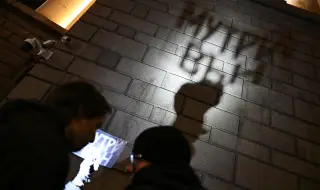
In order for its commands to be carried out even after the country's transition from a command to a market economy, the parallel government had to be "monetized". At the beginning, the process was carried out by the power groups created for this purpose, which brought in income through racketeering of the nascent private business and by redistributing state resources "under the table". "Muttri" slipped out of the social space. They came mainly from the sports schools that emerged during communism under the auspices of the army and the militia, which is why they could not subsequently escape the grip of the former State Security. Its ruthless handwriting was evident in the fact that most of the bosses of the groups, when they became redundant, were simply killed. Moreover, they could not arouse much sympathy in society, because they had a threatening underground profile, even if they fastened white collars on their thick necks.
The scumbags did the job "on the ground" - they forced "ordinary people" to accept that they would finance not only the official government (with their taxes), but also the parallel government - without asking exactly how. Life after November 10th was somewhat similar to that after September 9th, when "the people's government" took away the people's personal property without the right to object. Half a century later, the scale of the theft was more modest, but the sense of a breakdown of justice was similar. In this sense, the deep state committed not only a material crime, but also a mental one, darkening the joy and trust of millions of Bulgarians in democracy.
How does the model survive?
The redistribution of state resources - first in clientelistic privatization waves, and then with announced public procurements - requires motivating the state administration (up to its highest levels), for which the proven method is corruption. It drives the "metabolism" between the legal and deep state and between them and business, in which the most dedicated receive the "title" oligarchs. Their presence brings today's Bulgaria closer to the autocracies.
However, in order for the illegal connections between the "two" states and the oligarchs to continue to exist undisturbed, two things are important: they must not come to light and their impunity must be guaranteed. This implies that the deep state keeps the media and especially the judiciary dependent, and here the key figure is the Prosecutor General, who in Bulgaria is a "monopolist" of guilt and innocence. The judicial reform has become a political hit of the transition - it can never take place, as it will break the second dependency and from there the entire sock of the deep state will unravel.
Can Radev dismantle the oligarchic model?
The chance that Rumen Radev is the politician who will succeed in dismantling the oligarchic model is small. Why? Because a mandatory condition for this is that he belongs in terms of thinking and behavior to Western democracy, whose defining value is precisely the rule of law. And because the model itself is an Eastern invention - a modernized version of Soviet power, exercised with violence and coercion and practiced in its "pure form" by Putin's regime. And Radev not only does not say any critical words about this regime, but also leaves the impression that he intends to return Bulgaria's energy dependence on Russia.
He even resists possible European assistance against disinformation and foreign interference in the upcoming elections. And this strengthens the suspicion that it is most likely Russian.
Keeping silent instead of answering the question of whether Vladimir Putin is an aggressor is the ultimate 2 in 1. First, it turns out that in the war in Ukraine you are on Russia's side. And second, that you are working in its interests, hidden behind the dismantling of the oligarchic model that comes from it.