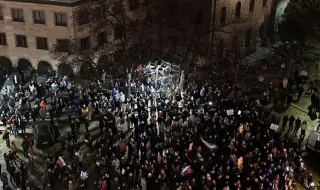
The political crisis after the fall of Zhelyazkov's cabinet shows how society is swinging between mass dissatisfaction, expectation of a strong leader and the eternal battle with the status quo. The Revolt of the Masses in Bulgarian – between hope and the search for a savior. By José Ortega y Gasset. The fall of Rosen Zhelyazkov's cabinet after a wave of protests showed the power of public discontent. Thousands of people took to the streets with the feeling that the state was captivated by the political status quo, embodied mostly by GERB and DPS – A New Beginning. This rebellion has all the characteristics of the “mass impulse“ that Ortega y Gasset writes about – strong, emotional, sometimes chaotic, but expressing an accumulated sense of injustice.
But is the warning about something important heard: the mass can destroy, but it has difficulty creating. It has the power to reject the old order, but it does not always have a clear vision of what to put in its place.
This is exactly what is happening in the Bulgarian political crisis.
After the protests, society remained in a state of expectation - between the hope for change and the fear of repeating the same pattern.
Against this background, Andrey Gyurov's office began a series of personnel reshuffles - in the Ministry of Interior system and among regional governors. Such actions always carry a double message. On the one hand, they are presented as an attempt to “cleanse“ the institutions. On the other - for many citizens they seem like another change of figures in the same system.
This is how the element of the masses appears - the tendency to look for a savior.
When society feels powerless in the face of the complexity of the political process, it begins to concentrate its hopes in one figure. This was the case with the Tsar, then a wave under Borisov, then Slavi Trefonov was “born“, followed by “We continue the change“, and now the Bulgarian situation in this role is inevitably associated with President Rumen Radev.
For a large part of the protesters, Radev has become a symbol of resistance to the status quo. In his image, many see a leader who can oppose the political networks of GERB and DPS.
This is a typical historical mechanism – When institutions lose trust, society begins to look for moral authority outside of them.
But… The masses, when disappointed, easily replace one dependency with another. Instead of building a stable civic culture and strong institutions, they can turn to the cult of leadership – to the figure of the “man who will fix everything“.
A peculiar paradox appears in the Bulgarian case. On the one hand, society rebels against the backstage and political dependencies. On the other hand, this same society often places its hopes in one person who must confront the system.
Thus, politics begins to move between two extremes: mass protest and personal hope.
Will Bulgarian society remain in a state of periodic rebellions against the status quo – or will it move to a more mature phase of civic participation?
Real change does not come only from the masses, nor only from the leader. It comes from the emergence of the “noble man“ - the citizen who does not wait for a savior, but takes personal responsibility for society. Bulgarian politics today is precisely on this border. Between rebellion against the old model, hope in a strong leader and the need for deeper change in society itself. History shows that protests can overthrow governments, but only mature citizenship can change the state.