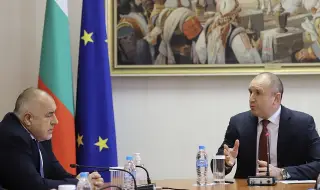
"Borisov-Peevski" has fallen, Rumen Radev's one-man rule is coming: Bulgaria's new strongman comes to power with an election result that rearranges the political map. Analysis by Emilia Milcheva:
"Borisov-Peevski" has fallen, long live Rumen Radev's one-man rule. Greeted first by Serbian President Aleksandar Vučić, who is also set to become prime minister after early elections, Bulgaria's new strongman comes to power with an election result that rearranges the political map.
The early elections on April 19 gave "Progressive Bulgaria" an absolute majority of 45%* of the votes - a rare and indicative vote after the last five years of instability and 10 governments (regular and caretaker).
For the first time since the time of Ivan Kostov and the United Democratic Forces, which ruled with 137 deputies, a formation comes to power that may not even choose a governing partner.
And for the first time since the beginning of the transition, the Bulgarian Socialist Party will not be in parliament.
The era of coalitions and assemblies is over. The era of concentrated power begins. Five parties will be represented in the 52nd National Assembly, with the first one strongly dominating - "Progressive Bulgaria", followed by PP-DB, GERB-SDF and "Vazrazhdane".
The challenges facing Rumen Radev
An independent government, burdened with the expectations of a quarter of Bulgarian voters, is a temptation and a danger. On the one hand, it allows for a clear majority and quick decisions without coalition compromises. On the other hand, it concentrates enormous power, which can easily be torn away from real public support and control. When the executive branch is formed, it will become clear whether some of his ministers in caretaker governments will return to head the governments.
In view of Rumen Radev's requests for judicial reform and the fight against corruption, a natural partner could be the PP-DB, for whom these topics have been their credo since their inception. With their support, "Progressive Bulgaria" could reach a constitutional majority of 160 deputies, necessary for deeper institutional changes. It is significant that almost all political forces declare as a priority the urgent election of a new composition of the Supreme Judicial Council, which would appoint a new prosecutor general, as well as the filling of the Inspectorate at the SJC.
This election could also happen without the current "Borisov-Peevski" status quo. The big question, however, is what the rules for selecting candidates and distributing quotas will be. And even more importantly - whether Rumen Radev will not repeat the "you chose him" model, a patent of Boyko Borisov.
Along with the launch of the judicial reform, a challenge for "Progressive Bulgaria" is the regular budget for 2026 due to fears of an economic crisis. The war in the Middle East is raising the prices of energy raw materials, and this topic was also reflected in Radev's comments on election night. Following his long-known sympathies, he made it clear that he is in favor of restoring dialogue with Russia in the context of energy prices: "If we want Europe to have true strategic autonomy, Europe must restore its competitiveness, stop the process of deindustrialization. Europe must think very seriously about this increasingly escalating crisis, especially to the south of us. How will it guarantee its resources, because without energy resources we cannot talk about competitiveness".
As a future Prime Minister, will Rumen Radev vote for the 20th package of sanctions against Russia, which the European Commission has so far failed to push through, and Slovak Prime Minister Fico and, until recently, Orban were against? Hardly. His position against sanctions is known. The absolute majority gives him the opportunity to do whatever he wants. The same majority will decide whether to ratify the document for Bulgaria's accession to the Peace Council of US President Donald Trump, where Hungary is also, brought there by the already dethroned Orban.
Was there a wave?
Although it did not reach the record voter turnout of over 67% in the June 2001 elections, when almost 2 million voted for the NMSV and the Tsar, there was still a wave. The predictions that Rumen Radev would steal votes from all parties, most of them from the largest ones, came true. According to the polls by "Trend", Radev's party has pulled 15.7% from GERB-SDF, 18.5 percent of former PP-DB voters, 10.7% from “Vazrazhdane”, 2.8% of those who have voted for the DPS so far, 11.3% from the BSP.
67% of those who did not vote in the last elections voted for Radev, and many people decided to do so in the last days and hours of the campaign. The former president is winning the votes of people from all age groups, he is even preferred by the youngest. According to the demographic profiles of "Alpha Research", 34% of GenZ (people between the ages of 18 and 30) voted for "Progressive Bulgaria". PP-DB is in second place, winning 22% of the young people's vote.
Generation Z was also among the most active participants in the December protests against the "Borisov-Peevski" model and for the rule of law. According to data from the "Myara" agency, 57% of those who voted for PP-DB participated in the protests, and of those who voted for "Progressive Bulgaria" almost two times less - 29%, were among the protesters.
Voting for Radev is a classic "collective vote" - protest, anti-system and highly personalized. It is not ideology, but the figure that unites voters.
GERB collapses, PP-DB second
The bitter cup is for Boyko Borisov's party, which has the weakest result in its almost 20-year existence. In addition to the penal vote, erosion in local government and rearrangement of business support are also visible.
Some mayors have hardly been so active - concerns expressed before the elections, and have probably switched to Radev's camp. Business circles, which have always been flexible when power changes in Bulgaria, have also reoriented along with them. But these elections are borderline for GERB, which will have to pay the price for the behind-the-scenes, and not only, collaboration with the oligarch Peevski, which Borisov never found the strength to end.
PP-DB partially regained positions after the "assembly", but Radev's rise puts them under pressure, including in their traditionally strong Sofia. A possible partnership between the two forces goes through a difficult choice: is the fight against the "conquered state" a priority or will geopolitical divisions prove insurmountable. "If you consider the conquered country as a fundamental issue, you leave aside the question of whose Crimea is", as political scientist Prof. Antoniy Todorov commented on BNT.
The news of these elections was also heralded by the splitting of the ethnic vote, after a significant part of the votes of the Turkish minority went to "Progressive Bulgaria", in addition to the MRF-New Beginning and the Alliance for Rights and Freedoms. The poor result of the MRF led by the oligarch Peevski was also helped by the activity of the Ministry of Interior in preventing vote buyers. This time, even the buses with emigrants to Kardzhali from Istanbul, Bursa and Izmir had no effect. The region recorded one of the lowest electoral activities.
The political system in Bulgaria has not just been rearranged, but has entered a new regime - with a strong government and many unknowns.
*The data is based on 87% of the votes counted.
This text expresses the opinion of the author and may not coincide with the positions of the Bulgarian editorial office and the State Gazette as a whole.