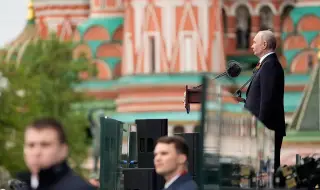
For Putin, May 9th is almost a sacred day. The Russian President loves history and has been using it to send a signal to the rest of the world about Russia's power and might, but this time it's different.
In Russia, President Putin has accepted this year's May 9th parade. A three-day truce negotiated by Trump allowed it to go ahead peacefully. Yet the parade has become a problem for Putin. For Vladimir Putin, the display of tanks, bombers and soldiers has always been an extremely important signal to the world - the pompous military parade usually serves another function - it is an attempt to consolidate Putin's power. This year, however, the traditional military parade on Moscow's Red Square is different. The war against Ukraine is dragging on, and the military successes promised by the Russian president are not happening. For the first time, clearer criticism of Putin is being heard in Russia.
Military parade without tanks and missiles
The display of tanks, artillery, missiles and other weapons at the military parade in Moscow has been canceled. Ukrainian drone attacks are increasingly terrorizing the Russian capital, and Russia is threatening retaliatory strikes on Kiev. However, the attacks on the Ukrainian capital have not stopped anyway.
Zelensky decided to further provoke his enemy by signing a symbolic "permission" for the May 9 parade in Moscow, adding the exact GPS coordinates of Red Square and instructing his army not to attack the venue.
And Putin, whose security has been sharply tightened in recent weeks, gave his speech this year to very few foreign dignitaries. In it, Vladimir Putin said that the Russian army was fighting in Ukraine against "aggressive" military forces supported by NATO, and that the "enormous merits" of the Red Army against Nazi Germany inspired today's soldiers during their campaign in Ukraine. Moscow's cause is "just", Putin declared.
Few foreign guests
The list of foreign guests is not long and includes, for example, representatives of the internationally unrecognized South Ossetia and Abkhazia, regular guest Alexander Lukashenko, as well as the presidents of Kazakhstan and Uzbekistan. The only EU leader to travel to Moscow is Slovak Prime Minister Robert Fico. He announced he would not attend the parade, but laid a wreath at the Tomb of the Unknown Soldier on Friday.
Fico's visits to Moscow have drawn heavy criticism, both in Slovakia and in the European Union. Fico has described himself as a "black sheep" in the EU over his stance on Russia, the Slovak news agency TASR reported. He said dialogue with the Kremlin was necessary and the war in Ukraine was coming to an end.
Parade is a "real disaster" for Putin
Abbas Galyamov, a former speechwriter for Vladimir Putin who knows the Russian leader well, said that this year's parade was not just a minor setback for Putin, but a real disaster, ZDF reported. Putin himself has been nurturing certain expectations related to the demonstration of military power for years, associating them with his name. According to Galyamov, what used to support and strengthen him - the parade and the war - is now working against him. ”Any problem with the parade is also a personal problem for Putin”, Galyamov told the German media.
The fact that the Russian secret services and the army were put on such a high level of alert that 13 airports in Russia were closed as a precaution and several parades in major cities were canceled altogether is perceived by many Russians as a sign of weakness.
Moscow's attempts to negotiate a ceasefire on its own have failed
Late on Friday evening, US President Donald Trump announced that Putin and Zelensky had agreed to his proposal for a three-day ceasefire - until May 11. The two sides have also agreed to exchange 1,000 prisoners of war, Trump announced, expressing his hopes that this could be "the beginning of the end of a very long, deadly war".
At first, the Kremlin unilaterally declared a ceasefire to mark May 9, the day Russia celebrates its victory over Nazi Germany in World War II. However, the Russian army continued to attack Ukrainian positions, Kiev reported. Ukrainian President Volodymyr Zelensky even said that because of this, he saw no reason for Ukraine to respect the ceasefire.
Later, however, the Ukrainian head of state announced that he had accepted Donald Trump's proposed ceasefire mainly because of the clause agreed in it for the exchange of prisoners of war, ARD writes. Later, Russian foreign policy adviser Yuri Ushakov confirmed that the ceasefire had also been approved by the Kremlin and said that it was the result of a telephone conversation with the US leader.