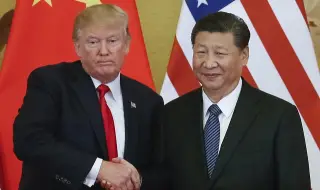
Trump will visit China this week and he definitely needs positive news on the foreign policy front. What can Beijing and Washington agree on?
Donald Trump will visit China this week after his first visit in April was canceled. The US is the largest economy in the world, and China is the second largest. At the same time, China is the largest, and the US is the second largest emitter of greenhouse gases.
From this point of view, the meeting between Presidents Xi Jinping and Donald Trump should not fail - this is what both Beijing and Washington are convinced of. The expected agreements between them will have a global dimension. At the same time, the two ambitious heads of state want to present their own populations, and in the case of the United States, voters, with results that will present them in a good light.
What Trump Needs
Trump is counting on communist China. He knows full well that he can count on good news if China makes the appropriate promises. Beijing does not want to embarrass its president, who has been in power for 13 years, with a possible failure of the meeting. Still, Trump needs to keep a reserve of compromises.
"Trump urgently needs positive news on the foreign policy front," said Chu Yin, a political scientist at the Pangoal think tank in the Chinese capital and a former professor at Peking University of International Relations. "Trump's confidence in the polls is at rock bottom ahead of the November midterm elections. "It seems his plan to quickly bring China's ally Iran to its knees through military strikes and celebrate his victory in Beijing as a bargaining chip has not worked," he added.
Now Trump must hope to reach at least a partial agreement in the trade war on punitive tariffs, Chu continued. Even before the meeting, negotiators from both sides will try to reach agreements in Seoul on Tuesday and Wednesday.
This would be a successful start to the midterm election campaign for Republican Trump. On November 3, all 435 seats in the US House of Representatives will be redistributed, as well as 33 of the 100 in the Senate. Republicans currently have a slim majority in both chambers. In addition, gubernatorial elections will be held at the same time in 36 states and three US territories.
Taiwan as a red line
In Beijing's eyes, however, the issue of Taiwan's legal status is a red line that must not be crossed in diplomatic relations with the US. Beijing views Taiwan as a breakaway province of the People's Republic of China (PRC), proclaimed in 1949 by the country's founder Mao Zedong. However, the democratically governed island still follows the constitution of the Republic of China, founded in 1911.
Beijing considers Taiwan to be part of its territory and follows the "one-China principle". In the 1972 Shanghai Communiqué, which, along with two other documents, is considered the basis for the resumption of diplomatic relations between the US and China, the US government simply "takes into account" this principle.
However, the "Taiwan Relations Act", which was passed in the US in 1979, authorizes the US government to "provide Taiwan with arms for defense" and to "oppose any use of force or other forms of coercion that would threaten the security or social and economic system of the people of Taiwan."
In Trump's second term alone, Taiwan has so far ordered a record $11.1 billion worth of weapons systems from US companies. On May 8, 2026, the Taiwanese parliament passed a law on arms purchases. By 2033, the island republic plans to purchase up to $25 billion worth of additional weapons systems from the US.
Beijing sees that US President Trump has a great deal of freedom of action within the legal framework. It is expected that Beijing will therefore use all possible means to get Trump to make a statement on the Taiwan issue that is favorable to Beijing.
Wars in Iran and Ukraine
"The US needs Chinese support in the war in Iran", says Peter Ku, chairman and founder of the Center for Globalization in Hong Kong. China plays a key role in ending Russia's aggressive war against Ukraine. After Trump, Russian President Vladimir Putin is also expected to visit Beijing - in June at the latest.
In both wars, China is not a party to the conflict and claims to have strictly complied with all international UN sanctions. However, Beijing is active and behind closed doors it is holding intensive talks with Tehran and Moscow.
Last week, Iranian Foreign Minister Abbas Araghchi visited Beijing. His Chinese counterpart, Wang Yi, expressed concern that the war in Iran seriously threatens regional and world peace. At the same time, China supports Iran in the peaceful use of nuclear energy in the civilian sphere, which is the right of every sovereign state.
In addition, Wang expressed hope that "all participants in the war in Iran will respond positively to the expectations of the international community to ensure safe shipping through Hormuz." It is in the interest of China's export-oriented economy that Iran no longer blocks the strait, US Secretary of State Marco Rubio said last week. "Iran should not lay mines. It should not take the world economy hostage," he added.
It is not yet clear whether Rubio will travel with US President Trump to Beijing. Because of his critical statements about the human rights situation in the Hong Kong Special Administrative Region and the Uyghur province of Xinjiang, he is on China's entry ban list.
Will the trade war continue?
Trump's message to the Chinese leadership is clear: the world should not only buy Chinese products. And China should also buy American products to compensate for the unbalanced trade. A year ago, Trump imposed high punitive tariffs on Chinese products. Some of them were later canceled. So far, however, negotiators from both sides have not been able to reach a meaningful agreement.
Despite the tariffs, according to the US Census Bureau for 2025, China still had a trade surplus of almost $202 billion. This is approximately the entire gross domestic product of Hungary.
"China is ready to buy American products", believes Peter Cui. "But China also wants to see something in return, such as easing the ban on the export of special American semiconductors for artificial intelligence."
The United States has imposed strict export restrictions on advanced artificial intelligence chips. China is on the verge of acquiring the technology to produce them, but due to American restrictions, this process is proceeding very slowly.
As for Vladimir Putin's upcoming visit to Beijing, Cui expects to discuss under what conditions the war in Ukraine can be ended. This is believed to be another of Trump's demands for China. And Putin has already given signals in this direction, without going into details.