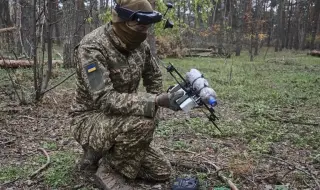
Thanks to technological progress, the Ukrainian military is now successfully hitting targets deep inside Russia. This allows them to cut off the supply routes of the Russian army.
Ukrainian units are fighting for control of the Russian army's most important logistical routes in the occupied regions of Ukraine. New medium-range weapons are now reaching Russia's supply routes inland, the Ukrainian military reports. Ukrainian drones can carry out reconnaissance and combat operations in the Mariupol area. Thus, parts of the so-called "land corridor" to Crimea, up to 160 km from the front line, could be hit by their strikes. As evidence, the Ukrainian military has posted numerous videos online showing burned-out Russian military aircraft along the route that runs through the occupied territories in southern Ukraine and leads to Crimea.
“The creation of a land corridor to Crimea is considered Moscow's greatest potential success during the bloody war from 2022 to 2026. But now it is clear that this is a temporary achievement. In fact, Ukrainian drones are already flying over the corridor, which civilians are not allowed to pass through. Crimea is becoming an overseas territory for Russia. And we will not stop there,” Ukrainian soldier Ihor Lutsenko, co-founder of the Air Intelligence Center, wrote on Facebook.
A turn for Ukraine in the war?
It is still too early to talk about full control over Russian logistical routes, says military expert Mykola Beleskov. "If there was full control, the Russian units in the south would feel differently," he told DW. But the vulnerability of the Russian troops is increasing.
Photos and videos prove that the Ukrainians' attacks at medium distances against the enemy have become more effective, Beleskov also noted. "Now the Russians are less active, although the area of their actions is quite extensive and there were heavy attacks there. We cannot speak of a turnaround yet. This only means that the situation is not getting worse for us."
New weapons are an advantage for the Ukrainians
Experts link the successes of the Ukrainian military to the technological breakthroughs achieved. Among other things, the defense forces now have drones from the Ukrainian manufacturer Wild Hornets with a built-in artificial intelligence system. "However, this will only give the Ukrainians a temporary advantage," says military expert Mikhail Shirokhov. He predicts that Russia will soon prepare additional mobile battle groups and cover the routes along the Crimean corridor with drone protection networks.
But it is good for Ukraine that Russia is forced to take such retaliatory actions, since any defensive measure requires resources, Shirokhov explains. "This is an additional burden for the Russians. They will have to invest money and redirect resources to secure the route. The effectiveness of Ukrainian strikes at the moment is due to the surprise effect, which will then decline. As soon as something effective appears, retaliatory measures are also taken - as four years of war have shown. "Therefore, this moment must be used optimally - while the Russians have not yet built effective air defense in this part of the front," the expert emphasized to DW.
What should Ukraine take now?
Shirokhov names a number of specific measures that could increase the pressure on the logistics of the Russian army: firstly, expanding drone attacks, which have already proven their effectiveness. Secondly, using heavier warheads in drones so that Russian tanks can be hit. And thirdly, identifying new targets. The expert is referring to the infrastructure along the route, which is hundreds of kilometers long. Strikes on gas stations and workshops could damage the logistics of the Russian army more systematically than hitting individual vehicles.
Military expert Mykola Beleskov also draws attention to other aspects. For example, that a number of tasks must be performed simultaneously at the front. “No matter how advanced the technologies are, without specialists they would not be able to unleash their potential. Waging war using robots continues to be highly dependent on human personnel. That is where, in my opinion, one of the biggest limitations lies. There is a shortage of trained personnel in all units that deal with medium-range attacks."
Added to this is the general lack of personnel at the front, the expert summarizes. That is why even the most effective technological solutions cannot fully unleash their capabilities.