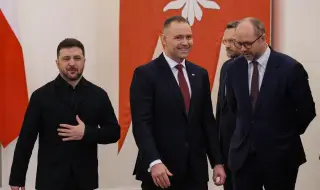
Poland is considering whether to deprive Ukrainian President Volodymyr Zelensky of the highest state award after he renamed a military unit of the Ukrainian Insurgent Army (UPA), which committed mass murders of Poles during World War II, BTA writes, citing a material from "Reuters".
The decision caused a wave of indignation in Warsaw and became the reason for Polish President Karol Nawrotski to demand that Zelensky be deprived of the Polish Order of the White Eagle, which he was awarded in 2023.
Here is how Poland and Ukraine's conflicting interpretations of their complex common history affect their relations today:
UKRAINIAN INSURGENT ARMY
Zelensky signed a decree recognizing the contribution of a unit of the Armed Forces of Ukraine in the fight against Russia, renaming it the “Heroes of the UPA“.
During and after World War II, when Ukraine was part of the Soviet Union, the UPA fought with the Red Army, thus for a time allying with the invaders from Nazi Germany, pursuing the goal of Ukrainian independence.
Ukraine stated that the renaming of the unit “has no anti-Polish character“ and was chosen by servicemen who wanted to honor the memory of their colleagues who also fought against Moscow.
However, the UPA also participated in the so-called Volyn massacre (in today's Ukrainian Volyn Oblast) - mass killings committed by Ukrainian nationalists in the period from 1943 to 1945. Warsaw claims that approximately 100,000 ethnic Poles. Thousands of Ukrainians were also killed in revenge killings.
Polish historians have described the mass killings as genocide, aimed at preventing post-war Poland from claiming sovereignty over predominantly Ukrainian areas that had been Polish territory between the two world wars.
Kiev denies the charge, saying that thousands of Ukrainians also lost their lives during the conflict.
The events have been a subject of dispute between the two countries for decades, although Poland has strongly supported Ukraine in its fight against Russian invasion. Warsaw has taken in more than a million refugees and continues to provide weapons to Kiev.
In 1947, Poland – now within new borders after World War II – forcibly deported some 140,000 ethnic Ukrainians and people identifying as members of the small Lemko ethnic group, from Southeastern Poland to territories it received from Germany.
These actions are intended to cut off support for illegal UPA groups in Poland, but Ukraine defines this as ethnic cleansing.
REQUESTS FOR EXHUMARIES IN UKRAINE
A series of Polish governments have consistently demanded access to places in western Ukraine that were once part of Poland and where the UPA carried out killings. However, these calls have not met with much success.
However, Poland began last year to exhume the remains of Poles killed in the former Polish village of Pużniki. A few days ago, Kiev gave permission for additional exhumations to be carried out in the small town of Lubomlsky district in Ukraine's Volyn region.
NATIONALIST PRESIDENT NAWROCKI
Polish President Karol Nawrocki - a historian with conservative and nationalist views, influenced by his American counterpart Donald Trump - has repeatedly accused Kiev of delaying permits for exhumations and called on Ukraine to recognize the Volhynia massacre as genocide.
Nawrotski took advantage of public discontent with the large number of Ukrainians in Poland and during his election campaign promised not to ratify Ukraine's possible accession to NATO so as not to provoke Russia. He referred to previous Polish positions on the issue, which, in turn, angered Kiev.
Critics accuse Nawrotski of promoting an approach to teaching history that glosses over difficult moments from Poland's past.