Comment by Denitsa Toshirova:
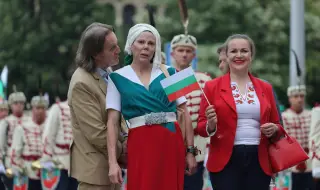
For another year, in parallel with Sofia Pride, the so-called "Progress for the Family" was held - this time supported by the ruling "Progressive Bulgaria" and led by Patriarch Daniil, according to whom the event was not directed against Pride, but "is a call to all people to join God's love".
Between symbolism and reality
The main message of the organizers of the procession is: support for the family, based on traditional Christian values.
But when we talk about traditional Christian values, what exactly are we talking about? About love for one's neighbor, mercy and care for the weak? Or is the goal simply to determine which families are "right" and which are not? Because if traditional Christian values mean compassion, solidarity and dignity for every person, then Bulgaria urgently needs them.
The reality for Bulgarian families is a shortage of places in kindergartens, insufficient support in early parenthood, uncertainty in the healthcare system, a feeling that the future depends more on luck than on politics. Because when politics begins to be guided by religious dogmas, and not by the real needs of people, society loses. And in the public debate "family" becomes a slogan.
The discrepancy is obvious: the political debate often focuses on value and symbolic gestures, while the real problems of families remain in the background. And these problems are visible to the naked eye. Families with children need accessible kindergartens, they need adequate financial support and policies that allow combining work and parenthood. Women - from security during motherhood and effective protection. Fathers - from a real opportunity to participate in childcare. Young people - from a perspective that does not push them towards emigration.
Recently, it has often been said that young people do not want children. But this misses the more important question - under what conditions would it be reasonable for them to have them? In a country that talks about family values, but discusses cuts to motherhood? In which police and security budgets many times exceed investments in education? In which young doctors protest without real results, and systemic problems in healthcare remain unresolved? Against this background, what kind of support does "March for the Family" actually provide?
It is easy to talk about the family as a symbol. It is much more difficult to talk about it as an everyday life - for parents who combine work and childcare, for families who rely on one motherhood or one salary, for people who spend hours on the road because they have not found a place in the nearest kindergarten.
Put away the tricolors and roll up your sleeves
Do you want to support the Bulgarian family? Then put away the balloons in white, green and red and roll up your sleeves. Because a country is strong when it is strong socially.
The future of Bulgaria is in children and young people - regardless of their religious affiliation or sexual orientation. National and cultural identity is not measured by the number of flags flown or costumes worn. They are measured by the extent to which a country is capable of ensuring a dignified life and equal rights for all its citizens.
It is time for Bulgaria to finally arrive in the 21st century, where human rights and freedoms are not a "trend", but a fundamental principle.
And if many young people leave, others stay or return. And what they are looking for are not slogans and tricolors, but conditions in which life here would have meaning.
Pride has existed and always will exist. Because the demand for dignity, equal rights and humane treatment is not a fad. It is part of the same values that many of the marchers claim to defend.