Author: Keno Verzek
Romanian President Nikusor Dan is a passionate chess player, and some say he is very good at the game. But in the months-long political crisis in Romania, he made a risky move that not only does not comply with the rules of the game, but could also turn the entire game upside down. Many observers wonder what prompted the former civil society activist to play this way.
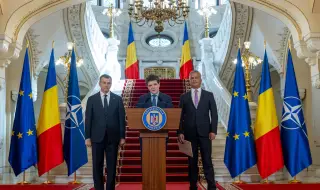
We are talking about the collapse of the four-party government coalition two months ago and the formation of a new government in the midst of a severe financial and socio-economic crisis in the country. On Sunday (June 14, 2026), Dan surprisingly nominated Adrian Veștea of the National Liberal Party of Romania for the post of Prime Minister, after the previous candidate returned the mandate to form a government.
Veștea is the chairman of the Brașov County Council and has attracted public attention in the past with negative actions. For example, being a graduate of a university known as a “diploma factory on a conveyor belt“, or his failure to build the road infrastructure for an important Romanian NATO military base.
"Hostile act"
The new nomination was made without the president consulting the parliamentary parties in advance, as required by the constitution. And most importantly: the leadership of the ruling National Liberal Party was not informed of the president's move. Its chairman and interim Prime Minister Ilie Bologian spoke of a “hostile act“ and “an attempt to split the party“. Some commentators called Dan's decision “brutal“, “authoritarian“ and accused the president that it was he, who presented himself as a fighter for the rule of law, who is now violating democratic and constitutional rules.
Romania has been in a political crisis for years, marked by frequent changes of government. For a long time, the country has had one of the highest budget deficits in the EU, at times exceeding 9% (2024). The country must carry out radical administrative and tax reforms. It must also impose fundamental reforms in the judicial system, which is considered corrupt. Without these reforms, Romania is threatened with a severe financial crisis and the loss of billions in European funds.
Strengthening the far right
However, Romania's political elite is having difficulty with reforms. Most parties have a self-serving mentality that has a long tradition in this country. The Social Democrats, a post-communist party originally made up of old functionaries from the Ceausescu era, are a symbol of political corruption and cronyism, and today they are already taking right-wing nationalist positions.
Due to the stagnation of reforms and people's dissatisfaction with the corrupt establishment, pro-Russian far-right parties have been gaining strength in recent years. In the parliamentary elections at the end of 2024, three of them received a total of about 35 percent of the seats in parliament. The largest of these is the Alliance for the Unification of Romanians (AUR).
How strong is Russian influence?
Again, in late 2024, the pro-Russian far-right esotericist Calin Georgescu surprisingly won the first round of the presidential election. Shortly afterwards, the election was annulled by the Constitutional Court due to alleged Russian influence. Russian propaganda is indeed strong in Romania, but it remains doubtful to this day whether Russian influence in the 2024 presidential election was as strong and direct as claimed.
The presidential run-off in the spring of 2025 was won by the mayor of Bucharest, Nicosor Dan – a former anti-corruption activist and moderate conservative. In his election campaign, he presented himself as a cosmopolitan, pro-European politician, promising to lead Romania out of the political crisis and determined to maintain the country's pro-European development course at all costs. He also promised to be closer to citizens and act transparently. "For an honest Romania!" was his campaign slogan.
After taking office in May 2025, he managed to form a four-party coalition of liberals, social democrats, the green liberal Union for the Salvation of Romania and the Democratic Union of Hungarians in Romania. Unlike the reformist Bolognese, the social democrats played the role of internal opposition in the government almost from the beginning. Just ten months later, at the end of April 2026, they left the coalition and brought down the government after a vote of no confidence, also supported by the far right.
Since then, President Nikos Dan has been trying to form a new pro-European government - to avoid early elections, in which far-right parties would likely gain a parliamentary majority. The situation is difficult, however: the National Liberal Party and the Union for the Salvation of Romania no longer want to govern together with the Social Democrats - although there is a small wing within the National Liberal Party that would still cooperate with them. Adrian Veștea belongs to this wing. At the same time, a new majority government, in which far-right forces do not participate, cannot be formed without the Social Democrats.
"We have gone astray"
Realizing this, the president has apparently abandoned many of his principles in order to attract the Social Democrats to his side. It is even possible that some far-right breakaways would support a Veștea government. For Nikusor Dan, who in previous years fought in Bucharest against the property mafia of the ruling Social Democrats, this is an absurd and dirty - in a sense even a devilish pact.
Many of the president's former supporters are shocked. Andrei Cornea, a philosopher and one of the most famous political commentators in Romania, recalls that the president has long violated his previous principles - for example, when he did not sign a law on stricter penalties against fascist propaganda. Or when he appointed officials with integrity problems to leading positions in anti-corruption bodies.
“We thought that Nikusor Dan, whatever mistakes he made, remained a democrat“, writes Andrei Cornea in the weekly “Revista 22“. “For a long time we believed that he was our president. But once again we have been mistaken. Now we know that it is not ours, but theirs!".