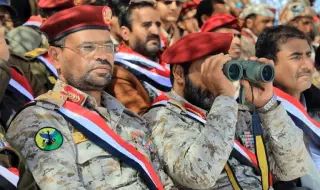
The US and Saudi Arabia have been striking Iranian-backed Shiite militias in Iraq, which both countries say are responsible for drone attacks on Saudi oil facilities. The strikes have focused attention on these armed groups, which have significant political and military influence in Iraq.
HOW DID ARMED GROUPS BECOME INFLUENTIAL IN IRAQ?
Shiite armed groups began to form as Iran gradually increased its influence over political and security matters in the country following the US-led invasion of Iraq in 2003 that toppled President Saddam Hussein.
With financial and military support from Tehran, these groups have become powerful formations capable of rivaling the Iraqi army in firepower. Over time, they have also established themselves as a significant factor in the political, economic and social life of Iraq, building business networks and gaining seats in parliament and government.
They are part of the “Islamic Resistance in Iraq“ – a coalition of about ten hardline Shiite armed groups, which together have about 50,000 fighters and an arsenal that includes long-range missiles and anti-aircraft weapons, said two security officials who monitor their activities.
„The Islamic Resistance in Iraq“, which is one of the main elements of the network of Iranian-backed armed allies in the region, said that since the beginning of the Gaza war in 2023, it has carried out dozens of missile and drone attacks against Israel and American forces in Iraq and Syria.
The administration of US President Donald Trump is pressuring Iraqi authorities to limit the activities of these armed groups.
WHAT ARE THE STRONGER GROUPS?
„Kataib Hezbollah“ is the strongest faction in the “Islamic Resistance in Iraq“.
It is among the armed groups with the closest ties to Iran and was founded in the mid-2000s by Abu Mahdi al-Muhandis. He was killed along with top Iranian general Qassem Soleimani in a US airstrike near Baghdad in 2020.
Soon after its formation, the group became known for attacks on military and diplomatic sites. It was accused of using snipers, rockets, mortars and roadside improvised explosive devices in its attacks.
According to US national intelligence, “Kataib Hezbollah“ has up to 10,000 members. Iraqi officials and members of the group claim that it has drones, rockets and short-range ballistic missiles. Over the years, the United States has repeatedly struck positions, bases, training camps, and logistics facilities of “Kataib Hezbollah“. The group has defied government calls to cease attacks on American forces.
During the Syrian civil war, it fought alongside other Shiite armed groups against predominantly Sunni rebels.
“Kataib Hezbollah“ has also claimed responsibility for several high-profile kidnappings. According to Iraqi officials, it kidnapped Israeli-Russian doctoral student Elizabeth Tsurkov in 2023 while she was conducting research in Iraq.
Another influential group is “Asaib Ahl al-Haq“ („League of the Righteous“), led by Qais al-Khazali.
Born in 1974 in Baghdad's impoverished Sadr City neighborhood, al-Khazali sought to soften his public image in an effort to establish himself as one of Iraq's leading politicians. He rose to prominence in the chaos following the U.S. invasion. In 2007, he was arrested by U.S. forces on suspicion of involvement in an attack on a government compound in the Shiite holy city of Karbala that killed five U.S. service members. About three years later, al-Khazali was released from a U.S. prison in Iraq.
Before forming his own armed group in 2006, al-Khazali fought alongside the „Mahdi Army“ – the armed formation of Shiite cleric Muqtada al-Sadr - against American troops.
In 2014, Al-Khazali was among the numerous fighters of Shiite armed groups who headed to northern Iraq to fight against the group “Islamic State“ after it seized large parts of the country and imposed a regime of terror.
In 2020, Al-Khazali stated that there was no longer a reason for thousands of American troops to remain in Iraq after “Islamic State“ was defeated, and that if they did not withdraw, they would be perceived as an occupying force.
Although he is a commander of an armed group, Al-Khazali did not participate in the attacks on American military sites during the Gaza war and was at the same time involved in the activities of the Iraqi Ministry of Education.
He denies that the group he leads was involved in the deaths of thousands of people during the civil war in Iraq in 2006 - 2007.
Translated from English: Elena Indjeva, BTA