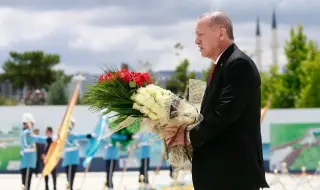
Turkey has never been so unavoidable, nor its regime so close to its decline. Erdogan is both a key partner on the international stage and a "chairman" who is tightening control over the country before handing over power. This is what Turkish economist and political scientist Ahmet Insel and French journalist Marc Semmo write in an article for the French publication Le Grand Continent. Located at the crossroads of the three main crisis zones on the borders of Europe — the post-Soviet space, the Balkans and the Middle East — Turkey has become a main pillar of NATO’s southeastern flank.
It is difficult to imagine a clearer recognition: Turkey’s geopolitical role is more decisive than ever. The summit in Ankara was planned long, as the rotation system allows all 32 member states to participate in organizing the Alliance's summits. Nevertheless, the meeting of their leaders in the Turkish capital, scheduled for July 7-8, marks a significant moment for Recep Tayyip Erdogan and so-called "Erdoganism".
Erdogan - the irritating peacemaker
While not a clearly defined political doctrine, "Erdoganism" refers to the way in which power is exercised by the ultra-nationalist, Islamist-conservative leader who has ruled Turkey without a real rival for the past 23 years. After serving as prime minister, he became president of this secular, Jacobin-inspired republic founded by Mustafa Kemal Ataturk on the ruins of the Ottoman Empire after World War I.
"Rais" (the leader), as he is known his supporters, is an extremely powerful orator with populist rhetoric, known for mixing religious discourse with the colloquial language spoken on the streets of Istanbul, where he was mayor in the late 1990s. This aggressive religious and nationalist rhetoric has not prevented Turkey from becoming an indispensable mediator in the series of crises that have shaken the region. Never since the end of the Cold War has the country occupied such a strategic position. The time of the failed coup of July 2016, after which the Turkish president indulged in "paranoid expansionism", seems a distant memory. Today, Turkey has returned to the basics of soft power and is increasingly convincingly demonstrating its geopolitical influence - an influence that is becoming increasingly indispensable, but also increasingly irritating: Recep Tayyip Erdogan likes to present himself as a peacemaker.
Turkey, a NATO member since 1952 Turkey, which began accession talks with the EU in the autumn of 2005, after significant democratic reforms implemented by Erdogan himself at the time. However, the country has since reversed course and over the past 20 years has never seemed so far removed from the values espoused by both the 27 member states and the Alliance's Charter.
In fact, the Assad regime has been relentlessly intensifying the repressive nature of the regime amid a social and economic crisis. It has destroyed the main opposition force, the Republican People's Party (CHP), founded 102 years ago by Mustafa Kemal Ataturk. Its most prominent representative and potential presidential candidate, Istanbul Mayor Ekrem Imamoglu, is serving a one-year prison sentence for corruption - a charge that is highly questionable.
To negotiate with a Turkey that is increasingly unpredictable and determined to play its own game both domestically and internationally is a in a foreign policy fueled by nostalgia or even neo-Ottoman ambitions, is tantamount to walking a tightrope. The task becomes even more complicated when you consider that the highly authoritarian Turkish president enjoys the strong support of his American counterpart. Despite his open hostility towards the Atlantic alliance, Donald Trump is fully determined to travel to the Turkish capital to greet this "long-time friend" of his who supported him even when he was "in exile", as he likes to say, referring to the four years he spent away from the White House between his two terms. The American president even announced that he would come to Ankara with "a gift that will make Erdogan very happy" - but to a much lesser extent, Congress, which has already expressed its disagreement with the idea.
Most likely, it is about the permission to sell American aircraft engines for Turkish KAAN fighters. The two leaders share quite similar views on the exercise of power and the advantages it brings. Both share with their close family circle the benefits of their policies, in which private interests and public funds are shamelessly intertwined. In a world where the right of might prevails over the power of law, Europeans have no choice but to start a dialogue with Turkey: although not exactly a model of good behavior, its "new sultan" is now an inevitable interlocutor for the European Union.
Turkey - the middle power that has become a key element of NATO thanks to "drone diplomacy"
Only a few years ago, France defined Turkey as a "strategic competitor", on a par with Vladimir Putin's Russia and Xi Jinping's China - that is, as an authoritarian neo-empire. The rivalry was intense in Libya, the Caucasus and the Aegean. Today, however, European defense industries are cooperating more closely with their Turkish counterparts. The French and Turkish presidents no longer exchange sharp attacks, but have in-depth discussions about the war in Ukraine and the situation in the Middle East.
"European security is unthinkable without Turkey", recalled Recep Tayyip Erdogan as early as the spring of 2025. It is indeed difficult to imagine European strategic autonomy without the Turkish armed forces. After the United States, which has about 600,000 troops, Turkey is the second country in NATO in terms of the number of troops that can be deployed. A NATO with less American involvement means a NATO with more Turkey.
The Turkish defense industry has become one of the most successful in the world, thanks in part to the development of the Bayraktar TB2 drones a decade ago. These drones, both effective and cheap, are used by Ankara in the fight against Turkish Kurdish PKK rebels, as well as in Libya and Azerbaijan in the re-establishment of control over Nagorno-Karabakh. Manufactured by Selçuk Bayraktar, an arms company owned by Erdogan’s son-in-law, these drones have earned the nickname "Kalashnikovs of the sky" for their versatility and ease of use. Before Kiev developed its own drones, they were the ones that helped Ukraine resist Russian aggression.
According to a ranking by the Stockholm International Peace Research Institute, Turkey is currently the eleventh largest arms exporter in the world. The success of Turkish drones is so great that one can speak of a real "drone diplomacy" - through their export, Turkey is expanding its influence, especially in Africa. At a time when middle powers are asserting themselves, Turkey can count on a number of advantages. Indispensable on the Ukrainian issue, it has played an active role since its inception as part of the "Coalition of the Willing" - a coalition of about 35 countries created by Paris and London, which promised to provide Kiev with security guarantees after the cessation of hostilities. The naval component of these guarantees and this multinational force will be Turkish, headquartered in Istanbul.
In fact, Turkey controls the Bosphorus and Dardanelles straits, strictly implementing the Montreux Convention of 1936, which prohibits the passage of warships of belligerent countries. In this way, Ankara is preventing Russia from restoring its Black Sea Fleet, 1/3 of which was put out of action as a result of Ukrainian missile strikes and attacks with naval drones. Recep Tayyip Erdogan is also striving to be an indispensable factor in the Middle East, where he is building his image as a defender of the Palestinian cause. He openly emphasizes Turkey's old and close ties with Hamas - a movement that originated from the "Muslim Brotherhood", like the ruling Justice and Development Party (AKP) in Turkey, which until recently was also close to this movement.
Erdogan is also not afraid of scandalous statements. For example, he stated that "Netanyahu surpassed Hitler in barbarity", which provoked sharp reactions from Israel. It is therefore difficult to imagine Turkey playing a key role in any future international stabilization force in Gaza or southern Lebanon, even though the country has the dual advantage of being both a NATO member and a predominantly Muslim country. Nevertheless, its military guarantees its status as a regional power, as it is currently the only military power capable of rivaling Israel.
Tensions between the two countries have been almost constant since the Islamic-conservative forces came to power in 2002. Israel's recognition of the Armenian genocide on June 28, 2026, triggered the last major diplomatic crisis. In response to Erdogan's harsh statements, Israeli authorities have also taken a tough stance. This is in sharp contrast to the past. As allies of the United States, Turkey and Israel had developed a long-standing military cooperation, the roots of which can be traced back to 1949, when Turkey became the first Muslim country to recognize the state of Israel.
In Syria, Turkey actively supports the new government in Damascus through its military presence on Syrian territory. In the Iranian conflict, however, the country has chosen to act cautiously. Only three missile strikes have been directed at Turkish territory, and all were intercepted by the country's missile defenses. Thanks to its transactional diplomacy, Turkey emerged as one of the winners of the war: it did indeed strengthen its role in regional security, developing closer ties with the Gulf monarchies, which clearly realized that American security guarantees alone were no longer enough to protect them. Ankara had already opened a base in Qatar and, together with Egypt, had joined the mutual defense agreement concluded a year earlier between Saudi Arabia and nuclear-armed Pakistan. Relations between Turkey and NATO have never been easy. They were particularly tense during the invasion of Cyprus in 1974, and then during the three military coups that have marked the history of the Turkish Republic. Later, further difficulties were created by the constant conflicts with Greece.
Although it represents a key element in NATO's defense strategy, Turkey often remained on the periphery of the Alliance precisely because of this disagreement with Athens. Today, it still stores American nuclear bombs on its territory, like five other European NATO members, but it does not maintain joint commands within the Alliance.
At the end of March this year, Turkish media revealed a project to create a multinational rapid reaction corps within NATO in Adana, in the south of the country, which, according to the Turkish Ministry of Defense, should be commanded by a Turkish general. And although the information has not yet been officially confirmed, the implementation of such a project would represent a significant diplomatic success for Ankara.
Only a few years ago, it was not uncommon to question Turkey's very membership in NATO. The reason was Erdogan's decision to purchase the S-400 anti-aircraft missile systems from Russia. Although the systems were delivered, they were never put into operation, and they are now expected to be returned to Russia. In response, Turkey was excluded from the US F-35 fighter jet program, but Donald Trump's return to power could help it be reinstated.
"Erdoganism" at the end of a reign: the risk of radicalization
The undeniable strengthening of Erdogan's international authority has been accompanied on the domestic political scene by an increasing tightening of the regime - a symptom of a political regime that feels increasingly threatened. While until recently "Erdoganism" was classified as an illiberal autocratic regime that controls the state apparatus but still allows for more or less free elections - similar to Viktor Orbán's Hungary, but with more repressive control over society - the past three years have seen a transformation of Erdogan's domestic policy towards a kind of "Turkish Putinism".
Moreover, the two autocrats have a certain admiration for each other, presenting themselves as nostalgic heirs of vanished empires that they seek to restore by any means possible. At the risk of stirring up old demons from Turkish history, Erdogan likes to talk about Turkey's "heart borders", which go far beyond its current state borders and include lands and cities that once belonged to the Ottoman Empire. "For us, these are not other worlds, but pieces of our soul," he insisted at a 2016 rally, where he expressed regret that islands located "within a rooster's crowing distance" remained under Greek control.
"Erdoganism" closely intertwines foreign and domestic policy. "Recep Tayyip Erdogan feels divinely destined to have a dual mission: to restore Islam to its rightful place in Turkey and to restore Turkey, the heir to the Ottoman Empire, to its rightful place in the world," sums up Cengiz Candar, a columnist and current member of parliament from the pro-Kurdish DEM party. He was once close to the Turkish leader when Erdogan surrounded himself with liberal and pro-European advisers in his early years in power. The reforms imposed by Turkey's ambition to join the European Union, supported by a large part of the population, served, for example, as a pretext for subordinating the army and the Kemalist upper echelons of the bureaucracy.
Erdogan has indeed never abandoned his main project - to close what he considers a two-century-old aberration in Turkish history by taking double revenge: on the one hand against the authoritarian modernism of Kemalism, and on the other - against Western Europe, which he accuses of continuing the work of the crusaders and colonizers. It is in the light of this aspiration that we must analyze Erdogan's destruction of any structured opposition, especially if it claims a republican and secular heritage, as well as his placing Turkish society under ever tighter political control. The authoritarian nature of Turkish rule is not new.
Since the founding of the Republic in 1923, secularism has been imposed by force on a largely resistant, conservative society. After a one-party system under the leadership of the "Eternal Leader" Mustafa Kemal and then the "National Leader" Ismet İnönü, Turkey experienced a pluralistic system, but this was interrupted at least three times by military coups in 1960, 1971 and 1980. Each time, after brutal repression of the population, especially in 1980, the military eventually returned power to the civilian population.
Thus, Turkey has constantly oscillated between authoritarianism and democracy. However, it is possible to distinguish certain constants, one of which, very important, is the deep attachment of Turkish citizens to free and fair elections as the only true source of legitimacy for the government. Elected mayor of Istanbul in 1994, Recep Tayyip Erdogan became prime minister in March 2003 before being elected president by popular vote in 2014. He has always presented his power as an expression of the national will, freely expressed in elections. Any opposition or challenge to his decisions is seen as discrediting his name and is labeled as anti-national. For example, during the Gezi Park protests of June 2013, which erupted against a project to redevelop a park in the center of Istanbul, he organized a large-scale counter-rally under the slogan "Respect for the National Will", declaring his intention to "stand up for the national will" and "unity with the nation".
In line with the ideological upbringing he received as a young man from radical Islamist-nationalist ideologues, notably Necip Fazel Kasakürek - the poet who founded the radical Islamist-conservative Büyük Doğu (Great East) movement in the 1950s - Erdogan has always perceived power as single and indivisible, concentrated in the hands of an absolute leader. This political vision turns democracy into simply a means to achieve more concentrated, more absolute power. Erdogan himself formulated this with his famous phrase: "Democracy is like a tram - when you reach the last stop, you get off". Erdogan's long rule has been characterized by a gradual slide towards authoritarianism, marked by several periods of acceleration. The decisive turning point was undoubtedly the attempted military coup in July 2016. Erdogan, who described this failed putsch as a "gift from God", used it as a dual tool: it allowed him to carry out mass repressions and declare a state of emergency that remained in force for three years, but also to organize a constitutional referendum in 2017 with the aim of establishing a hyper-presidential regime.
After losing its parliamentary majority, his Justice and Development Party merged with Devlet Bahçeli’s Nationalist Action Party, a far-right nationalist party. It was this alliance that ensured his re-election in 2023. However, since then, there have been increasing signs of weakening public support for the regime. In 2019, after twenty-five years of uninterrupted rule of Istanbul and Ankara, the country’s two largest metropolises, the AKP lost the local elections in both cities to the candidates of the Republican People’s Party. "Whoever wins Istanbul wins all of Turkey", Erdogan had predicted thirty years earlier, using himself as an example. It is therefore not surprising that the new mayor of Istanbul, Ekrem İmamoğlu, has become Erdogan’s most formidable rival. In the next local elections in 2024, the Republican People’s Party capitalized on this success in the new cities and became the largest party in the country. From then on, the state apparatus was activated, seeking to remove not only the mayor of Istanbul, but also his entire party.
At the request of the authorities, Istanbul University revoked Imamoglu's university degree, which he had received thirty years earlier, thus preventing him from running for president: having a university degree is a prerequisite for holding office in Turkey. He was arrested in March 2025 and faced numerous charges ranging from corruption to espionage. As a result, the Istanbul Chief Prosecutor, Akin Gurlek, who was subsequently appointed Minister of Justice in February 2026, launched a large-scale operation to arrest and remove elected mayors from the Republican People's Party (CHP) - more than thirty to date. These operations are still ongoing. Despite all these efforts, opinion polls predict a possible defeat for Recep Tayyip Erdogan - if he runs for a third term - in 2028 against an HDP candidate, whether it is Imamoglu, Mansur Yavas, the mayor of Ankara, or Özgür Özel, the HDP chairman who was removed from office by the court.
Erdogan has little chance of extending his rule with the support of a majority of voters. Thus, his growing authoritarianism, the limits of which are unknown, is complemented by massive repression of civil society and the cultural sphere, the takeover of the army, the judiciary, universities, much of the media and major economic groups, as well as a judicial offensive carried out through an institution under the control of the regime. The aim is to neutralize the main opposition force, the PKK, which has united behind Özgür Özel, the ousted PKK president, by turning it into a remnant of the party or even a means of reviving the regime's popularity, the only one capable of "protecting the interests and security of the state". Erdogan has found the perfect pretext: Turkey has not yet found an "opposition worthy of our nation".
This slide towards dictatorship has been accompanied by a search for new political support, especially among the Kurdish electorate, without, however, achieving the desired results so far. The authorities have managed to convince the historical leader of the Kurdish armed resistance, Abdullah Öcalan, who has been imprisoned on the island of Imrali since 1999, to call for an end to the armed struggle and for the self-dissolution of the PKK (Kurdish Workers' Party). The government, however, has done nothing to address the Kurdish issue in response, as the Kurdish community, which makes up approximately 20% of the population, demands recognition of their collective rights and greater local autonomy. The so-called "Dirty War" between the state and the PKK insurgents since 1984 has resulted in the deaths of nearly 50,000 people and the displacement of hundreds of thousands in the predominantly Kurdish regions of southeastern Turkey.
Today, repression against activists and elected representatives of the legal pro-Kurdish party continues, although delegations from that party are allowed to visit Öcalan regularly to receive his views and recommendations. But much of Erdogan's electoral base is nationalist, fiercely anti-PKK and anti-Öcalan. Therefore, any attempt at political rapprochement with the Kurdish movement could cost the ruling party a drain of many more votes than it would bring them. That is why the Islamic-nationalist coalition in power has retained from this process only its official name: "Turkey without terrorism", without undertaking any significant political reforms to resolve the Kurdish issue.
Neo-Ottoman ambitions, the "gang of five" and religious extremism. What is republican sultanism? Another feature that brings Erdoganism closer to Trumpism is the placing of the political narrative above reality. The regime is experiencing a period of decline in domestic politics. The presidential palace has become the only place where public decisions are made - including the creation of new companies and the acquisition of shares in companies and cooperatives belonging to local authorities (a total of 1,400 municipalities). This super-presidential power, exercised behind closed doors, is becoming increasingly paralyzing. Like all autocrats in the twilight of their power, "Rais" is increasingly surrounding himself with courtly and unconditionally loyal associates - the so-called. yes men, whom he appoints primarily because of their loyalty.
Most of the political figures who were with him during the creation and rise of the Justice and Development Party (AKP) have already left or been removed. This was the case with former President Abdullah Gul, as well as Ali Babacan, a former economy minister at a time when the Turkish economy was booming. University professor and international relations specialist
Ahmet Davutoglu - the architect of neo-Ottoman diplomacy, focused on the former territories of the Ottoman Empire, with the aim of transforming Turkey into a proactive regional power - was also dismissed. Erdoganism at the end of his rule is not only expressed in increased authoritarianism. It also marks a kind of "Middle Eastern transformation" of the way the state is governed and power is exercised - a model that is far from the republican principles of Mustafa Kemal.
A clan has formed around Erdogan, partly family, partly ideological, whose main driver is the pursuit of profit. He controls entire segments of the economy, including strategic sectors. The economy of close political connections and privileges, as in other autocratic regimes, has become the dominant model. The allocation of public contracts, especially for large projects such as the third airport in Istanbul and perhaps one day the digging of the "Istanbul Canal", intended to duplicate the Bosphorus, is mainly entrusted to a few holding companies close to the presidential palace. The opposition is particularly critical of the "gang of five": the companies Cengiz, Limak, Kalyon, Kolin and MNG Group are among the ten holdings that win the most public contracts worldwide, according to a 2020 World Bank report.
Within the same logic of favoritism and patronage, public funds are also used to serve religious foundations whose main purpose is to promote a culture war. In the first nine months of 2025, these amounts amounted to 480 million euros, according to the Court of Auditors. Bilal, Erdogan's youngest son, heads one of these foundations, TÜGVA (Turkish Youth Foundation), founded in 2014, and participates in the management of six other similar organizations. In 2012, Erdogan first clearly expressed his goal of creating a "pious and vengeful generation". At the foundation's congress, he addressed the young people present, asking them to "not forget that we are there, and against us are our enemies." Thus, TÜGVA became the flagship of this mission, defending kitschy rewritings of the Turkish national narrative.
The most striking symbol of this is undoubtedly the construction on the outskirts of Ankara, on the site of Mustafa Kemal's former model farm, of a huge palace of 200,000 square meters - four times the size of the Palace of Versailles. The complex has 1,150 rooms, and to impress any foreign statesman who visits it, an honor guard of sixteen mustachioed warriors in armor has been created, symbolically representing the sixteen Turkish or Turkic-speaking empires that have existed successively in the Anatolian peninsula over the past two millennia.
It is within this narrow circle that the question of Erdogan's successor will be decided. There are signs of internal power struggles, although still weak. The temptation of dynastic power is palpable: one can choose between Bilal, Erdogan's younger son, a rather unremarkable figure, or one of his two sons-in-law - Selçuk Bayraktar, known for his successes in the arms industry, or Berat Albayrak, responsible, along with his father-in-law, for one of the worst economic decisions of the Erdogan era: the reduction of interest rates, introduced to combat rampant inflation. This policy ended with his dismissal from the post of Minister of Finance and Economy in 2020.
Among the potential successors, the name of Foreign Minister Hakan Fidan, who led the intelligence services for thirteen years until 2023, is also mentioned. Erdogan himself often called him "my black box", i.e. the person who keeps all his secrets. This former non-commissioned officer has made a lightning-fast path to the heights of power. But, like any fading autocrat, the Turkish president has strictly avoided public discussion of this issue. Instead, through his spokesmen, he is gradually preparing public opinion for a new candidacy in the 2028 presidential elections, presented as "indispensable for the security and prosperity of the country".
However, the task is not easy: the Turkish constitution provides for a maximum of two terms. To get around this obstacle, the Erdogan clan is considering calling early presidential and parliamentary elections just a few months or even a few weeks before the scheduled date in May 2028. Dissolving parliament would allow the head of state to run for a third term. But this maneuver requires a 3/5 majority in parliament. The ruling coalition currently lacks just under forty deputies to achieve this. Another solution would be to amend the constitution, but this would require a much larger majority, two-thirds of parliament, or even a referendum.
Even if these political maneuvers were successful, there is no guarantee that the current president could win, except through large-scale fraud - which has not happened so far, except for limited violations during the constitutional referendum that introduced the hyper-presidential system - or by judicially removing all candidates who could defeat him in the election. Today, a large part of Turkish voters, especially young people, women and those from the middle class, especially in the big cities, express growing dissatisfaction with the policies of Erdogan and his party. "The AKP's rule has exhausted people's hope. Eight out of ten people think that it is no longer possible to start a family and raise children in this country", according to sociologist Bekir Agırdır. During the 2024 local elections, "the vote of young working people mainly led to the AKP's loss, especially in Istanbul", analyzes Murat Güvenç, a professor at Koç University. The AKP's electoral base has eroded and now represents only a third of Turkish voters.
The strength of this party, which won almost every election for nearly twenty-three years without blatant manipulation of the ballot boxes, lay in its economic proposals. During the election campaigns, Erdogan often appealed to "poor Turks in a rich Turkey". Per capita income has more than tripled in a quarter century of Islamic-conservative rule. But this economic miracle shows serious signs of slowing down. High and persistent inflation, exceeding 30%, is weighing heavily on workers and pensioners. The policy of artificially maintaining a strong Turkish lira is reducing the competitiveness of labor-intensive export sectors and negatively affecting tourism revenues. The gap between the rich and the poor is constantly widening. The unemployment rate is over 20%. Added to this is legal uncertainty, which is also affecting the economic sphere, pushing some wealthy people to transfer their capital outside the country.
Foreign direct investment is stagnant due to the indecisiveness and unpredictability of Turkish economic policy. All major economic indicators are flashing red. The failure of Erdoganism is also evident in the meager results achieved over the past fifteen years in this cultural war waged against secular-modernist hegemony. In Turkey, it seems that the "sunset of the pious" has begun. During these years in power, a conservative, Islamic-nationalist intelligentsia has not emerged; the regime prefers to focus on subjugating the cultural circles through judicial investigations and arbitrary arrests, supported by smear campaigns and bans on most cultural events. Turkish television series, extremely popular beyond national borders and a true pillar of Turkish soft power, are beginning to suffer from this policy and are losing their appeal.
The policy of re-Islamizing the public sphere is producing results that are the opposite of what was expected. Religious practice is declining. According to a study by the Konda Sociological Institute, the number of those who identify as practicing believers has decreased by nine points between 2008 and 2025, while the number of non-believers has increased by six points, much to the dismay of religious circles and especially the country's Directorate of Religious Affairs. With nearly 140,000 religious officials, this institution is at the forefront of strengthening state control over Sunni Islam by providing moral guidance to the population, especially young people, and revising school curricula. Faced with this fiercely conservative cultural policy, an increasing number of the most qualified young people - doctors, engineers, computer specialists - are leaving Turkey or are seriously considering doing so. The main reason is not always economic. It is also about escaping an increasingly stifling cultural and political environment.
This failure to achieve true cultural and ideological hegemony is therefore pushing Recep Tayyip Erdogan to increasingly radical actions. We are witnessing the establishment of a true republican sultanism - something between Putin's regime and that of the Aliyev family in neighboring Azerbaijan. This political project clearly extends beyond the horizon of the next elections and does not seem to meet with disapproval from the United States. Tom Barrack, the US ambassador to Ankara and Donald Trump's envoy, has repeatedly stated that in the Middle East, where only strength is respected, "the only things that work are regimes with strong leadership and benevolent or republican monarchies". Turkey remains an official candidate for the European Union, although its accession process has been frozen for fifteen years.
The latest European Parliament report on Turkey, adopted on 17 June, expresses concern about the serious erosion of the rule of law and the lack of judicial independence and calls for sanctions against the Turkish Minister of Justice. Furthermore, in the Committee of Ministers of the Council of Europe, the opening of a sanctions procedure against Turkey has been pending for more than a year for its failure to comply with judgments of the European Court of Human Rights, in particular regarding the continued detention of philanthropist and human rights defender Osman Kavala. The Committee of Ministers postpones the decision every three months so as not to "interrupt the dialogue with Turkey".
While the European Parliament report highlights Turkey's strategic and geopolitical importance and the need to strengthen regional security cooperation, it also criticizes the "Blue Homeland" doctrine, which defines Ankara's claims to its exclusive economic zone in the Eastern Mediterranean. However, these criticisms invariably remain at the level of political declarations. In practice, they are accompanied by an indefinite postponement of both Turkey's accession process and the modernisation of the Customs Union Agreement signed in 1995 between the EU and Turkey. Europe remains torn between its founding political principles and considerations of economic and geostrategic interests.
As is often the case, the latter prevail over the former.