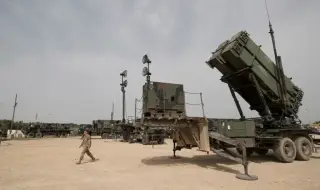
The US and Ukraine continue negotiations on a license for interceptor missiles for the "Patriot" systems, despite President Trump's contradictory statements. But experts doubt that the license will be granted soon.
The prospects for Ukraine to receive a license to produce American interceptor missiles for the "Patriot" systems look increasingly bleak. US President Donald Trump, who first promised to grant a license to Kiev at the NATO summit in Ankara in June and then confirmed this at a meeting with Ukrainian President Volodymyr Zelensky in Washington in late July, now, in early August, says that he is not sure that the US itself needs these missiles. Recently, the "Reuters" reported that the US and Ukraine are continuing negotiations, despite Trump's contradictory statements.
Expert: "The issue of the license is practically non-existent"
Austrian military expert Gustav Gressel does not believe that Ukraine will receive a license to produce the "Patriot" in the near future. "I think that Ukraine was too optimistic. And the issue of the license is practically non-existent. In the best case, in 4-5 years, Ukraine will receive a license to produce missiles of the RAS-2 type," Gressel told DW.
The interceptor missiles for the "Patriot" complexes are of two main types - the somewhat outdated RAS-2, whose capabilities to shoot down ballistic missiles are limited, and the more modern RAS-3. They are precisely what Ukraine needs, because they are capable of very effectively shooting down Russian ballistic missiles.
The intensified shelling of Kiev and other areas by the Russian army has revealed the acute shortage of these missiles in Ukraine. During one of them, in the first days of August, not a single Russian missile was shot down. The "Patriot" complexes are the only weapon of the Ukrainian troops that can shoot down ballistic missiles, but it seems that Kiev's stock of interceptor missiles has run out. Negotiations with the United States and Ukraine's Western partners for urgent additional supplies have so far yielded no results.
The United States is not particularly inclined to transfer licensed production of "Patriot" abroad. So far, the only country to have received such a license is Japan. The second should be Germany, where GEM-T missiles, a modernized version of the RAS-2, will be produced. The United States has close economic ties with both countries, and American military contingents are stationed in both.
Negotiations with Germany have lasted five years
The manufacturer of the RAS-3 - the company "Lockheed Martin" - has not been and is not ready to transfer production abroad, says Gressel. "Regardless of what Trump promises, the company's policy is the same. Even "license production" in Japan is carried out only under the strictest control and is not true license production - it is an assembly of parts manufactured in the United States. Key components, such as radar seekers, are manufactured in the United States." According to the expert, "Japanese license production does not lead to the expansion of production worldwide, since it depends on the limited production capacities of the United States. Radar seekers are complex devices, and the US lacks skilled workers to scale up their production."
In Germany, the path from political decision to the start of production takes almost five years. The agreement between Berlin and Washington was reached in 2022. From there, the contracts were coordinated and after another two years, construction of the plant began, although the production capacity was already available - Germany is where the technical maintenance of the Patriot missiles for NATO countries is carried out. The first "Made in Germany" missiles are expected to roll off the assembly line in Bavaria in late 2026 - early 2027.
One of the options being discussed for Ukraine is licensed production with facilities in Germany. But no one is taking the trouble to predict how quickly this can happen. Gustav Gressel suggests that betting on the Patriot both for Ukraine and for Europe it is a temporary solution and alternatives must be sought, i.e. to create our own production. Such projects, including with the participation of Ukraine, already exist, but they are at an early stage.