Comment by Emilia Milcheva:
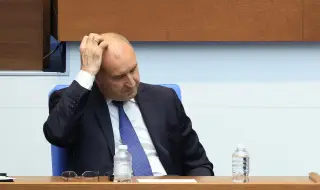
One hundred days after Rumen Radev's government was sworn in, all power is his, but the promised dismantling of the old model has not begun. The protest vote produced a one-party government, the services were arranged around the prime minister, Bulgaria distanced itself from common European policies, and Turkey became a privileged partner.
On August 19, the first stress test of the battle with the addressless oligarchy is coming. The legal dispute over 29% of the shares of the Plovdiv Fair is in the hands of Finance Minister Galab Donev. If he does not confirm that the state is continuing the case, the court may terminate it and Georgi Gergov, who is close to the government, may retain control, without the dispute being resolved on its merits.
Why is Plovdiv important
The final battle for the Fair and the murder on the Youth Hill are two different cases that make Plovdiv a symbol of the government. The first tests the government's readiness to confront a businessman close to it, the second - the state's ability to protect citizens from an organized massacre presented as “civil justice“.
Why is Plovdiv important to Radev? Because it is the center of his power circle. He commanded the “Graf Ignatievo“ airbase in 2005-2009. Two of his most influential associates come from the Plovdiv region. The former secretary to the presidency, Nikolay Koprinkov, who is now his chief of staff, was the mayor of the village of Trud and a BSP cadre in the municipality of “Maritsa”. Another close associate, Plamen Uzunov, headed the regional directorate of the Ministry of Interior, and later became the presidential secretary and advisor to Radev. The two are cited as key personnel officers in the security, customs, revenue agency, etc. sectors. The Minister of Interior, Ivan Demerdzhiev, is also from Plovdiv. Above this network stands the figure of Gergov - a long-time leader of the BSP in Plovdiv and the de facto master of the International Fair.
The man who died after an hour-long beating and abuse on the Youth Hill in Plovdiv is a resident of Krichim, whose mayor, Atanas Kalchev, was on the list of “Progressive Bulgaria” in the Plovdiv region. He was elected as an MP, but resigned in order to complete his fifth consecutive term as mayor. In Krichim, over 68% voted for Radev. The case of their fellow citizen sparked protests and demands for a fair trial for the perpetrators.
The government was silent for several days after the murder, and when it did speak, it carefully avoided the most uncomfortable questions - about neo-Nazi influences, Russian models of self-defense, and who and how radicalized minors. Deputy Prime Minister Ivo Hristov called the accused "minor sadists" and dismissed as "essays" the reasoning about the role of the family, education, and the state. Radev, in turn, shifted the conversation to the erasure of anti-fascist memory and the removal of "anti-fascist monuments" - an obvious reference to the Monument to the Soviet Army. Thus, one reduced the murder to the personal cruelty of the perpetrators, while the other used it against his political opponents.
However, the most significant change in the first hundred days is in foreign policy. While Radev distances himself from Brussels, his cabinet opens more and more doors to Ankara, and also to Asia.
The privileged partner Turkey
In a hundred days, Turkey has transformed from an important neighbor in the Balkans into a privileged partner of the “Radev” cabinet. The intensity of contacts shows the new weight of Ankara in the cabinet's foreign policy. In just three months - from May 22 to August 13 - at least seven meetings at the government level can be counted. Energy Minister Iva Petrova met twice with her Turkish counterpart Alparslan Bayraktar - on May 22 and June 26. On June 11, Foreign Minister Hakan Fidan spoke in Sofia with Prime Minister Rumen Radev and his colleague Velislava Petrova-Chamova.
On June 29, Transport Ministers Georgi Peev and Abdulkadir Uraloglu discussed joint railway and road projects. On July 6, Radev met with President Erdogan in Ankara, accompanied by the Minister of Economy, Energy and Transport, and Fidan, Bayraktar and Uraloglu participated on the Turkish side. This week, Turkish Interior Minister Mustafa Ciftci was in Sofia, promising Demerdzhiev assistance for exported criminal capital.
And after yesterday's conversation with Uraloglu, Prime Minister Radev stated that “the future of the region will increasingly be determined by the connectivity between Bulgaria and Turkey”. The transport ministers of the two countries have already announced that the “Black Sea” highway between Varna and Burgas will be built by Bulgarian and Turkish companies.
Unlike the attitude towards Russia, the strategic rapprochement with Turkey has at least been declared openly. Added to these meetings is the new protocol between “Bulgargaz“ and “Botaş“, which freezes payments under the contract, but it is not clear under what conditions and what will happen to the over 360 million dollars owed by the Bulgarian side. Radev has already spoken of “adapting the contract to current market conditions” and renewed interest in natural gas supplies through the Turkish-Bulgarian connection. The Turkish state company TPAO acquired 33% of the exploration rights in the “Khan Tervel” Black Sea block. And in the Plovdiv economic zone “Trakia” a trade and logistics center will operate to assist Turkish and Bulgarian investors. All this seems more than good neighborliness.
A strategic argument for rapprochement with Ankara is the so-called Middle or Trans-Caspian Corridor - a 6,500 km route from China through Kazakhstan, the Caspian Sea, Azerbaijan, Georgia and Turkey to Europe, which bypasses Russia. On June 29, the transport ministers agreed that Bulgaria and Turkey would work together with the European Commission to develop it. The cabinet's management program already includes the 71-kilometer Yambol-Elhovo-Lesovo-Turkish border railway line with a deadline of the end of 2030, as well as the inclusion of Varna and Burgas in cargo flows across the Black Sea.
The rail route is part of a bilateral memorandum signed in 2023 and is particularly important for Turkey. It provides it with a second railway entrance to European markets, as it is an alternative to the line through the particularly busy Kapitan Andreevo-Kapikule point. It is not yet clear how much it will cost and where the funding will come from. About 32 km of the route: Elhovo-Lesovo-border, is completely new construction through difficult terrain, including a new border station.
The change of figures
Radev did not destroy the state of party appointments, he only changed the list of contacts. State-owned companies and the second echelon were filled with familiar faces. Cadres of GERB, BSP and “There is such a people”, also associated with the MRF, receive positions, including advisors.
A study by “Alpha Research” on the eve of the hundred days of the cabinet showed where the greatest discrepancy between problems and solutions is. The index of the effectiveness of management policies shows that they have not worked on the most important problems for citizens - prices, corruption, the quality of health services and road safety.
The “Basket of care” - for goods with a 10-15% discount in retail chains - emptied shortly after its announcement. In an attempt to show that care does not stop, the government published for public discussion a methodology by which the so-called “fair value” of basic foods will be determined. Economists criticized the project with the argument that it effectively represents a price ceiling and will lead to even higher prices. Instead of encouraging farmers to cooperate, which will help produce quality food at competitive prices, the cabinet is postponing the law, expected for more than a decade, to March 2028. This deadline is included in its management program, and the construction of markets and structures is only in the last year of the mandate - 2030. If it even gets there.
Public procurement and corruption
The narrative with which the former president came to power - shedding light on public procurement and investigating political corruption, is in a dead end. The Ministry of Interior and the services are working, but the prosecutor's office is hindering them. In the first hundred days, there were no revelations of serious abuses, despite the promised inspections by ministries. At the same time, cadres of GERB, BSP and “Ima takve narod”, also affiliated with DPS, are receiving positions in the state administration.
After the major accident in Sofia in June with four victims and eight injured, Prime Minister Radev demanded “draconian measures”. A new National Road Safety Plan must be ready by the end of August. It discusses a single control body, uniting the “Automobile Administration”, the toll administration, RIA and other structures, as well as using all 272 points of the toll system to control the instantaneous speed. For now, these are intentions that require changes in laws and organization. But the cabinet places emphasis on monitoring and punishing drivers, while there are no measures for the other two problems mentioned by Radev himself - the quality of training and the dangerous road infrastructure. If we do not count the expert committee that will analyze the regulation on the barriers.
Expectations for Radev are huge, because his power has no one to hide behind. He has a parliamentary majority, services centered around him, and a government without internal opposition. However, instead of dismantling the system, whose accuser he was, he seems to be adapting it to himself.