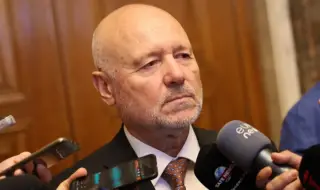
In the explosion at the EMKO plant near Tryavna, the most important thing in the first hours was not to hastily rule out possible versions. That is why I was disturbed by the categorical statement of the Minister of Internal Affairs Dremdzhiev that there was no external interference, made even before the actual inspection was carried out.
This was written on "Facebook" by the former Minister of Defense Todor Tagarev.
The company stated that there was no evidence of human error and that the vehicle did not ignite spontaneously. Moreover, the probability of gunpowder stored under relatively controlled conditions spontaneously igniting is extremely small.
This does not prove external interference, but it means that it should not be ruled out in advance. Especially considering the series of explosions in recent years at EMKO, VMZ - Sopot and “Arsenal“ facilities, some of which have raised serious suspicions of actions by Russian military intelligence. The problem is that for years these investigations have not yielded convincing public results.
Distrust is building up. In the attempted poisoning of Emilian Gebrev in 2015, the initial reaction of the prosecutor's office was almost mocking. It was only after the “Skripal“ case and investigations in the Czech Republic that connections with Russian military intelligence officers began to be made. Therefore, doubting the hasty official versions is not conspiratorial thinking, but healthy caution.
The case of the drone near the Bulgarian-Romanian border is even more indicative.
Four hours between its discovery and the press conference of the Prime Minister and the Minister of Defense were enough to present the main photographic material. Instead, the information was provided in portions.
We also received mutually incompatible statements.
The Prime Minister spoke of a relatively large drone that "intruded" and "exploded". The Minister of Defense questioned whether there was an explosion at all. Once he defined the platform as a "drone decoy", and then explained that the radars did not see it because it was too small. But the decoy drone is designed to imitate a more significant target, and that is why it may have reflectors that make it more visible to radar.
There is almost no doubt that the drone is of Ukrainian origin. However, this does not answer the most important question: why did it end up on Bulgarian territory?
The most likely version, in my opinion, is a Ukrainian drone that deviated due to Russian electronic countermeasures - jamming or "spoofing" of the navigation system.
But a provocation cannot be ruled out.
Drones fall, are intercepted, repaired, and reused. This creates the possibility of a false flag operation. The origin of the platform is an important clue, but it does not prove who sent it and for what purpose. The same logic would apply if a Russian drone were to be found on Bulgarian territory later on - its origin alone would not automatically prove a Russian operation.
The language of Prime Minister Radev is also significant. The wording that the drone "intruded" and "exploded" creates the impression of a targeted attack - as if two squadrons of bombers had entered Bulgarian airspace. Given that we do not yet know the trajectory, the reason for the deviation, and even whether there was a combat unit, this language is unduly emotional and probably intended to instill fear.
Also problematic is the attempt to shift part of the responsibility to the allies - by suggesting that Romania and the NATO center in Torrejon did not see the drone and Bulgaria was almost left alone. We do not have enough information to draw such a conclusion.
This brings up the bigger question: how should Bulgaria build anti-drone defense?
We do not need a fire response — a downed drone means we immediately buy something or pour money into random local companies. A strategic approach is needed.
With drones, the innovation cycle is already measured in weeks.
The current know-how for countering the latest Russian systems comes primarily from Ukraine, where these technologies are tested daily in real war.
I have received information that Bulgarian companies already have well-established cooperation with Ukrainian companies and are ready to start production in Bulgaria, but are not receiving the necessary assistance from the government.
This is precisely the reasonable model: **Bulgarian production with access to the most up-to-date Ukrainian combat experience and technologies**.
Against this background, Iliana Yotova's positions sound like a weak and impersonal echo of the government line — to give more funds to Bulgarian companies. But the real question remains: with what technology, based on what operational experience and in partnership with whom?
The explosion in EMKO and the drone near the border are different cases, but they show the same problem: hasty conclusions, selective provision of information, contradictory messages and lack of strategic thinking. And the result is inevitable — a decline in public trust and doubt in Radev's chosen direction of development of Bulgaria.