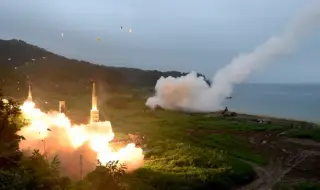
At one time, Ukraine actively participated in the Soviet missile program and has sufficient scientific potential in this area. Why then does it still not have its own ballistic missile?
Ballistic missiles are one of the few types of weapons that Ukraine still does not have, despite the Soviet missile heritage. During the war, work on creating its own ballistic missile progressed, but there is still no result.
Technology that is already decades old
Historically, ballistic missiles are not a new type of weapon. Their prototype is considered to be the V2 rocket ("V-2"), created in Nazi Germany and first used in 1944. The first successful intercontinental ballistic missile was the Soviet R-7, tested in 1957.
“Ukraine participated in the development of the basic projects for strategic missiles used by the USSR. The technical solutions were implemented by the Ukrainian side, and the implementation took place in Russian factories," Ukrainian weapons expert Serhiy Zgurets told DW.
However, he added that the accumulated scientific base was not fully transferred to today's Ukrainian scientists. Meanwhile, the missile industry has continued to develop, and new design bureaus have at times had to start from scratch.
State and private ballistic weapons
The first project that Ukraine began working on was for a ballistic missile with a medium range of 500 km, which was initially called "Borysfen", but was closed and then the decision was made for the "Sapsan" complex.
Ukraine has been working on it since 2026. "Some elements of this operational missile complex have already been demonstrated at parades. Certain elements have even been tested," former Deputy Chief of the General Staff of the Ukrainian Army, Lieutenant General Ihor Romanenko, who was responsible for the "Sapsan" program at the time, told DW. But he complains that "because of the Kremlin's agents, everything failed."
The beginning of Russia's war against Ukraine has made the issue of the development of the "Sapsan" missile very relevant again. In 2023, former Defense Minister Alexei Reznikov mentioned that there was a "very realistic chance" of using this complex against Russian troops. In 2025, President Zelensky confirmed that successful tests of the "Sapsan" missile had been carried out and even stated that it was being prepared for serial production. However, more details about the tests have never been officially disclosed by Ukraine.
In addition to the state sector, the private company Fire Point is also engaged in the development of ballistic weapons. Its director general Irina Terek said in an interview with the „Reuters" agency that about 15 test launches of the FP-7 ballistic missile with a range of 300 km have been conducted so far. Terek expects the first combat use of the missile to take place in early autumn, and in late autumn Fire Point plans to begin the combat use of the FP-9 missile with a range of up to 850 km.
The obstacles facing Ukrainian ballistic missiles
„The promise is one thing, and the actual implementation of the program is quite another", aviation expert Valery Romanenko commented on this occasion to DW. He gives the example of the „Flamingo" missile, of which the manufacturers had promised to produce three units per day since the beginning of the year, and are currently launching three units per month.
Serhiy Zgurets also says that the statements about „Sapsan" and Fire Point have yet to be confirmed in practice. The expert does not look favorably on companies that tackle several things at once, as is the case with Fire Point, which deals with drones, ballistics and anti-ballistics. According to him, this reduces their ability to concentrate on one project.
The expert also points out that the creation of a Ukrainian ballistic missile requires the solution of a number of complex tasks. “One of the urgent problems that has not yet been fully resolved by the Ukrainian side is rocket fuel. In addition, we need a guidance system."
Fire Point is trying to solve these tasks at a plant in Denmark, where - according to the company - it is planned to start producing rocket fuel, engine cases, parts for other components of the missile, as well as assembling the engines. According to the plan, the opening of the first phase of the plant should take place this year, and the main one - in 2027.
At the same time, Ukraine will have to solve many of the problems in the development of ballistic technologies on its own, since not all partners are in a hurry to share their experience with it. For example, during the presidency of Joe Biden, Ukraine asked the Americans to share the fuel formula from its older ATACMS for the “Sapsan”, but was refused. President Zelensky has complained that a number of countries in the world are not interested in the development of Ukrainian ballistic and anti-ballistic technologies due to competition in the global arms market.
Russia's strikes and the capabilities of its air defense
Valery Romanenko notes that, in addition to all this, an important factor that is stopping the development of Ukrainian ballistics is Russian strikes on key missile technology enterprises in the Dnipro, Pavlograd and Zhytomyr regions.
For his part, Zgurets points out that ballistic missiles with a range of 300 km would allow Ukraine to destroy Russian air defense systems and could help it defend itself more successfully against Russian "Iskander" missiles. "They would no longer be able to launch missiles at Ukraine with impunity. The range of the "Iskander" is a maximum of 500 km. We know where the areas from which they are launched are. Therefore, the destruction of the launch sites and charging stations of the "Iskander" missiles will be easier with the presence of ballistic missiles. Russian air defense does not pose a significant obstacle to the fulfillment of our tasks."
However, it is not clear when this will happen. On August 6, Volodymyr Zelensky said that he expects "to achieve the necessary results" in the ballistic and anti-ballistic programs in 2026 and 2027.