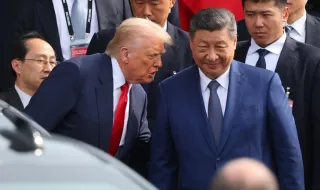
Donald Trump promised Americans to "make America great again". While his success so far is doubtful, one country can thank the American president for strengthening its global position and influence: China. The main rival of the United States for the title of leading world power has reaped unexpected dividends, first from a trade war and then from a full-scale war with Iran. How this happened, explains Alexei Kalmykov of the BBC Russian Service in his analysis.
China is not involved in the current war in the Persian Gulf, but several leading American experts believe that it is emerging victorious. Chinese analysts are traditionally more cautious in their assessments (more on this below).
However, Americans point out that Donald Trump started the war without warning, provoked a full-scale energy crisis, and questioned the readiness and ability of the United States to defend its allies.
"Both friends and rivals of the United States agree that the country increasingly resembles a rogue state, posing a threat to global stability and order, and is increasingly becoming an object of ridicule," says American political scientist and philosopher Francis Fukuyama, one of the leading Western experts on democracy, governance, and world order.
"Under Trump, America has so consistently harmed itself that China does not even need to do much," he writes.
The attack on Iran and Trump's trade wars have turned the United States into an unpredictable, destructive power and automatically made communist China, the second largest economic and military power on the planet, an anchor of stability and rational policy.
"From Beijing's perspective, Washington is gradually undermining the foundations of its own power, quarreling with its allies, and turning the whole world against itself," notes Julian Gewirtz, a former China adviser on the National Security Council and the State Department under President Joe Biden.
"As a result, many countries are beginning to see it as easier and more reliable to negotiate with China than with America, which increasingly acts solely in its own interests," writes Gewirtz, now an expert at Columbia University.
The famous American economist and Nobel Prize winner Paul Krugman echoes this view.
"China was not directly involved in the third Gulf War," he writes. "However, he clearly does not hide his satisfaction at our humiliation. Both the course of the war and the role that China played have significantly shifted the global balance of power in his favor."
"The Chinese are serious people, and we are not."
"Yes, China is a corrupt autocracy; it does not respect human rights and does not share democratic values," Krugman notes. "But people around the world have concluded that the Chinese are serious people, and we are not."
"That is why America lost this war and China won," he argues.
The US-Israeli war with Iran has inflicted military and economic damage on America's allies in the Persian Gulf and around the world. Meanwhile, China acts as a stabilizing force.
Experts from the Carnegie Endowment for International Peace note that China's main advantage is the lack of clear adversaries in the region. "Unlike the United States, Beijing maintains friendly relations with everyone, including Washington's key ally, Israel," they write.
"The gap in diplomatic influence between the United States and China is narrowing. China continues to build its soft power while the United States undermines its own position, systematically resorts to armed conflict, and gives diplomacy an increasingly less important role in Middle East politics," they argue.
China has also acted as an economic stabilizer. He helped countries affected by the closure of the Strait of Hormuz by cutting oil imports by almost half thanks to his huge reserves, easing the energy crisis and preventing oil prices from rising to $200 a barrel, as economists had predicted before the Chinese intervention.
How the US is losing ground to China
"This is a new dimension in world politics. In the past, when there were problems in the oil market, the first thing a US president would do was call Riyadh and ask Saudi Arabia to increase its oil exports," said Bloomberg's chief oil expert Javier Blas.
"Now it is possible that they will first call Beijing and ask them to reduce imports", he said. "This is an extremely interesting change. It will be very interesting to see what political consequences this will have for the United States."
According to Blass, the Chinese are flexing their oil muscles for two reasons. China does not need a global crisis because its economy is entirely dependent on exports, and a crisis would deprive buyers of Chinese goods of money.
The second reason is conspiratorial, but there are grounds as a theory.
China and the United States are in constant dialogue, and Blass does not rule out the possibility that the stabilization of world oil prices was part of backstage agreements. For what? "One can only guess", says Blass. But there are circumstantial signs that Washington is softening its stance on Taiwan, a key issue for China.
In May, the White House suspended a major military aid package to Taiwan worth about $14 billion, officially citing the need to preserve supplies for the war in Iran. And in August, Trump ordered a reduction in the scale of military exercises with South Korea aimed at deterring North Korea and said he had a very good relationship with Kim Jong-un.
"Trump's decision is not just an attack on an ally and a gift to Kim Jong-un." "Chinese officials have long expressed dissatisfaction with these exercises, especially recently," notes Julian Gewirtz. "When I worked at the U.S. State Department, Chinese officials regularly raised this issue in bilateral contacts."
"Therefore, scaling back the exercises is exactly what China has been seeking for many years," he writes.
Such concessions by Trump risk another war, warns Francis Fukuyama.
"Trump has said that China will not attack Taiwan while he is president of the United States. In this respect, he may be right: Xi Jinping does not want to prevent the decline of the United States," he writes. "But if America were to elect a president willing to change course at some point, it could force Xi to act quickly and decisively."
"They no longer trust us, they no longer fear us."
Meanwhile, China is exploiting Trump's mistakes and vanity, Fukuyama believes.
"Trump reserves his anger and rage for domestic opponents, not foreign dictators," Fukuyama writes, recalling Trump's visit to Xi in May.
"The atmosphere of the meeting revealed how much Trump has fallen in the eyes of the Chinese. Worst of all was the constant flattery: Trump called Xi a "great leader", "a true friend", and repeatedly praised China. Based on his experience with autocrats, Trump probably expected reciprocity. Xi, however, limited himself to saying that the US and China "should be partners, not rivals".
It is not only the Chinese who are losing respect for American power under Trump. According to the Pew Research Center, this year for the first time China is perceived more favorably than the US, and the Chinese president is perceived more favorably than the American president.
"Even many of our long-time allies, countries that helped us win World War II and then the Cold War, now view China more favorably than the United States," said Nobel laureate in economics Paul Krugman, commenting on the results of the survey.
Krugman, a long-time critic of Trump, believes that the problem lies in the erosion of the foundations of American hegemony. He writes that Trump's reforms and personnel decisions undermine America's leadership in science and technology, military superiority, soft power, financial power, and the role of the dollar as the world's main reserve and payment currency. Most importantly, they destroy the alliances that have allowed America to be a leading world power.
Julian Gewirtz of Columbia University shares a similar opinion.
"The United States is cutting funding for leading universities and creating conditions that make it either extremely unattractive or simply impossible for foreign scientists to work in America. At the same time, the US is eliminating its instruments of influence around the world, from USAID to the Voice of America," he writes.
"From China's perspective, the US is effectively voluntarily disarming itself."
The war in Iran is yet another example of this, Krugman argues.
"Trump, without consulting anyone, launched a war that not only brought death and destruction but also cut off the world from a significant portion of its oil and gas supplies. And once the war began, America demonstrated its inability to impose its will on Iran, lift the blockade of the Strait of Hormuz, or protect its allies in the region," Krugman writes.
"So now the world no longer trusts us and no longer fears us."
A View from China
The Chinese are pleased but in no hurry to celebrate the victory. Things could still turn out badly for them, says one of China's leading Middle East experts, Professor Wang Jin of Northwestern University in Xi'an, China.
"The situation should not be reduced to a simple thesis that America lost and China won", he wrote in an article for the authoritative regional publication Diplomat. "On the contrary, with the onset of a new phase of transformation in the region, China may face new challenges, while new strategic opportunities open up for the United States."
Rich countries in the Middle East remain dependent on American military technology, and their need for weapons has only increased due to attacks with Iranian missiles and drones. Neither the UAE nor Bahrain will find a replacement for the US as a military ally, Wang Jin notes.
"Neither Russia, China, nor Pakistan are currently capable of filling the strategic vacuum if US military cooperation is significantly curtailed. While the Gulf Arab states seek diversification, no third power is currently capable of replacing the US as the leading military power in the Middle East," he writes.
Furthermore, the US, as the world's largest oil and gas producer, has consolidated its position as a leading energy power due to the shortage of raw materials caused by the blockade of the Strait of Hormuz. At the same time, China, the largest importer, has lost significant supplies from the Persian Gulf, including Iran, and the United States could further undermine China’s energy security in the future.
"If Iran and the United States agree to ease sanctions on Tehran, significant Western investment could enter the Iranian market. As a result, China’s long-standing economic advantages in Iran could weaken," Wang Jin describes one potential problem.
Another problem is diplomatic. China will have to navigate between the warring parties in the region. Supporting Iran will complicate relations with those it bombs, primarily the UAE. And criticizing or pressuring Iran will sow discord in Sino-Iranian relations.
"Therefore, finding a balance between ensuring energy security, protecting freedom of navigation, and maintaining relations with both Iran and the Gulf Arab states is likely to become an increasingly difficult diplomatic challenge for China," the Chinese expert said.