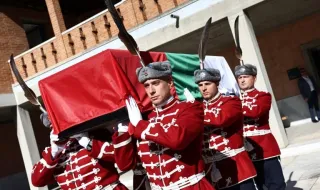
Bulgaria now has its own medieval king in its lands. The mortal remains of Samuil, king of the Bulgarians more than a millennium ago (997-1014), were laid to rest in the capital's church "St. Sophia" in a marble sarcophagus brought from the city of Prilep, North Macedonia.
A huge spectacle in honor of Tsar Samuil
The staging of the event united the authorities, the army, the Orthodox Church, the media and citizens. BNT broadcast live under the title "The Return: Tsar Samuil". Two pairs of MiG-29 and F-16 fighter jets intercepted the military transport "Spartan", which was carrying the remains from Thessaloniki, while still in the air. The formation flew over the estimated 8,000 people gathered at "Prince Alexander I" Square, most of whom were young people and families with children.
The Guards Brass Band performed the anthem, followed by 21 artillery salutes, and then a procession to "St. Sophia" and a memorial service. Prime Minister Rumen Radev concluded his speech with the words: "Eternal rest to the warrior and guardian of the Bulgarian people". And the bells of the "St. Alexander Nevsky" memorial church rang for nearly half an hour. Nearly 800 police were mobilized to maintain order, and the center of Sofia was blocked.
The Bulgarian state had not organized such a spectacle around a historical figure for a long time - with fighter jets in the sky, guardsmen, a military orchestra, artillery salutes, a procession and thousands of people in the streets.
But the people in the square had come because of Tsar Samuil, and because of the ceremony and the event, and because of the good weather. "I think we should honor and respect our history because of the glorious past, because of the efforts that were made to bring the remains of a Bulgarian king here. Let's not forget!", says 23-year-old Tsveta Minkovska.
For her friend Plamena, this is "a great Bulgarian event". "I want to respect what people did for Bulgaria by bringing the remains of Tsar Samuil", she says.
33-year-old Elisaveta Dimitrova, who is breastfeeding her three-year-old son, is straightforward. "We came because the child wants to see the planes, because of the air show. It's a historic moment, but I admit that if it weren't for the child, I wouldn't have come. We're glad the weather is nice, and the child is also interested in the guards." Her husband intervenes: the moment is historic and worth seeing.
A young man next to me asks me in English why so many people have gathered. I show him the big screen across the street and explain that Bulgarians are welcoming the remains of a medieval king, a great warrior and ruler. The image of Samuil appeared on the screen according to the plastic reconstruction of the anthropologist Yordan Yordanov, made from the skull from the grave in the church of "St. Achilles" on the island of the same name in the Small Prespa Lake. There, the Greek archaeologist Prof. Nikolaos Moutsopoulos discovered the royal remains.
"You Bulgarians are patriots!", he exclaims. It turns out to be a Pole. "We, the Poles, are the same. We have fought against the Russians for a hundred years…"
After the official ceremony, the procession headed to "St. Sophia". But until the time for the funeral service came, the temple remained closed to the public. Only the BNT team and people who had previously registered for weddings and baptisms were allowed inside. For a few hours, one of the oldest churches in Sofia had to combine its usual Sabbath life with the state reburial of a tsar who died more than a millennium ago.
Samuil was never buried in the lands of present-day Bulgaria. The first Bulgarian kingdom under him extended over territories that today belong to several Balkan countries, and the political center of Samuil's state was far to the southwest - in Prespa and Ohrid.
Thus, the most visible traces of Samuil today are distributed between three countries: his grave was in Greece, Ohrid and the fortress that bears his name - in North Macedonia, and his remains are now in Bulgaria.
Two years ago, Bulgaria welcomed the remains of another of its monarchs. In 2024, 76 years after his death, Tsar Ferdinand was returned from Coburg by military aircraft and state honors. Guardsmen escorted the coffin, but the burial in the family crypt of the "Vrana" palace was in a narrow family circle.
With Samuil, the authorities chose a solemn ceremony in the center of the capital. Rumen Radev himself presented it as the fulfillment of "a long-awaited duty". "This square remembers many parades and processions. The noisy river of our history flows through it," the prime minister told those gathered at "Knyaz Alexander I" square. In Thessaloniki, when the remains were received by the Greek state, he stated that "our contemporaries and future generations deserve to pay tribute to their ancestors".
And in Sofia, he turned Samuil into a message to the present - his testament, according to Radev, is "to protect Bulgaria".
The remains were handed over earlier that day to the Museum of Byzantine Culture in Thessaloniki in the presence of Rumen Radev, his Greek counterpart Kyriakos Mitsotakis and the Ministers of Culture Evtim Miloshev and Lina Mendoni.
After a thousand years, the king changed the location of his grave. But behind this move stands a political deal between Bulgaria and Greece.
Bones for relics
Greece is handing over to Bulgaria the remains of Samuil, as well as the remains of two other sarcophagi in the Basilica of "St. Achilles" in the Small Prespa Lake, which are believed to belong to his son Gavril Radomir and other members of the royal family. Bulgaria returns to Greece 48 church treasures taken by the Bulgarian army from three Greek monasteries during World War I. Brought to Bulgaria, they were never used in church rites.
With the transfer of the bones, the old Bulgarian-Greek dispute is closed. But at the same time, the dispute between Skopje and Sofia over the past remains open.
In 2015, for the millennium of Samuil's death, a monument to him was erected meters from "St. Sophia". The monument is over six meters high, and the bronze figure of the king is cast from melted shell casings. Eleven years later, his bones will also rest nearby.
"...They should change the monument, it looks bad!", says a teenager, stopping briefly with friends. "And it looks down!", comments another. Then police officers take over the cordon on "Rakovski".
Source: www.dw.com