The return of Tsar Samuil shows that we can gain much more from the nationalism of recognition, writes Daniel Smilov.
There are two types of nationalism: nationalism of denial and nationalism of recognition. The first is more standard and in it the self-promotion of one nation comes at the expense of the denial of the power, influence and contribution of other nations. The second type again relies on self-promotion, but it also recognizes what other nations and peoples have given it and which it has built on and improved.
The first focuses on battles won and lost, the second on processes in which different peoples have contributed to the achievement of something common and great.
Bulgaria and Greece have never gotten along so well
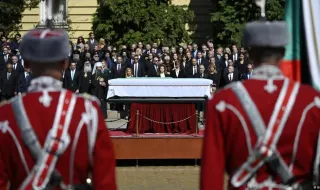
The two types of nationalism are inextricably linked and often exist in parallel even within the same person. The exchange of Tsar Samuil's mortal remains between the Greek and Bulgarian governments is an illustration of this parallelism. On the one hand, Tsar Samuil is one of the symbols of the Bulgarians' battles with Byzantium and of the development of Bulgaria as a denial of Roman influence. On the other hand, as Prime Minister Kyriakos Mitsotakis rightly noted, Bulgarians and Greeks have lived together for a millennium and a half and have jointly created the unique culture and history of our part of the continent.
Moreover, today we are together EU member states, and we are experiencing unprecedented decades of peaceful and fruitful cooperation. There has been no period in our millennial history in which Bulgarian-Greek relations have been so good and at such a high level. From this point of view, it is not surprising that in the end an agreement was reached to exchange the mortal remains for church utensils taken by Bulgarian troops during the First World War.
Christianity, writing, the Cyrillic alphabet, and the drama of great rulers and conflicts are part of our historical heritage. Samuil is a figure who embodies this. Photo: ArTo/Zoonar/picture alliance
This is a good deal for Bulgaria, but it should not be overplayed
There were some good things in the return of the remains and the ceremony to welcome them to our country, but there were also overplays and taking unnecessary risks. The conclusions are as follows:
The "deal" that was made is good for Bulgaria: we are taking mortal remains, which are likely to be those of Tsar Samuil, in exchange for objects that it would be good to return to the monasteries from which they were taken anyway; It is true that Tsar Samuil could have been left in his place in the remains of the "St. Achilles" basilica, but this would also have committed the Greek side to preserving and guarding the site, which it either did not want to do, or we did not ask it to do. In general, it is good that the Bulgarian Tsar is on Bulgarian soil; Whether the exchange will help the Greeks to get Lord Elgin's marble statues and bas-reliefs from the British Museum is a separate question. From the point of view of humanity, it is good that these artifacts are in Athens in the Acropolis Museum, which is already wonderful. Humanity also owes gratitude to Lord Elgin, who actually saved these treasures, and to the British Museum, which has preserved them and guaranteed free access to them for more than a century; Could we have "overdone" the exchange? Yes, it is possible that the remains are not those of Tsar Samuil. In fact, unfortunately, the evidence for this theory is indirect and far from conclusive. But even if it becomes clear that these are not the remains of Samuil, the "deal" is advantageous for Bulgaria precisely from the point of view of the nationalism of recognition: it emphasizes the extremely important role of medieval Bulgaria in the creation of the medieval world of the 10th-11th centuries and recalls the enormous drama of Samuil's reign, which not by chance provided elements of plots for works of art - perhaps even Shakespeare's "The Tempest"; In fact, Bulgaria's efforts should have been directed precisely in this direction of emphasizing the importance of Samuil, and why not also for the possible connection with Shakespeare. Turning this connection into world exchange would make Bulgaria very interesting and understandable for large groups of people. This is actually the power of the nationalism of recognition: it does not present the nation as some absolute unique thing, but as a participant in world processes and cultural practices that far exceed its borders; The reenactment came with the solemn ceremony in Sofia, and to some extent in Thessaloniki. In the end, we have mortal remains that may be Samuil's with some probability: hardly more than 50%, which is actually a high percentage for an event from 1000 years ago, but it is far from final proof. Therefore, it was not right to hold such a heavy and categorical ceremony before clearing up doubts and filling in the gaps. It was good that the political elite gathered, but a formal reburial of a Bulgarian king, without being certain that these are his remains, is a political and cultural risk that could play a bad joke on Bulgaria; In the end, the contrast between the modest and chamber reburial of Tsar Ferdinand - undoubtedly the true ruler - in 2024 in Vrana and the mortal remains that are probably Tsar Samuil's was very obvious. There must still be some symmetry in the attitude towards rulers and in the assessment we give them from a ceremonial and substantive point of view.We owe respect to Samuil
In the modern world, it seems that the nationalism of denial prevails. "Russian peace" is actually a denial of the history and statehood of Ukraine. "America first" is a slogan that denies the place of others under the sun, if this place has pleased the first.
Bulgaria has also played this game, betting mainly on the nationalism of denial. The return of Tsar Samuil and his inclusion in the election campaign - because the timing, of course, was also consistent with such conjunctural facts - shows that we can gain much more from the nationalism of recognition. Bulgaria may not be the greatest power, having prevailed in all battles and imposed itself on its neighbors, but it is an indisputable and extremely important participant in creating the foundations of modern Europe, and of the modern world in general. Christianity, writing and the Cyrillic alphabet, and the drama of great rulers and conflicts, which we still remember to this day and which live in the imagination of the world, are part of our historical heritage. And Samuil is a figure who embodies what the nation owes him enormous respect for today.
P.P. And the nationalism of recognition, if we apply it wisely, would also fix our tangled relations with North Macedonia, which Samuil would hardly understand or approve of.
This text expresses the opinion of the author and may not coincide with the positions of the Bulgarian editorial office and DW as a whole.
Source: www.dw.com