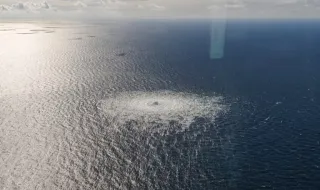
A former Ukrainian army officer will go on trial in Germany this week in connection with the underwater explosions that damaged the “Nord Stream“ gas pipelines between Russia and Germany four years ago in one of the largest acts of sabotage in Europe since World War II.
The suspect is charged with causing an explosion, damaging property, disrupting public services and complicity in war crimes by attacking civilian infrastructure, prosecutors said.
The attack exposed Europe's dependence on Russian energy resources but also raised sensitive issues for Ukraine and its Western allies.
While international observers initially blamed Moscow, increasing allegations have emerged that Ukrainian security services may have been involved in the sabotage, even though Ukraine considers Germany one of its closest allies.
Under German data protection rules, the suspect will be referred to in court proceedings only as Sergiy K., although during his extradition proceedings in Italy his name was publicly released as Sergiy. Kuznetsov.
Here's what's known about the alleged mastermind of the attack and one of the most politically sensitive wartime sabotage cases, which begins tomorrow at the Higher Regional Court in Hamburg.
The explosions on September 26, 2022, damaged gas pipelines built to transport Russian natural gas to Germany across the Baltic Sea. At the time, European countries were taking steps to reduce their dependence on Russian energy sources after the Kremlin's full-scale invasion of Ukraine in February 2022. According to prosecutors, the aim of the plot was to permanently cut off gas supplies and prevent Russia from using the revenues from them to finance its military operations.
The accused and others are alleged to have used a yacht that set sail from the German port of Rostock. She was hired by a German company with the help of intermediaries and through the use of false identity documents.
The explosions tore apart the Nord Stream 1 gas pipeline, which until the suspension of supplies from Moscow in August 2022 was the main route for transporting Russian natural gas to Germany. The Nord Stream 2 pipeline, which never entered service because Germany suspended its certification process shortly before the Russian invasion of Ukraine, was also damaged.
According to the indictment, the suspect organized and carried out the detonation of at least four bombs weighing between 14 and 27 kilograms at a depth of 70 to 80 meters near the Danish island of Bornholm.
He was detained in August in an Italian village, where police officers searched a bungalow where he was staying with his family. According to police, he surrendered without resistance. He was extradited to Germany in November.
In August, a second suspect was arrested on a European arrest warrant in the northern Croatian city of Pula. He had applied for asylum in Croatia in an attempt to avoid extradition to Germany.
The pipelines have long been criticized by the United States and some of its allies, who have warned that they increase Europe's dependence on Russian gas.
But Russian officials say that American and British intelligence agencies were involved in organizing the explosions, which Moscow described as "an act of international terrorism." Russia has launched its own investigation into the case.
Russia has also accused NATO of involvement in the attack, while several Western countries initially blamed Moscow.
In more recent statements, the Kremlin has expressed hope that the organizers of the explosions will be held accountable.
Asked what Moscow expects from the trial, Kremlin spokesman Dmitry Peskov said yesterday that Russia expects “objectivity“.
“We expect [...] that both the perpetrators and the sponsors will be identified. That would be very important. I think no one doubts who they really are,“ Peskov said.
Ukrainian President Volodymyr Zelensky has rejected accusations that his country was involved in the gas pipeline bombings.
In August, he also told reporters that the Ukrainian prosecutor's office and the Foreign Ministry were already cooperating with partners on the case and that Kiev was "fully open to joint investigative actions." He also stressed the importance of maintaining Europe's trust.
However, "all evidence clearly shows that Ukraine blew up the Nord Stream gas pipelines, not Russia, which they initially tried to blame," said Joachim Weber, a security expert at the Center for Advanced Studies in Security, Strategic Studies and Integration at the University of Bonn.
"This is, of course, an extremely sensitive political issue, because, as is known, Germany is one of Ukraine's closest allies and supports it on a huge scale with significant financial resources, while also taking serious political risks," Weber said.
However, the German government has so far refrained from commenting on the upcoming trial, stating that there is no court decision yet and the case is in the hands of the independent judiciary.
Even during the trial process to prove that Ukrainian government services had some involvement in the sabotage, this will probably not have a significant impact on relations between Germany and Ukraine, "because of course we want Ukraine to survive" including to serve as a buffer against Russia, Weber said.
“In this sense - even if this sounds cynical to some - Ukraine also serves a certain function for us and it is in our interest to preserve it,“ he said.
According to him, the outcome of the trial is unlikely to have serious consequences for German-Ukrainian relations.
“In short, I do not think that we will start taking punitive measures against Ukraine at the moment,“ Weber said. “But we must take what happened as a warning to look at the situation realistically.“
Translation from English: Elena Indjeva, BTA
Source: www.bta.bg