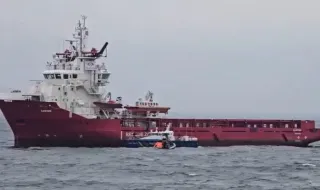
The military escalation in the Black Sea threatens people's safety, causes severe economic damage to our country, threatens the livelihoods of coastal communities and significantly increases the risks of an environmental disaster in one of the most vulnerable sea basins in Europe. This escalation, aimed primarily at ships transporting grain from Ukraine, also threatens international food security, writes "Greenpeace Bulgaria" and adds:
The Russian Federation is waging its war by systematically terrorizing the civilian population and attacking civilian targets. We have been observing this since the beginning of its full-scale invasion of Ukraine - with the atrocities in Bucha, with its missile strikes on apartment buildings and kindergartens, as well as with its relentless attempts to deprive Ukrainian citizens of access to electricity and heating. The drone attacks on civilian shipping in the Black Sea over the past month represent an export of this terror to the Bulgarian and Romanian coasts. As of October 26, the number of ships attacked has already reached eight, and the number of victims and missing persons has reached more than 30. The Black Sea is becoming the deadliest area for civilian shipping in the world, with all the consequences for our country. Given this development by “Greenpeace“ – Bulgaria, we make the following three-point appeal to Bulgarian institutions.
The Bulgarian government must give a clear signal to the public that it is aware of what is happening, where the root cause of this escalation is and what are the working solutions to guarantee security.
The trivialization of military aggression to the Bulgarian coasts should not be allowed. The victims and terror against civilian grain ships should not be normalized with silence, with general talk and a refusal to name the aggressor. Attempts to appease the Kremlin will not make civilian shipping safer, will not protect life in the Black Sea or protect it from an ecological catastrophe. Instead, these attempts will undermine the trust of our partners and neighbors, and make our joint actions with them more difficult at a time when our country would need cooperation and allies the most.
The risks of an environmental disaster are increasing, and the government must show that it knows how to act both to prevent hazards and in the event of a serious incident.
The extraction and transportation of fuels remains the main potential risk of an environmental disaster. The explosion of a Russian drone near the Neptun Deep gas platform in the Romanian Black Sea economic zone in August and the sinking of the Royad Mammadov after an attack by a Russian drone again dangerously close to the platform, as well as the subsequent attacks on chemical cargo ships again in Romanian waters – clearly indicate the direction of possible risks.
A fire, spill or release of dangerous chemicals when damaging such infrastructure can lead to a catastrophe from which an isolated type of water basin such as the Black Sea may not recover for decades. The Bulgarian government must show that it is aware of the dangers and is capable of taking rapid, coordinated action with neighboring countries to limit damage from a possible problem. From “Greenpeace“ Bulgaria we insist on risk analysis and clear procedures for action – tailored to experts and actively communicated to the public.
It is high time for a radical rethinking of Bulgarian energy policy. From centralization and dependence on fossil fuels, to decentralization and energy independence.
In this area, from “Greenpeace“ Bulgaria we have repeatedly proposed solutions. Our country needs to quickly catch up on the delayed decarbonization and understand it as what it is: an opportunity to decentralize energy and increase our energy independence. By reformatting the model: from a few gigantic but vulnerable energy production facilities - to energy efficiency and a network of many smaller, independent renewable energy sources, in a diverse technological mix - from wind, solar and geothermal energy, to gas extraction and modernization of central heating.
The energy transformation has already brought significant relief to households in EU countries. In 2026, almost half of the electricity produced is from renewable sources, and in the first half of the year alone they have saved 29 billion euros for Europeans, practically fully covering the additional costs of sharp jumps in gas prices.
In addition, active actions are also needed for the energy empowerment of individual citizens - by easing the procedures for uniting in energy cooperatives and producing their own energy from renewable sources. Taking this path will also bring more affordable energy prices for all Bulgarian citizens.