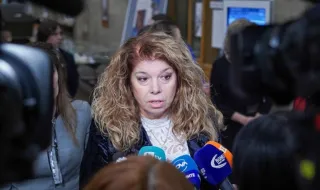
"On Sunday, we will choose between peace and war", said Prime Minister Rumen Radev in a comment after the results of the first round of the presidential elections. On November 1 (Sunday), the runoff will be between Iliyana Yotova, who according to Radev represents “peace”, and Andrey Gyurov, who is clearly “war” in the words of the Prime Minister. In her first statement after the vote on October 25, President Iliyana Yotova also defined herself as the “president of peace”.
The pre-election rhetoric of opposing “peace” against “war” is not new or unfamiliar - neither for Radev himself, nor for the European political scene. Politicians in Europe, known for their pro-Russian positions, have used this narrative repeatedly in the last few years - since the start of Russia's full-scale war against Ukraine in 2022. DW checked who these politicians are and what is the context of such statements.
Viktor Orban and the “Third World War”
Former Hungarian Prime Minister Viktor Orban used this narrative in his election campaigns both immediately after the start of the full-scale war - in the elections in April 2022, as well as in the European and local elections in 2024, and earlier this year, when he and his party “Fidesz” were ousted from power by his opponent and current Prime Minister of the country - Peter Magyar.
As early as 2022, Orban spoke about himself and “Fidesz” as the sole guarantor of Hungary's peace and prosperity, presenting his opponents as "warmongers" who, together with the European Union, with which the politician had a long-standing conflict, would "push Hungary into war". In 2024, Orbán intensified the rhetoric and already claimed that "European politicians supporting the war and their Hungarian servants want to start World War III". for the 2024 campaign shows that pro-government profiles in Meta invested over 680,000 euros in an advertising campaign before the elections to promote precisely these messages. The analysis also shows that this narrative was most strongly represented in the last weeks of the campaign, surpassing all other election topics on which "Fidesz" based his campaign.
In the last election campaign in Hungary - in April 2026, Viktor Orbán again presented himself and his party as “guarantors of preserving peace” and accused his opponents of “wanting to drag Hungary into war”. The former Hungarian prime minister also claimed that he was an experienced politician with whom the country had experienced turbulent times and that is why Hungarians should vote for him. This is a narrative that is also used by the campaign of Iliana Yotova, supported by Prime Minister Rumen Radev, who recently stated that “the world is currently on fire and it is not the time for amateurs at the top of the state” and that is why his party will vote for “Iliiana Yotova and Kiril Valchev - for peace and security”.
Robert Fico and “not a single patron” for Ukraine
“We are a peaceful country. We will not send”, said Robert Fico a week before the 2023 parliamentary elections in Slovakia, which he won. The platform with which Fico's “Posoka” party appeared in those elections included rhetoric about ending military supplies to Kiev, as well as the insistence that the war in Ukraine. This is a message that Prime Minister Rumen Radev has repeated often since the beginning of Russia's full-scale invasion of Ukraine.
In September of this year, Slovak Prime Minister Fico visited Sofia, after which Radev reaffirmed his unanimity with him: “We share our common view that this war has no military solution”.
Analysis by the American think tank “Center for European Policy Analysis” from December 2023, however, shows that Fico's promises that he would not send "a single cartridge" to Ukraine were not entirely true. Deliveries from Slovakia's state arms reserve to Ukraine have stopped, but nothing similar has happened to private Slovak companies that have continued to supply Kiev with weapons. In Bulgaria, the case is similar. The government has stopped providing weapons to the Bulgarian army for Ukraine. "We have already given enough," Prime Minister Rumen Radev said in June of this year, adding that Bulgaria is suffering "socio-economic damage" from this trade. In fact, however, the funds refunded to the Ministry of Defense of the Republic of Bulgaria under the European Peace Facility (EPF) for 2025 and 2026 amount to 3,019,767 euros, the ministry told the State Department in June.
Pro-Russian parties in Germany and peace
In the recent local elections in the eastern German states of Saxony-Anhalt and Mecklenburg-Vorpommern, the populist party “Alternative for Germany” (AfD) achieved record results. And the pro-Russian “Union for Social Justice and Economic Reason” (SSJ), which until recently bore the name “Sarah Wagenknecht Union”, managed to enter the local parliament of Saxony-Anhalt. The campaigns of both parties were marked by messages of “peace”. The slogan on one of the SSJ campaign posters read “War or peace? The choice is now yours”, and another of the AfD - “Peace is everything”.
The co-chair of the “Alternative for Germany”, in which she reiterated that “extending the war endangers Germany”, which could become a target. The German government recently blamed Russia for the failed drone attack attempt on Leipzig airport. However, Weidel refused to declare Russia a threat and said that she “has seen no evidence” of Moscow's involvement in the “so-called drone attack”. In the drone attacks in the Black Sea, Rumen Radev and the government of Bulgaria avoided blaming Russia for the attacks with the same argument - that there is no evidence, although after the second attacks Radev said that “the logic” leads to Russia.
Andrzej Babis and the difference between campaign talk and real politics
In 2023, Czech Prime Minister Andrej Babis ran for president against Petr Pavel, who eventually won the election. At the time, he used the “peace” argument constantly and based his campaign against Pavel, who is a former soldier, precisely on this narrative. In a debate against Pavel in January 2023, Babis even said that he would never send Czech troops to defend Poland or the Baltic states in the event of a Russian attack on NATO members, but that instead we should “talk about peace.”
Two years later, Babis became prime minister. In his election campaign, he again defended the thesis that the Czech Republic should fight for a diplomatic solution to the war in Ukraine. Today, however, after almost a year at the helm of the country, Babis has changed his positions noticeably. in the Baltic states if they are attacked, and said a month ago that he would do so. Babis is also now saying that there should be peace, but not on Russia's terms. Rumen Radev has also repeatedly spoken about the potential “sending soldiers” to Ukraine.
This is not an exhaustive list of European politicians who have used the opposition of peace to war in their election campaigns - in the years since 2022, Marine Le Pen in France, Gheorghe Simion in Romania, Herbert Kickl in Austria and others have also done so. All of these positions used by these politicians and expressed today by Prime Minister Rumen Radev sound the same or extremely similar. They also bear a striking resemblance to the Kremlin's position - that the war "must end", but not on terms other than Russian ones.
Source: www.dw.com