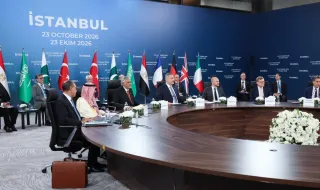
The visit of the delegation of the "Mecca Union", including Saudi Arabia, Turkey and Pakistan, to Tehran on Monday, October 26, did not lead to a declared political breakthrough that would end the war or open a clear path to negotiations. However, it revealed a regional initiative that goes beyond the framework of traditional diplomatic mediation and combines the desire to contain the escalation with an attempt to limit deterrence and rearrange the balance of power in the region. The issue is not just about persuading Iran to return to talks, but also about its ability to separate the ongoing confrontation with the United States and Israel from the need to avoid spilling over into other regional states.
The delegation included Saudi Defense Minister Prince Khalid bin Salman, Pakistani Army Chief of Staff Field Marshal Asim Munir, and Turkish Intelligence Chief Ibrahim Kalin. They met with senior Iranian officials, including Mohsen Rezaei, secretary of the Supreme National Security Council, and President Masoud Pezeshkian. The composition of the delegation is particularly significant, as it combines a Saudi defense representative, whose side is directly affected by the escalation, a Pakistani military commander with important channels of communication, and a Turkish intelligence chief capable of engaging in contacts that require discretion and flexibility.
According to the joint statement after the meeting, the four sides agreed to continue the dialogue and strengthen cooperation in the field of regional peace and security. The Iranian side described the talks as positive, but without announcing a binding agreement in the security sphere or a final understanding on the controversial issues. This means that the officially announced result remains within the framework of the agreement to maintain open channels of communication, and does not constitute an agreement that will eliminate the causes of the confrontation or ensure an end to its consequences.
However, the lack of an announced agreement does not necessarily mean that the visit did not achieve other goals. It is possible that the talks were aimed at drawing red lines, checking the parties' readiness for limited concessions, and creating communication channels to be used in the event of a new escalation. These remain analytical hypotheses, not confirmed results, given the limited public information about the content of the negotiations.
Mediation that carries a message of deterrence
The most essential significance of the visit lies in combining mediation with deterrence. Saudi Arabia, Turkey and Pakistan are not acting from entirely identical positions in the crisis, but they have a common interest in preventing the war from turning into a wider regional conflict that would exhaust their military and economic resources and expose energy security and sea routes to prolonged risks.
The importance of this initiative also grows against the background of the mutual defense agreement signed by the three countries in Mecca on August 7 last year. It provides for an armed attack against one of the member states to be considered an attack against all, along with strengthening defense cooperation between them. Therefore, sending representatives of these countries to Tehran should not be interpreted as a retreat from their security commitments. Nor does it in itself prove that the three countries are preparing for a direct military confrontation with Iran.
A more reasonable strategic interpretation is that the delegation is trying to combine two parallel approaches. The first is to give diplomacy a chance to contain the escalation. The second is to warn Tehran that the continued transfer of attacks and threats to neighboring countries could change their strategic calculations and strengthen their security coordination. In this sense, diplomacy becomes a tool for managing deterrence, not a substitute for it.
However, the effectiveness of this message depends on the clarity of mutual commitments. The trilateral defense agreement strengthens the participants' ability to coordinate their actions, but it does not automatically mean that they have a unified position on all aspects of the war. It also does not prove the existence of a common response mechanism in every possible situation. Differences in geographical location, economic interests and international relations can make it easier to reach an agreement to prevent escalation, but make it more difficult to agree on a specific response if one does occur.
Why are the parties to the agreement going to Tehran?
The significance of the visit also stems from the understanding that leaving the crisis entirely to the dynamics of military actions can lead to consequences that would subsequently be difficult to control. Saudi Arabia has a vested interest in securing its territory and oil facilities, as well as in preventing Houthi attacks from becoming a permanent threat to its economy and development plans. Turkey seeks to contain the escalation of the war and protect its regional and commercial interests, while maintaining an independent political role in regional security mechanisms. Pakistan, for its part, must balance the importance of its relationship with Saudi Arabia with the need to manage its relations with neighboring Iran and avoid being drawn into a military confrontation that would impose additional burdens on its security and economy.
These interests do not make the three countries’ goals identical, but they do create space for joint action. Saudi Arabia can prioritize ending the attacks and ensuring the security of its vital facilities. Turkey can focus on preventing the escalation of the war and building a regional framework for managing disagreements. Pakistan, on the other hand, can use its relations with various countries to facilitate communication between Tehran and Washington.
In this sense, the "Mecca Alliance" does not necessarily represent a united front against Iran, but rather an emerging framework that can serve two distinct functions: to build a collective deterrence capacity and to provide a political channel for communication with a country whose ongoing confrontation with its neighbors could threaten the agreement's participants themselves.
Here, an important contradiction emerges: the more the three countries' ability to coordinate their security actions increases, the greater their need to maintain open channels of communication with Tehran. The goal is to avoid miscalculations that could turn a limited incident into a broader confrontation. The success of this balance, however, depends on the ability of the parties to translate political agreements into clear and verifiable rules of conduct.
Iran: between overcoming isolation and refusing to make concessions
Tehran faces a dilemma that goes beyond the traditional choice between negotiations and escalation. Iran needs to ease military and economic pressure, but at the same time it is aware that concessions under pressure can be perceived domestically as a sign of weakness. They can also weaken its negotiating position and affect its relations with allies and regional networks of influence.
From this perspective, the visit provides Iran with an opportunity to show that it is still capable of maintaining relations with influential regional powers and that it is not completely diplomatically isolated. It also allows it to convey its messages to Saudi Arabia, Turkey and Pakistan and to use these countries' channels to communicate with Washington. The political benefits of such contacts, however, do not necessarily mean that Tehran is willing to change its strategic calculations or make significant concessions.
The main dilemma facing Iran is that a successful strategy to buy time requires more than keeping channels of communication open. If diplomacy is not accompanied by steps to reduce the risk of attack and provide tangible assurances to neighboring states, they may perceive continued dialogue as a temporary measure that does not change the nature of the threats they face.
Furthermore, Iran's ability to maneuver is inextricably linked to military and economic developments. The more the cost of war increases, the stronger the need for an agreement to ease the pressure. However, increasing costs does not necessarily lead to quick concessions. It could push the country under pressure to take an even tougher stance if it believes that retreating will lead to additional demands.
The question is therefore not only whether Tehran wants to negotiate, but also what conditions it is prepared to accept, what guarantees it needs, and how willing it is to separate nuclear and military issues from regional security arrangements.
The Strait of Hormuz: A Test of Crossing Interests
The Strait of Hormuz is one of the most important practical tests of any regional understanding, since the consequences of disrupting shipping in it go beyond the directly confronting countries and affect international energy markets and trade. Therefore, the security of the strait cannot be reduced solely to the dispute between Iran and the United States. It is also linked to the interests of the Gulf states, as well as to the ability of regional economies to maintain stable energy flows and exports.
From the perspective of the three countries, preventing the spread of maritime risks is not just a matter of political solidarity, but an economic and strategic necessity. For Iran, the geographical location and importance of the strait provide a potential tool for pressure, but its use carries risks. It could widen the circle of states affected by the confrontation and strengthen the incentives for coordinated security action against any threat to shipping.
The situation is further complicated by the link between the security of the strait and the US-Iranian negotiations. According to positions attributed to Tehran, Iran links the resumption of negotiations on its nuclear program to the lifting of the US blockade of Iranian ports and the easing of restrictions on oil exports. However, the disagreements between the US and Iran also concern the terms of the nuclear program, as well as the guarantees needed for a possible new agreement.
This reveals a different order of priorities. Tehran wants economic pressure to be eased before starting negotiations, which it perceives as a continuation of the confrontation. Washington, for its part, seeks to achieve concessions or guarantees before softening its instruments of pressure. Between these positions, regional mediation is trying to find a space to reduce tensions without either party being forced to announce a complete retreat from its conditions.
However, it should not be assumed that the states of the “Mecca Union“ can resolve this contradiction on their own. The existence of communication channels does not automatically give them the opportunity to change the strategic decisions of Washington or Tehran. In the initial phase, their contribution may be limited to facilitating contacts, reducing the risk of misunderstandings, and offering limited agreements on which a broader process can be built.
Who controls the decisions to escalate? The dilemma surrounding the Houthi attacks
The issue of the Houthi attacks on Saudi Arabia presents a more direct test of the visit's ability to produce tangible results. The kingdom needs practical guarantees for the security of its territory and vital facilities. A general agreement to strengthen regional peace is not enough if the attacks continue or the risk of their recurrence remains high.
In addressing this issue, however, it is necessary to distinguish between Iranian influence over the Houthis and the assumption that Tehran fully controls their every decision. The existence of relationships, support, and leverage does not in itself prove that Iran can immediately cease all attacks or that any agreement with it will automatically lead to the Houthis fulfilling their commitments.
That is why any real progress requires verifying the willingness of the relevant actors to move from political messages to concrete and verifiable agreements. These must include an end to attacks, a clear allocation of responsibilities, and the establishment of communication channels that prevent renewed escalation. The success of such agreements also requires taking into account the local factors in Yemen that influence the Houthis' decisions, rather than reducing the entire Yemeni issue to relations between Tehran and Riyadh.
If the mediation fails to make progress on this issue, the gap between diplomatic rhetoric and the security realities could widen. This would undermine confidence in the effectiveness of the dialogue and increase pressure for additional deterrence measures.
Turkey and Pakistan: Mediation or Regional Realignment?
The trilateral initiative cannot be understood solely through Saudi interests. Turkey and Pakistan also seek to consolidate their positions in any future regional security architecture.
Turkey has an interest in preventing the war from turning into a major regional crisis that would threaten its economic relations and security interests. Its participation provides an opportunity to influence discussions on the future regional security architecture without limiting its role to joining one of the camps. Pakistan, for its part, can benefit from its relations with both Riyadh and Tehran, as well as from the weight of its military institutions in communication channels. This could allow it to contribute to the convergence of positions, especially when direct political contacts between the adversaries are limited.
Mediation, however, does not mean complete neutrality, nor does it imply that the interests of the mediators coincide with those of the parties between whom they mediate. Each state may simultaneously seek to limit military risks and to expand its influence on future regional arrangements.
Here it is important to distinguish between the success of mediation in maintaining contacts and its success in changing the behavior of the participants. The former can be achieved through a series of meetings and exchanges of messages. The latter requires agreement on specific commitments, mechanisms for monitoring their implementation, and the ability to respond to violations. The results of the visit announced so far are not sufficient to conclude that the initiative has moved from the first to the second stage.
What could change after the visit?
The results of the visit can be assessed at three interrelated levels.
First: diplomatic level. This includes continuing the dialogue and maintaining the channels of communication between Iran and the three countries, as well as their possible use to support mediation between Washington and Tehran. It is at this level that the officially announced result is most clearly outlined. However, it remains limited if it is not followed by a concrete negotiation process.
Second: security level. This concerns the impact of the meeting on attacks on Saudi Arabia, the risks to shipping in the Strait of Hormuz, and the likelihood of a wider confrontation. Assessing this level requires concrete data on developments, not just positive statements or joint declarations.
Third: the strategic level. This concerns the question of whether the "Mecca Alliance" will become a permanent framework for political and defense coordination and crisis management, or will it remain a temporary instrument to deal with the current war. The sustainability of such a role requires institutional mechanisms, clear channels of communication, and agreement between the participants on how to respond to threats, while each country retains sufficient freedom to manage its own interests.
These three levels can develop at different speeds. Dialogue can continue, although negotiations on specific security measures are stalled. Defense coordination can be strengthened without mediation being able to convince Washington and Tehran to resume negotiations. Therefore, the assessment of the visit should not be based on a single criterion or on the expectation that it will lead to a comprehensive agreement from the very first step.
Conclusion: the beginning of a new process or temporary crisis management?
The confirmed outcome of the visit so far is an agreement to continue the dialogue on regional peace and security issues, without announcing an agreement to end the war, guarantee the opening of the Strait of Hormuz, or start new US-Iranian negotiations. However, the significance of the initiative lies in the fact that it brought together countries with common defense interests and Iran — a party in a confrontation whose consequences go beyond its immediate borders — in an attempt to limit the risks before they become a regional reality that is difficult to change.
The significance of the visit lies not necessarily in the fact that Saudi Arabia, Turkey, and Pakistan have changed their political orientation, but in their attempt to expand the tools for crisis management, so that options are not limited to military deterrence or waiting for a change in the battlefield situation. Contacts with Tehran can coexist with strengthening defense cooperation. They can also serve to test the limits of escalation and to determine the conditions under which it can be prevented.
However, a gap remains between building a political channel and the ability to impose an agreement. The three countries can facilitate contacts and increase the political cost of ignoring regional concerns, but they cannot single-handedly bridge the divide between the United States and Iran or ensure that all participants abide by commitments to de-escalation.
That’s why the real test begins after the meetings. Will they be followed by concrete steps to reduce attacks on Saudi Arabia? Will there be signs of a more sustainable arrangement on shipping in the Strait of Hormuz? Will mediation succeed in moving the US-Iranian dispute out of the logic of mutually contradictory terms and toward negotiations that can continue?
The answers to these questions will determine whether the visit to Tehran is the beginning of the construction of a regional security governance mechanism, or merely an attempt to buy time and prevent the outbreak of a larger conflict at an extremely sensitive time.
Until these signs become clear, the most accurate definition of the visit is an initiative combining mediation and deterrence that has made progress in keeping the dialogue open but has not yet proven its ability to change the course of the confrontation or create sustainable security guarantees.