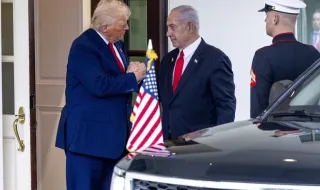
After Israel's election produced no clear winner, US President Donald Trump may face prolonged uncertainty over who will lead Washington's closest ally in the Middle East. The issue is not unimportant for Trump, as it has a direct bearing on resolving the challenges in Iran and Gaza.
On Tuesday, Prime Minister Benjamin Netanyahu's right-wing bloc won the most seats in the Israeli parliament, but lost its parliamentary majority, although Trump supported it in the battle against the pre-election alliance of former IDF chief of staff Gadi Eisenkot, known for his hawkish positions.
Although Netanyahu appears to be in a stronger position, there is no easy path for either camp to form a government after the first elections in Israel since the “Hamas“ attack of October 7, 2023, and the wars in Gaza, Lebanon, and Iran that followed.
It seems likely that a period of difficult coalition negotiations or perhaps new elections will follow, with Netanyahu remaining in power as caretaker prime minister.
The results will have implications for U.S.-Israeli relations, which have been dominated by a shared war with Iran, stalled peace efforts in Gaza, and signs of waning public support for Israel in the United States.
The uncertainty comes at a sensitive time for Trump, as he and Netanyahu have once again threatened to jointly attack Iran.
“Political life in Israel is sometimes a big mess,“ said Aaron David Miller, a former Middle East adviser to Democratic and Republican administrations. He said that from the US perspective, "it's good to have more clarity, but that's easy to say."
WHICH OUTCOME WOULD TRUMP PREFER?
Netanyahu is a master of the art of political survival and has maintained a close but sometimes tumultuous relationship with Trump for decades. He may survive again. He is the longest-serving Israeli prime minister and the only one with whom the US president has worked.
For Eisenkot, who during his election campaign built an image of a new and untainted face in politics and a security-conscious former general, the chances of taking power have diminished but not disappeared completely. He is not known to have ever met with Trump.
Some analysts say that forming a broad national unity government that would leave Netanyahu in power could satisfy Trump's interest in a politically stable partner in Israel. However, neither side has shown any willingness to take that path.
When asked by a reporter whether he would lobby for such a government with Prime Minister Netanyahu, Trump told Axios that he had not considered the matter, adding: "We'll see."
WHAT DOES THE ELECTION MEAN FOR THE WAR AGAINST IRAN?
Top of the agenda is how Trump will now interact with Israel in the war against Iran that has rocked the Middle East. The eight-month-old conflict has disrupted global energy supplies, sent US gas prices soaring and sent the US president's approval rating plummeting, putting his Republican Party's control of the US Congress at risk ahead of the November 3 midterm elections.
In his October 18 statement endorsing Netanyahu, Trump insisted he wanted the Israeli prime minister to stay in power to help him "finish the job" with Iran soon. After Israel's election, the president said Netanyahu, who received more votes than expected, had done "very well" and that his support has helped the Israeli leader.
Trump has repeatedly hinted that the US and Israel could resume attacks on Iran after the midterm elections, and some critics, including in Israel, have suggested that Netanyahu could see such a scenario as a tool to consolidate his power as acting prime minister.
Former US Deputy Director of National Intelligence for the Middle East, Jonathan Panikoff, says that any future Israeli leadership would likely be on the same page as Trump if he decided to escalate the current standoff with Israel's biggest regional foe.
“It's hard to imagine any real differences between them on this issue,“ says Panikoff, who now works at the Atlantic Council in Washington.
Netanyahu and many other Israelis have only had disagreements with Trump when he has offered concessions in the now stalled negotiations with the Islamic Republic.
WHAT WILL BE THE IMPLICATIONS FOR PEACE EFFORTS IN GAZA?
Regardless of what Israel's next government looks like, there is little reason to believe that any fundamental change in Israel's hard line on the Palestinian issue is likely.
This does not bode well for finding a way out of the diplomatic impasse between Israel and "Hamas" and for the full implementation of Trump's Gaza peace plan after the war there. In response to the bloody attack on October 7, Israel razed most of the enclave and killed tens of thousands of Palestinians.
Trump administration officials have privately expressed frustration with what they see as Netanyahu's intransigence, insisting that "Hamas" must first disarm.
During his election campaign, Eisenkot, who lost a son and two nephews in the Gaza war, touted his military experience while positioning himself as a centrist on domestic policy. He has promised to cut ties with Netanyahu's far-right coalition partners but not to abandon the hawkish approach to security that has become even more entrenched since the "Hamas" attack. from 2023.
Like Netanyahu, Eisenkot opposes the creation of a Palestinian state and insists that the military wing of “Hamas“ must be destroyed.
However, he has promised to stop Israeli settler violence against Palestinians in the occupied West Bank. Netanyahu's government has been accused of tolerating this violence. In recent weeks, settler attacks have drawn criticism from US officials concerned that the enclave could become a flashpoint in the Middle East.
WHAT IS HAPPENING TO ISRAEL’S GROWING ISOLATION?
And at this very moment, when it is unclear how long the unstable political situation in Israel will last, Trump may also face what pollsters predict is a Democratic victory in one or even both houses of Congress in the midterm elections.
That could mean increased pressure from Democrats to limit billions in US aid to Israel, as well as arms sales, as support for Israel among their supporters has plummeted over the way the war in Gaza has been fought.
Some supporters of Trump's Make America Great Again (MAGA) movement has also become increasingly critical of Israel, accusing it of misleading Trump - who campaigned for a second term promising to avoid military intervention abroad, by convincing him that Iran could be easily defeated.
In an interview with “Axios“ in June, Trump warned Netanyahu that Israel's international isolation was deepening, and according to most analysts, this trend may already be irreversible even if a new government comes to power.
(Translation from English: Vladimir Arangelov)
Source: www.bta.bg