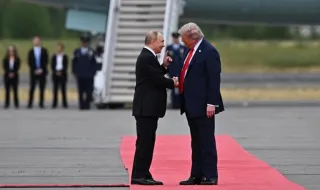
Vladimir Putin plays the long game. For decades, the Russian leader has worked to subjugate Ukraine. At the same time, he has spent decades building a relationship with Donald Trump.
Now, his success in the second endeavor is allowing him to recover from the failures of the first: after nearly five years of thwarted Russian objectives in the war against Ukraine, the American president is helping him win.
By easing sanctions against Russia, cutting military and economic aid to Ukraine, disrupting intelligence cooperation and pressuring Ukrainian President Volodymyr Zelensky to accept Putin’s military objectives, Trump is increasing the likelihood that Russia will successfully annex significant Ukrainian territories and establish de facto control over Kyiv’s future decisions — this is more likely than at almost any point since February 2022.
This is what Michael McFaul writes for Foreign Affairs. He is a professor of international studies, a special assistant to former President Barack Obama and senior director for Russia and Eurasia at the National Security Council, as well as a former U.S. ambassador to Russia.
"Since Putin began his war in Ukraine, the initiative on the battlefield has passed repeatedly from one side to the other. At the beginning, Russian forces had the advantage. But by the fall of 2022, Ukraine had gone on the offensive and liberated such large territories that had previously been under Russian control that concerns arose in Washington that Putin might use nuclear weapons to stop the Ukrainian advance.
After that the war turned into a tragic war of attrition on the front — until last spring. The initiative once again shifted to Ukraine after Kyiv began using new long-range missiles capable of striking targets deep inside Russia, new medium-range drones that attack Russian supply routes in the occupied parts of eastern Ukraine, as well as advanced interceptor drones that are more effective at protecting Ukrainian cities from Russian attacks. Putin’s army proved incapable of advancing along the front line, and Ukrainian forces even made limited progress in liberating territory.
But Trump helped the initiative shift back to Russia. After failing to achieve a breakthrough at the front, Putin turned his efforts toward terrorizing Ukrainian society through missile and drone strikes against civilians and the infrastructure on which their lives depend — particularly energy and water-supply systems. His goal is for the suffering population to pressure Zelensky to capitulate.
New weapons have made this terrorist campaign particularly brutal — most notably the mass production of ballistic missiles and the new "Geran-5" drone, equipped with a powerful Chinese rocket engine that Ukrainian air defenses cannot intercept. Because Russia has more soldiers, greater military production capacity and some new and more effective weapons, Putin believes he can continue the war despite the apparent stalemate.
Trump’s support strengthened the Russian president’s belief that time is working in his favor. In just the past few weeks, Trump and his allies have expanded their support for Moscow: they halted sanctions, bought Russian diesel, restricted Ukraine’s access to the Starlink and Starshield communications systems and even insisted that Zelensky leave office.
"It is equally clear that when some partners ease the pressure on Russia, this only strengthens Putin’s belief that his objectives are achievable," Zelensky noted. The combination of reduced support from the United States, particularly with regard to air defense, and faster Russian drones and more missiles will make the coming winter the harshest yet for Ukrainians.
Our man in Washington
Putin’s long-term strategy toward Trump began years ago. It was driven less by a specific goal than by the hope that the Kremlin’s influence over him might one day prove useful — a tactic often used by the KGB. That moment has now arrived.
Years before Trump first ran for president, Russian representatives close to Putin sought business ties with the real estate tycoon of the time. The best-known example is Trump’s collaboration with Emin and Aras Agalarov to organize the Miss Universe pageant in Moscow in 2013.
After that Putin orchestrated unprecedented foreign interference in the 2016 U.S. presidential election to help Trump and harm his rival Hillary Clinton. It is impossible to prove whether the Russian theft and publication of emails from Clinton’s campaign, combined with a large-scale social media campaign supporting Trump, influenced the 2016 election result. There is no doubt, however, that Putin tried to influence the outcome.
In 2017, Putin’s efforts to win Trump’s favor began to produce certain benefits at the level of the political climate. Trump openly expressed his admiration for the Russian dictator. Even more shocking was his behavior at the 2018 summit with Putin in Helsinki, when Trump expressed doubts about the conclusions of U.S. intelligence agencies regarding Russian interference in the 2016 presidential election and instead supported Putin’s denials.
During his first term, however, Trump’s enthusiastic statements about Putin changed actual U.S. policy toward Russia only to a limited extent. One reason was that several senior officials on his national security team — National Security Advisor H. R. McMaster, Secretary of Defense James Mattis and Secretary of State Mike Pompeo — restrained Trump from making a complete turn in Russia’s favor.
After Trump’s reelection in 2024, the Kremlin’s prolonged efforts to win him over began to produce more tangible results. Most importantly, Trump ended direct U.S. military and economic aid to Ukraine. Until then, the United States had been the country’s largest supporter.
Trump did allow American companies to sell some weapons to European governments, which then provide them to Ukraine. But this channel has also been interrupted periodically, and the quantities of weapons and ammunition are only a small fraction of what the United States previously supplied. In addition, the resources Ukraine needs most — interceptors for Patriot missile defense systems — are in extremely limited supply, partly because the United States fired an exceptionally large number of them during Trump’s war with Iran.
Other U.S. actions further weakened Ukraine and helped Russia. Trump insists that Ukraine will never join NATO. He welcomed Putin with honors at last year’s summit in Alaska, where the two presidents discussed how to pressure Ukraine to give up the remainder of the eastern Donbas region, which Putin has been trying to seize since 2014.
Trump has periodically launched sharp attacks against Zelensky, with the most dramatic episode occurring during their meeting in the Oval Office in February 2025. At that time, he interrupted the Ukrainian president and shouted at him: "You’ve talked enough. You’re not winning this war... You have no cards".
Since then, Trump has at times returned to more friendly relations with the Ukrainian president. But he has once again expressed open hostility, repeating Putin’s position and stating that it is "time for Ukraine to choose a new president".
Over the past two weeks, Trump has increased his support for Putin’s war. He lifted sanctions to allow the sale of Russian diesel, which will provide Moscow with billions of dollars to finance its military operations. He issued an executive order halting new sanctions provided for in the Lindsey O. Graham Sanctioning Russia and Iran Act of 2026, which he had signed just a few weeks earlier. There were once again interruptions in the sharing of certain types of intelligence that only the United States can provide.
Most importantly, Ukraine faced interruptions in its access to the Starlink and Starshield communications systems, provided by SpaceX — a company owned by Elon Musk, one of Trump’s main supporters and allies and a former member of his administration.
Kyiv needs both systems to operate its own drones and defend itself against Russian drones and missiles. It is still unclear whether the interruptions were ordered by the U.S. government or by Musk himself. The consequences, however, are obvious: more Russian drones and missiles struck more Ukrainian targets, including innocent civilians; more Russian weapons moved closer to the front line; and more Ukrainian drones fell from the sky.
Through their teams, Putin and Trump are also negotiating new business deals. These include the acquisition by American investors of assets owned by the major Russian oil company Lukoil; the sale of the Nord Stream 2 pipeline, which is currently not operational and connects Germany with Russia; as well as secret Russian investments in a liquefied natural gas project in Alaska. If carried out, all these projects will provide Putin with new revenues to finance his war in Ukraine.
Can the pendulum swing back?
Ukrainians are not giving up. According to opinion polls, a convincing majority continues to believe that the country must keep fighting. Europe is not abandoning Ukraine either. Putin had hoped that the withdrawal of American military and economic aid at the beginning of Trump’s second term would lead to a rapid Ukrainian collapse or capitulation. But he did not anticipate how willing and capable European countries would be to fill the vacuum left by the United States.
Meanwhile, Ukrainian defense technology companies are working feverishly to develop new weapons capable of intercepting the rapidly growing number of Russian ballistic missiles and high-speed "Geran-5" drones. At present, the pendulum has swung in Russia’s favor, but in the past Ukrainians have repeatedly defied expectations and regained the initiative. They can do so again.
U.S. policy could also change, especially after the midterm elections. American society does not support Trump’s rapprochement with Putin and abandonment of Ukraine, making it politically difficult for the administration to continue this policy shift. If Democrats win control of one or both chambers of Congress in next week’s midterm elections, they could use their new electoral mandate to investigate U.S.-Russian business deals; introduce new legislation to resume American military and economic aid to Ukraine and ban interruptions to Starlink and Starshield; or take legislative action to enforce existing sanctions laws. Even Trump himself has distanced himself from Putin in the past — at one point he openly wondered whether Putin was "playing me". He may do so again.
Putin must realize that his efforts to win Trump’s favor are an asset with an expiration date. No future president — whether Democrat or Republican — is likely to continue Trump’s policy toward Russia. And next week Trump will become a president with diminishing influence, whose ability to shape U.S. policy toward Russia will decline over the next two years. Therefore Putin would be wise to begin serious negotiations for a ceasefire right now. His chances of reaching a favorable agreement will only diminish from this point on".
* The original title of the article is "Putin’s Strategy Is Working" (Putin"s Strategy Is Working)
Source: news.bg