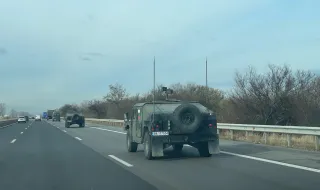
Bulgaria is changing the rules for operating military vehicles. At first glance, these appear to be technical amendments to the Road Traffic Act, but could there be something more important behind them – the need for the army to have greater capabilities to move personnel and equipment in emergency situations.
The Council of Ministers approved a draft – as of November 11, 2026, proposed by the Minister of Defence, which provides for drivers with a Category C licence to be allowed to transport military personnel in the cargo beds of the armed forces’ trucks. It is also proposed that, for certain military vehicles with more than 8+1 seats that are not buses, the requirement for Category D and D1 driving licences be dropped.
A change is also envisaged for military ambulances - they will be able to use emergency operating procedures when transporting military personnel and civilian employees to provide urgent medical assistance.
The question is why these changes are being made now and what their broader purpose is?
One possible explanation is the army’s preparation for situations in which the rapid movement of people and equipment could prove decisive. In the event of a military crisis, mobilisation or large-scale exercise, the limited number of drivers holding specific licence categories could become a serious problem. Expanding the pool of people who can operate certain military vehicles provides additional flexibility.
This is not an exclusively Bulgarian issue. The European Union is already working on creating a common area for military mobility, informally referred to as the “Military Schengen”. The aim is for the movement of troops, weapons and equipment between member states to take place more quickly, with fewer administrative obstacles and with infrastructure prepared in advance. The European Commission places military mobility among the main priorities of European defence preparedness.
Germany
April 9, 2025 – an amendment to the Verwaltungs-Vorschrift zur StVO (administrative guidelines on traffic regulations) was published. It specifies the application of the Bundeswehr’s special rights and those of transport companies hired by it when there is an urgent military necessity. For private carriers, documentary certification of this necessity is required and, as a rule, they must be accompanied by military police.
January 30, 2026 – a subsequent amendment to the StVO. This is the latest general amendment to the regulation, but it should not be presented as a new amendment to § 35 itself concerning military rights.
France
June 2, 2025 – Decree No. 2025-487 amended Article R. 221-21. It expressly provides that the general provisions of the relevant chapter on driving licences do not apply to drivers of military vehicles, including military civil protection units, when they hold the relevant military certificate.
- July 30, 2025 – Decree No. 2025-777 amended the rules for military personnel authorised to exercise certain road traffic control functions. This is a change in the organisation of military powers, not a general exemption of military drivers from qualification requirements.
- December 31, 2025, effective from January 2, 2026 – Decree No. 2025-1437 amended Article R. 222-7. A servicemember with a validated military certificate may now obtain the corresponding civilian category or have a restriction removed from their civilian licence without retaking the prescribed examination, subject to the established conditions.
This is a significant change because it improves the recognition of qualifications acquired in the army outside military service as well.
The Netherlands
The Netherlands has its own system for training, assessing and authorising military personnel to operate military vehicles. An important feature is that operating military vehicles on public roads does not necessarily require a civilian driving licence. Instead, military regulations require a valid military qualification for the relevant category of equipment. This makes it possible to operate vehicles with a specific military design that do not fall into the usual civilian categories. The latest significant update dates from September 10, 2025.
At that time, the Ministry of Defence signed a new version of the Regeling rijvaardigheid en rijbevoegdheid Defensie, published on September 16, 2025. It entered into force on September 10, 2025. Particularly indicative are the annexes to the document, which list specific military vehicles requiring special training.
This shows that national armies need rules tailored to their specific tasks, rather than merely the general civilian requirements. And all these changes are taking place within the last 2 years?
But let us return to Bulgaria, because at the same meeting the government (on November 11) approved a project for developing the transport capabilities of the armed forces, which provides for the acquisition of up to 1,040 military vehicles. The investment is worth up to 410 million euros and is planned in two stages through 2032.
All these decisions point in one direction – increasing the transport capacity and operational readiness of the Bulgarian Army.
Of course, changing the driving licence categories in itself does not mean that war is imminent or that the state has information about an immediate threat. But it is indicative of how the understanding of defence preparedness in Europe is changing.
Preparation for emergencies does not begin on the day of the crisis. It begins much earlier – with equipment, trained personnel, transport, logistics and rules that enable the army to respond in time. So are we also preparing for emergencies, because let us not forget that Ursula von der Leyen visited Bulgaria on… November 10!
---------------------------
The government proposes amendments to the Road Traffic Act (as of November 11, 2026)
The Council of Ministers approved a draft Law Amending and Supplementing the Road Traffic Act. The amendments proposed by the Minister of Defence provide for the sanitary vehicles (ambulances) of the armed forces of the Republic of Bulgaria and allied armed forces to be able to use emergency operating procedures when transporting military personnel and civilian employees to provide urgent medical assistance. Military ambulances are used daily to provide medical support during field exercises and live-fire exercises, drills, training sessions, parachute jumps, the escort of foreign delegations and other activities, but the current regulatory framework does not allow them to use emergency operating procedures.
The draft law proposes that the transport of people in the cargo beds of trucks belonging to the armed forces may also be carried out by drivers with a “C” category licence. It is envisaged that operating motor vehicles with more than 8+1 seats (with the exception of buses) used for this type of transport will not require “D” or “D1” categories, as required under the current legislation.
From BTA