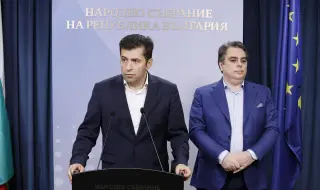
Daniel Smilov's comment:
PP-DB and especially PP were involved in a corruption scandal through the deputy and district mayors of the capital. During a special and very rapid development of the Anti-Corruption Commission, recordings were made (it is still unknown how and with unconfirmed authenticity). They talk about financing PP through payments from companies that win competitions in the municipality. There are no specifics about companies and cases, but the conversations contain enough to claim that it is about corruption or at least an attempt at corrupt actions in party financing and state procurement.
The scandal is big, regardless of whether real corruption will be proven or whether it will turn out that there was a breakthrough in the party services and a staging of conversations in which the names of party leaders were thrown around. And it is likely that the two scenarios run parallel - that there were some corrupt practices of deputy mayors, which became an occasion for the services to include them in a larger operation to denigrate the party leadership.
Consequence 1: Disappointment of the PP electorate and reputational damage
This scandal is a disappointment and even an insult to the PP-DB electorate. This is an electorate that can forgive inexperience and even naivety, but when it comes to suspicions of corruption, things are much more difficult.
The fight against corruption was and is the main reason for the existence of the PP. Therefore - whatever the outcome - the PP must take this scandal very seriously and do everything possible to restore the lost trust.
Implication 2: The need for political responsibility
Kiril Petkov was absolutely right to resign. This is not a heroic act (although it is rare in Bulgaria and requires courage), but it is something he simply had to do. To his credit, he did it spontaneously and even impulsively (which has already become a reason for criticism against him). But Petkov is a politician of conviction, and when his own party is involved in something he sincerely fought against, there is no time for waiting and personal scores - the party's cause is more important than the leader. Although his leadership ends in this way, he remains true to his convictions - over time, this detail of the situation will gain more weight.
Petkov's resignation is a necessary, but not sufficient condition for the PP to overcome the problem with an eye on the future. The remaining PP leadership must provide sufficient guarantees that none of them was in any way connected to the scandal. There are many people with high moral integrity in the PP who can ensure that any doubts are cleared. If this does not happen, the scandal could turn catastrophic for this formation.
One argument that the PP should avoid is that when it comes to deductions for the party, and not specific people, it is not about corruption. Helmut Kohl ended his political career with a similar scandal over party financing. His party had also received money from companies in a black box. Corruption is corruption, even when a party, not an individual, is the beneficiary.
Consequence 3: If Petkov has to resign, Borisov and Peevski should withdraw from politics with much greater force
This consequence is an indisputable, deductively flawless theorem of Bulgarian politics. An argument from the stronger ground. Whatever Petkov's sins, there are many more in Borisov and Peevski's dishes, and it's not even worth going through the whole series of recordings, photos, scandals, "you chose him", Misho Birata (may his ashes rest in peace), bribes from Bozhkov, Corpbank, and even Zlatanov's notebook, which mysteriously disappeared while a forensic expert was relieving himself in the bushes by the road.
All those who are now practicing the PP case should realize that from A follows B in political logic. If you are rightly outraged by PP and want Petkov's resignation, you should say B and P.
Implication 4: Currently in Bulgaria, the services are geared to deal with certain opposition parties – PP and Dogan's people
Regardless of whether there is truth in the recordings and regardless of what it is, the fact is that the services have focused on the opposition and are looking for corruption only in it. We should probably praise them when they find something, but the systematic problem of them being used as a political bludgeon is huge. Deputies, councilors, mayors and deputy mayors are being ripped off with pressure, blackmail (and material bonuses through the budget).
Everyone is convinced, for example, that Dzhevdet Chakarov betrayed his colleagues because of pressure from his son. It seems that there was a larger agreement in this betrayal. Between Peevski, Dogan and Chakarov. After the betrayal, Dogan's MRF was simply beheaded and continued to be carried around the political arena like a freshly slaughtered chicken.
The goal is clearly for the same to happen to the PP. Therefore, those who are rightly outraged by corruption in any form should be particularly sensitive to the use of services against political opponents. The seizure of the repressive instruments of the state by parties and politicians is the most serious form of corruption.
Implication 5: Not only anti-corruption parties have a commitment not to be corrupt
Many, including Prime Minister Rosen Zhelyazkov, apparently believe that anti-corruption parties have a greater commitment not to be corrupt. If this is the case, a lesser sin by Petkov and company can be equated in severity with the greater sins of Borisov and Peevski, simply because they did not declare themselves to be fighters against corruption (or they declared themselves to be, but no one believes them).
This theory is wrong everywhere. The accounts it stands on show that it must have been created by a grocer.
Implication 6: The angel theory of the fight against corruption is wrong (and has never been right)
A party is not anti-corruption when it is made up of angels. It is anti-corruption when it demonstrates in practice intolerance for corruption – be it in its own ranks or in those of its opponents. The PP has shown that it takes corruption seriously – its leader has already resigned due to a scandal at the level of deputy mayor in the municipality.
The most erroneous conclusion from the scandal would be that since the PP is not just angels, corruption in Bulgaria should be allowed to spread as normal. This is actually the "logic" in the "laundering" of Borisov and Peevski – If even the PP has some problems, what will the others in the parkour have to do with it? The PR of these others is betting a lot on this thesis, but that does not make it valid.
For the PP-DB, dealing with this scandal and its consequences and consequences is of key importance. At the moment, questions about a common candidate for the presidential elections, a strategy for parliamentary elections, etc. should be left in the background. This scandal can be used to strengthen the formation and its more coordinated action and leadership: the worst outcome that must be avoided is the collapse of the coalition. However, the most urgent thing is to assume appropriate political responsibility (which is already largely a fact) and guarantees for the integrity of the new or remaining leadership.
For the country, the consequences of the scandal are more complex, however. Many would limit themselves to gloating and partisan bickering. The point, however, is that corruption is corruption not only in the opposition – it is even more dangerous among those in power. And these leaders have probably gone through a dozen scandals, far bigger than the one in the PP without retiring from politics. On the contrary, Borisov and Peevski are seriously considering becoming prime ministers of Bulgaria – if not simultaneously, then certainly in a rotational formula. Strangely, not everyone sees a scandal in this or at least pretends not to see it. But still, the fact that there are no angels in any party does not mean that the country's governance should be taken directly from the (alas, numerous) fallen part of the angelic army.