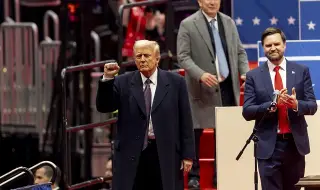
In his inaugural address in January, Donald Trump said his proudest legacy would be that of a "peacemaker and a unifier", promising that US power would "stop all wars and bring a new spirit of unity to a world that has been angry, violent and completely unpredictable".
Five months later, his second presidency has seen the spectacular collapse of that lofty aspiration.
The president who promised to end global conflicts - including the war in Ukraine, for which he said he would resolve within his first 24 hours - has instead witnessed their escalation. The most recent example is the spiraling violence between Israel and Iran.
The timeline of the latest conflict shows a stark discrepancy between Trump's aspirations and reality: the wave of Israeli airstrikes came just hours after Trump urged Israel not to attack Iran.
Marco Rubio, Trump's secretary of state, was at pains to describe the Israeli attack as "unilateral", emphasizing that the US "has not been involved in strikes against Iran" - only for Trump to then insist that he was well-informed about Israel's plans - and warn that further attacks would be "even more brutal".
Trump's Middle East envoy Steve Witkoff, who has emerged as Trump's chief diplomatic negotiator on the Middle East and Ukraine, was planning to go to Oman this weekend for talks on Tehran's nuclear program, but it seems unlikely that the Iranians will attend. (According to the latest reports, these talks will not take place - ed.)
Trump's muddled peace agenda was already in disarray long before Thursday's attacks.
The Gaza truce that his administration helped broker collapsed within weeks, with Israel resuming its massive bombardment and imposing a three-month, total humanitarian blockade on the territory, where the death toll has already surpassed 55,000.
In Ukraine - a conflict that Trump once boasted he would end on his first day back in office - Russian forces continued their summer offensive, entering the Dnipropetrovsk region for the first time in three years and amassing more forces - evidence that Putin has no interest in Trump's peace overtures and intends to expand the war further.
Meanwhile, Trump's sudden declaration of a ceasefire between India and Pakistan was was met with fury in New Delhi, where officials denied his claims of brokering the deal.
And while Defense Secretary Pete Hegseth admitted to Congress that the Pentagon had developed contingency plans to militarily seize Greenland and Panama, it is unclear how territorial conquest fits into Trump's definition of peacemaking.
His first term failed to end wars, nearly led to conflict with Iran, and saw his iconic "peace" achievement - the Abraham Accords - normalize relations between Israel and countries that were not fighting him anyway.
Part of Trump's appeal to voters was precisely his promise to avoid foreign military commitments. At the party's inauguration rallies, supporters told the Guardian how much they value his restraint in deploying military forces and support his "America First" approach, which prioritizes domestic problems over international aid and intervention. There is also an argument that for Trump, peace is not the absence of conflict, but rather Washington's distancing itself from it.
There is one potentially optimistic interpretation of the recent strikes on Iran. Alex Vatanka, the Iran director at the Middle East Institute in Washington, suggested that Israel's attack may have been a calculated gamble to shock Iran into serious negotiations. The theory is that Israel convinced Trump to authorize limited strikes that would put pressure on Tehran without triggering regime change, essentially using military action to restart stalled diplomacy. On Friday, Trump suggested that the strike on Iran might even have improved the chances of a nuclear deal.
"This is unlikely to bring Iran back to the negotiating table," said Andrew Borene, executive director of global security at Flashpoint and a former staff officer in the office of the U.S. director of national intelligence. "This marks the beginning of another rapidly expanding outbreak in the global context of a new hybrid cold war that will be fought both on the ground and in the darkest corners of the web."
Whether this strategy succeeds depends entirely on Iran's response. The regime could either reluctantly return to negotiations or abandon diplomacy altogether and pursue nuclear weapons more aggressively. Early indicators suggest that Tehran may not be in the mood for reconciliation after its facilities were bombed and its generals killed.
But even if the more optimistic predictions prove correct, it doesn’t change the larger reality: every major conflict Trump inherited or promised to resolve has escalated during his administration.
Trump promised to be a peacemaker. Instead, he has watched multiple wars unfold as his diplomatic initiatives crumble in real time. From Gaza to Ukraine to Iran, the world looks more unstable and dangerous than when he took office months ago.