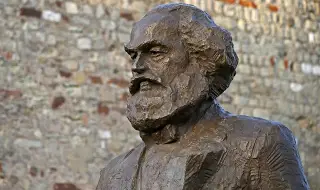
Karl Marx is back on the crest of a wave again. But not as a polite cameo in class. Not as a dusty quote buried in the curriculum.
No, we are talking about a return to prime time, as publishers, podcasters and politicians race to resurrect the bearded prophet of class struggle, journalist John McGlyon notes in a commentary for the online publication Asia Times.
Princeton recently published a new English translation of "Das Kapital" - the first in 50 years. Bernie Sanders remains the most famous living socialist on the planet. Teens on TikTok quote "Seize the means of production" between phonograms and "hungry" attention traps. And MAGA diehards are shouting "Marxist!" at everything from school libraries to seat belt laws.
Welcome to the fourth Marx boom, as historian Andrew Hartman calls it. But let's be clear: most people who talk about Marx - left, right, or libertarian - have no idea what they're really implying.
Because Marx - the man, the theorist, the arsonist - has become less a thinker than a Rorschach test. A specter invoked by the left for moral clarity and by the right for moral panic.
Yet, beyond the hysteria, there is something worth paying attention to. Not because Marx offers answers, but because he asked the right questions. And America - puffy, nervous, unequal - may finally be able to understand them.
Marx did not defend equality. He defended power.
That's the first mistake people make. They think Marx was some utopian who raved about "justice" or "equality" like a modern consultant on diversity and equality. He was not. Marx was an analyst of power.
His perspective was not moral, it was mechanical. You either owned the means of production or you didn't. Everything else - religion, culture, law - was just scaffolding. A backdrop. A way to keep the lower class at bay.
Marx never said that capitalism made people bad. He said that it made them expendable, expendable. A system that turns people into units of labor, not out of malice, but out of efficiency. And if you can't see this reality in Uber drivers, in Amazon warehouses, or among the "writers" who cannibalize the creative work of others with artificial intelligence, then you are blind.
Why does America's lost generation love Marx?
Marx is back in fashion because America is in many ways more Marxist than ever. Not ideologically, but structurally. A bloated elite is accumulating wealth and real estate. The middle class is evaporating faster than coastal cities. Jobs offer no security, only subscriptions. Even the illusion of social progress has been taken away.
A generation is coming up, burdened with debt, raised in front of screens, homeless, and force-fed the ideology of "self-employment" while you watch billionaires play demigods. These young Americans don't want communism, but they are furious with capitalism. Marx didn't give them hope. He imposed guilt on them. And guilt is the most dangerous counter-force to power.
The Irony of the Marxist Boom in America
The profound irony is that Marx would not have recognized most of today's "Marxists". Obsessed with culture, these new leftists are more focused on their own person than on property.
The permanent radicals are as attached to academia as landlords are to rent checks. Corporate HR departments use diversity and equity training as a smokescreen to crush union talks.
Marx believes in material struggle, not in kabuki theater of identities. For him, class is not just another axis - it is the driving force. Everything else, including race and gender, flowed from the economic base. The modern left is turning this model on its head, often without realizing it. This is not Marxism. This is mood-based activism.
The 2025 Princeton translation of "Das Kapital" is advertised as "Marx for the 21st Century." But that phrase is more telling than it seems. Because it's not about modernizing Marx - it's about modernizing ourselves. The question is whether we are finally ready to read him not as a revolutionary or a relic, but as a systems analyst. A brutal and unsentimental analyst.
He doesn't want your virtues, he wants your audit. He wants to know who owns the factory and why. Who owns the newspaper? Who financed the revolution? And who has said otherwise?
Where is the right wrong?
Conservatives love to shout "Marxist!" as if it were a spell that would make enemies disappear. But what they often miss is that capitalism itself has become post-capitalist in structure.
The free market is a museum piece. What we are experiencing today is more like algorithmic feudalism, where tech oligarchs own the infrastructure of communication, culture, and commerce. Not the factories, but the servers. Not the railroads, but the data.
Marx saw feudalism mutate into capitalism. What he did not live to see was capitalism mutate into platform monopolies. If lords once controlled the land and industrialists controlled labor, today's titans control the interface. And when you control the interface, you don't have to own the worker. You simply own his access to work.
Where is the left wrong?
The left idealizes Marx, but forgets that he diagnosed a disease, not prescribed a utopia. He didn't tell you what to build; he just showed you what would collapse. Every time someone waves the hammer and sickle flag while sipping Starbucks and tweeting about revolution, a ghost in Highgate Cemetery rolls his eyes.
The real tragedy is that the left, by abandoning the concept of class for a cultural abstraction, has lost the very tools Marx gave it. It tries to cut steel with slogans. It has replaced criticism with vibrations. And the ruling class couldn't be happier.
Marx doesn't have to be right, he just has to be useful
Of course, Marx was wrong about a lot of things. He underestimated the plasticity of capitalism. He misunderstood the role of the middle class. And he never quite managed to predict how consumerism would turn exploitation into entertainment.
But he understood cycles. He saw how inequality, left unchecked, weakens empires. He saw how narratives are instrumentalized to justify hierarchies. And he saw that the people who are most confident in their system are usually the ones who gain the most from not questioning it.
Sound familiar? You don't have to be a Marxist to read Marx. You just have to stay awake.
Because despite all the noise, what's happening in America is not a cultural revolution, but a real class confrontation. And if we look beyond the hashtags and the hysteria, we see that Marx is not returning as a prophet. He is returning as a mirror.
And America, swollen, shattered, and blinded by its own exceptionalism, is finally starting to see.