Comment by Evgeniy Dainov:
The similarities between the summer of 2020 and the summer of 2025 are obvious. The differences - not so much.
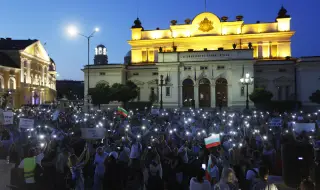
The similarities are visible to the naked eye. The same type of people as five years ago - with a visibly European, modern appearance and behavior - are protesting for the same things: to respect the principles of law. Then it all started with the demand that the citizens of the Republic have access, provided to them by the Constitution, to the public (i.e. everyone's) state property - the Rosenets beach, illegally seized by Ahmed Dogan. Today, the protests in Bulgaria are once again demanding that the principles of law be respected: that people inconvenient to the government should not be arbitrarily arrested and imprisoned.
The game today
However, the differences are significant. Then, in the first months of 2020, the participants in the "Borisov" model had decided that they were in power forever. And in front of everyone's eyes they began to apply the principle formulated by their representative Emo Rothmans a decade earlier (on the occasion of illegal logging): "The government is ours. The forest is ours. We do what we want". In the case of 2020 - in front of everyone's eyes, the clientele of the "model" was taking out public money (on the principle "the money is ours") in sacks. And the beneficiaries of the "model" they stopped even imitating the construction of highways with these means.
Today the game is different. The removal of mayors and municipal councilors, the seizure of power in the countryside, the arrests of key figures in elected positions are aimed at creating a situation in which power this time truly and forever remains in the hands of the Peevski-Borisov tandem. And only then can its agents begin to do whatever they want - undisturbed and unsupervised by a defeated society and its subdued institutions.
That this intention is as serious as death is evident from several important developments. The first was the drastic increase in salaries in the Ministry of Internal Affairs. One might think that the incomes in the Ministry of Internal Affairs were increased for repressive purposes, and not to maintain the rights and security of citizens. And that the money was given so that the uniformed officers would be motivated to terrorize citizens when ordered to do so.
We see the second important development in the actions of the seized state institutions in the "Blagomir Kotsev" case. Even before the start of the court hearing on July 17 on the preventive detention measure of the Varna mayor, it was clear that the state could do one of two things. One: to abandon judicial repression in the face of civil anger and the explicitly formulated concern on the part of leading EU member states, as well as authoritative representatives of the European Parliament. The second: to sharply harden its resistance against citizens and against the EU on the model of its colleagues in Kremlin-occupied countries such as Georgia, for example.
The day before, the state gave a sign that it would harden itself. Completely unprecedented in democratic times was the public reprimand by the Ministry of Foreign Affairs of the German ambassador for her presence at a protest in support of Kotsev. In an official document, which will remain forever available in the archive, the Ministry of Foreign Affairs reprimands an ambassador of an allied country. Not to mention the edifying and provocative tone of the writing, unseen since the time of the USSR.
The court panel of July 17 clearly follows this new party line. Looking into the eyes of representatives of our allied countries present in the hall, the panel took the same firm position: we will keep Kotsev in prison, no matter how many ambassadors report later that they observed not a trial, but political repression against the opposition; we do not care what they say about us in Brussels, Berlin or Paris; We have prosperous, golden times ahead of us here, in our own country.
And the judiciary - both the prosecutor's office and the court - simply showed the middle finger to the citizens of the Republic. We accept, the court shouts, the withdrawn testimony of a witness who denied them, since there was no new testimony. Why was there no new testimony? Because the prosecutor's office had not questioned him again. And why hadn't they questioned him? So that the old testimony would be valid, so that Kotsev would remain in custody.
This is a mockery of the citizens of Bulgaria
This is a direct, direct provocation, a mockery of the citizens ("we do whatever we want, and you shout...") and a demonstrative contempt for any conceivable legal order. Such "feints" (probably their authors think they are very clever and pat each other on the back) are typical of the justice systems of countries like Myanmar and Venezuela. That's where they are dragging us. And they are not shy about demonstrating it to us.
Somewhere in the depths of the dark world of Peevski-Borisov, a decision has been made: power, all power, forever - even at the cost of permanent protests inside the country and problems in the international arena. In preparation for taking over all power, its future owners are already securing resources on the principle of "the power is ours and the money is ours". For whom do you think are those over 16 billion in debt, drawn down in just months by this government? For your streets, villages and neighborhoods? No, my dear.
The struggle for all power never selects the means. And the outcome of this struggle is decided by sheer force. In the coming days and weeks, we will see exactly this: whether the power of Peevski-Borisov is greater than the power of the citizens of the Republic and its allies in the EU.