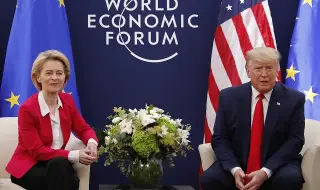
The compromise reached with the US on tariffs will allow the German economy to "take a breath". But the deal comes at a price and it will be a burden on the German and European economies, critics say.
The agreement reached in the customs dispute between the EU and the US brings some relief, but mostly provokes critical reactions from the economy, notes ARD. The compromise announced by EC President Ursula von der Leyen and US President Donald Trump will allow the German economy to "take a breath", the German Chamber of Industry and Commerce said. But the deal comes at a price, and "this price will be a burden on the German and European economies."
According to the agreement, tariffs on most European imports to the US will be 15 percent, which also applies to cars, semiconductors and pharmaceuticals. However, tariffs on steel and aluminum imports will remain at 50 percent.
"Short-term stability, nothing more"
"Many companies really need to breathe," Helena Melnikov, head of the German Chamber of Industry and Commerce, told ARD. With the agreement, the EU is preventing the worst, although many details are still unknown. "The agreement provides short-term stability, nothing more. It is only a first step." The EU and the US must continue to negotiate and "work on a comprehensive, fair and future-oriented trade agreement".
The Federal Association of German Industry is much more critical. Union expert Wolfgang Niedermark believes that the deal sends a fatal signal that the EU is agreeing to painful tariffs. "Because even a rate of 15 percent will have enormous negative repercussions on the export-oriented German economy."
The Federation of German Industry also criticizes the high tariffs on steel and aluminum, which it describes as another serious blow. "This puts pressure on a key industry that is already facing extraordinary challenges and transformation," Niedermark was quoted as saying by German public media. His recommendation is that the EU show that it is more than just an internal market. “We need a strategy for a competitive and sustainable economy, as well as political will to participate confidently in the global race.”
The expert nevertheless notes the positive side of the agreement - that for now further escalation is postponed.
Every percentage of duty is too much
The Association of the Chemical Industry in Germany states that “whoever expects a hurricane is also grateful for ordinary bad weather”. And although further escalation is ruled out for now, based on the deal, European exports will be less competitive, the agreed duties are too high for the chemical industry.
The German Foreign Trade Association, in turn, described the tariff agreement with the US as “a painful compromise”. Every percentage of duty is too much, said the chairman of the Wholesalers' Association, Dirk Jandura. “The tariff increase is a threat to many of our traders."
And while there is currently some certainty about trade conditions, supply chains will change, prices will increase. “The agreement with the US will have a tangible impact in Germany - it will cost growth, welfare and jobs."
15 percent is not small at all
Finance expert Ulrike Malmendiet warns that even the agreed tariffs of 15 percent will lead to a serious loss of welfare. “The sad thing is that this rate will remain for a long time. Because once these tariffs are increased, it will be difficult to reduce them again later."
At the same time, Malmendiet points out that the new tariffs will have a more negative impact on the US than on the EU. Overseas, growth is expected to fall by 1.5 percent of GDP, while in the EU the decline is likely to be halved.
The threat has not disappeared
The director of the Institute for the German Economy, Michael Hüttner, warns that a return to calm cannot be expected. “Donald Trump has not completely abandoned his threats to increase tariffs.” Therefore, the EU's negotiating strategy should be more solid.
The president of the Institute for the World Economy in Kiel, Moritz Schulerik, in turn, states that “there is no reason for euphoria based on the agreement reached - the higher costs will come later”.
Michael Hüttner, quoted by ARD, commented: “Instead of defending the rules-based global trade order, the EU is proposing a deal that is uncertain how durable it will be, which is governed by the sentiments of a populist rather than the law, and which is almost incompatible with the rules of the World Trade Organization”.
What do politicians say?
The German public media also writes that the agreement could cause trouble for Ursula von der Leyen, as Brussels has already noted that it is “not a masterpiece”. Even the European Christian Democrats (which includes the EC President - ed.) are unhappy with the deal, which should reduce the risk of a trade war, but could lead to new injustices.
The chairman of the EP Trade Committee, Bernd Lange, said he was not at all convinced of the quality of the deal. The concessions to the Americans are hard to bear, says the social democrat. “15 percent on imports means a fourfold increase in the current rates, while the rate for imports from the US to the EU will be zero.” This inequality will affect the EU's competitiveness.