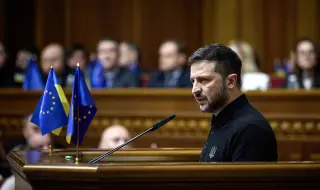
The biggest domestic political crisis in Ukraine since the Russian invasion seems to have been overcome for now: with 331 votes "for" the parliament approved a law proposed by President Volodymyr Zelensky that restores the independence of two anti-corruption bodies. There were no "against" votes or "abstentions". The session was broadcast live - a rarity in wartime. The president immediately signed the law for publication and entry into force.
All this happened after nine days of protests and a situation that was on the verge of a political crisis. Thousands, mostly young Ukrainians, demonstrated in a number of cities, including on voting day. The European Union has criticized the disempowerment of anti-corruption agencies and, according to media reports, has threatened to freeze billions in aid - another novelty since the Russian invasion.
Services with symbolic significance
The protests were sparked by a law passed on July 22 that limits the independence of the National Anti-Corruption Bureau and the Special Anti-Corruption Prosecutor's Office. Both agencies deal with corruption at the highest level: judges, ministers, and deputies are at the center of their attention. The most impressive case to date involved the now-ousted Supreme Court Chief Justice Vsevolod Knyazev. The contested law placed the two anti-corruption agencies under the authority of a presidentially appointed prosecutor general. The reason: suspicions of Russian espionage among investigators. But this did not sound convincing enough. Critics of the law suggested a completely different motive: suspicions of corruption and investigations into the president's entourage, such as against former Deputy Prime Minister Oleksiy Chernyshov.
The scale of the protests is determined by Ukraine's recent history. The two anti-corruption bodies were established in 2015 under pressure from the West - with the corresponding symbolic significance. They were considered a prerequisite for Ukraine to receive visa facilitations for the EU.
Now the new law restores the autonomy of the National Anti-Corruption Bureau and the Special Anti-Corruption Prosecutor's Office. At the president's request, protection against espionage will also be increased. Investigators will be periodically checked with a lie detector.
Zelensky's image suffered
The new law was adopted with relief by observers in Ukraine. Political expert Volodymyr Horbach told DW that the "dynamics" in Ukrainian politics have been welcomed. The parliament has been criticized for its lack of transparency during the war.
The EU has also reacted positively. Zelensky's signature is a welcome step, said EU President Ursula von der Leyen and European Council President Antonio Costa. The new law "addresses key issues of independence" of the two bodies involved, said an EC spokesman in Brussels.
However, some doubt that this is the final end to the crisis. The case has exposed problems in the fight against corruption that go far beyond the two anti-corruption bodies, observers from Ukraine and abroad believe. Contradictions in Ukrainian legislation remain - such as the possibility of avoiding arrest by posting bail and fleeing abroad.
Most of all, however, the image of Ukrainian President Volodymyr Zelensky has suffered. As one widely circulated analysis puts it, he has made his biggest domestic political mistake since the Russian invasion. His "Servant of the People" party has been weakened, says political expert Volodymyr Fesenko. The new law has prevented more damage, but it will take time for the cracks to be filled.
Author: Roman Goncharenko