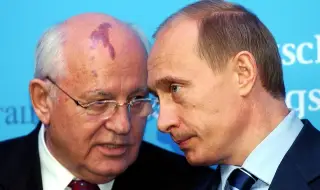
Putin admires Soviet dictators like Brezhnev and Andropov. They would be shocked by what Russia has become on the international stage today, writes Konstantin Eggert.
The Helsinki Accords, signed in August 1975, are probably the greatest diplomatic success in the entire 71-year history of the USSR – they are the ones that put a final end to the disputes over the end of World War II. On the Soviet side, they were signed by the General Secretary of the CPSU Leonid Brezhnev, and in addition to him, the leaders and governments of European democracies, the USA and Canada put their signatures under the document.
The triumph of the "evil empire"
The Helsinki Accords confirmed the “inviolability of borders in Europe” and in fact, thus legalized the Soviet occupation of the Baltic countries and the secession of Moldova from Romania. The act also legalized Soviet control over the rest of Central and Eastern Europe, including the GDR, where about a million Soviet soldiers were based at that time.
The document provides for constant consultations and the development of “confidence building measures” between the Soviet Union and the West, between the Warsaw Pact and NATO - i.e., it reduces the risk of the Cold War turning into a “hot”. This is an important moment for the USSR - because the country's economy was not in the best condition and could not withstand the global opposition. Appropriately called eight years later by Ronald Reagan the "evil empire" the Soviet Union reached the peak of its influence in Europe.
Against all the geopolitical concessions made, the Soviet leadership agreed to the proposal of the Western countries to add a point to the document on the need for "respect for human rights". This addition gave courage to the heroic dissident movement behind the "iron curtain", which from then on appealed precisely for compliance with the Helsinki Accords. However, the Politburo believes that this is an acceptable price for strategic stability in Europe and for reducing the risk of the collapse of the weak Soviet system under pressure from external factors.
The Moscow leadership is particularly pleased with the fact that it has the opportunity to discuss European security issues on an equal footing with America. The element of equality with the United States has always been extremely important for Soviet leaders, a kind of certificate of the status of a “great power”.
In 1990, Mikhail Gorbachev signed the Charter for a New Europe, also called the Paris Charter of the Conference on Security and Cooperation in Europe (CSCE), which symbolically marked the end of the Cold War in Europe. The former Soviet republics became member states of the CSCE, which became the largest global organization in the field of security. In 1995 it was transformed into the Organization for Security and Cooperation in Europe (OSCE) with headquarters in Vienna.
“For the Motherland! For Putin!”
Five years later, Vladimir Putin became president of Russia. And a quarter of a century later, his Russia became unwanted even in this organization, created by Putin's favorite Soviet communist statesmen, including his favorite Russian dictator - Yuri Andropov. Formally, meetings are still held in the Austrian capital, in which Kremlin emissaries ardently "defend the interests of Russia", i.e., of the Putin regime, which replaced their homeland. They invited representatives of Belarus and sometimes some countries from Central Asia.
During this time, outside the meeting room, even staunchly neutral Austria talked about joining NATO. And already in 2023, In the Alliance, Finland, which had been proud of its neutral status for 70 years, regularly inspects its howitzers. If a major military crisis occurs, they will open fire on military facilities near St. Petersburg and Vyborg. Formerly neutral Sweden is also planning, together with the Americans, to seize the Kaliningrad region - in the past, part of the same East Prussia, which passed under the control of Moscow with the Helsinki Accords. Azerbaijan, without taking into account the Kremlin's opinion, offers NATO member Turkey to build a military base on its territory. Finally, the wounded Ukraine rightly does not lose hope of raising the blue flag of the Alliance along its borders - so that the residents of the Kursk, Belgorod and Bryansk regions can see it.
For all this, Vladimir Putin can only thank himself. The combination of cynicism and self-confidence is deadly for successful foreign policy. Even if the incredible were to happen and Putin were to leave the Kremlin tomorrow and the Russian army were to return behind the 1991 borders, new Helsinki Accords would hardly be long in coming. Trust in Russia has been lost for a long time and will not return anytime soon. Europeans will arm themselves and separate themselves from their eastern neighbor in every possible way, including radical ones. It is no coincidence that Lithuania, Latvia, Estonia, Finland, Poland and Ukraine withdrew from the International Convention on Anti-Personnel Mines.
The OSCE is unlikely to self-liquidate, but Russia will retain its status as an unwanted party in the organization for years to come. If it survives at all on its own. Brezhnev would be in shock