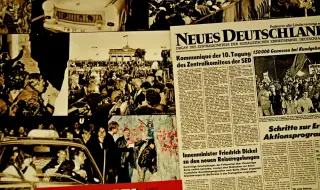
"Comrades, we must know everything!" These were the clear instructions given by Erich Mielke, who headed the Stasi - the GDR's Ministry of State Security - from 1957 to 1989. All citizens of the GDR were under systematic control everywhere - both at their workplaces and in their personal contacts. The goal was to identify "enemies of the people": people who criticized the system, or were associated with the "class enemy", i.e. with the "imperialist" or "fascist" capitalists in the West.
The methods of the STSI: control and intimidation
The Berlin Wall, built in 1961, protects the "enemies" from the outside, but the "enemy" is also inside the country, everywhere. Has someone told a joke about the head of state or listened to inappropriate music? Has someone received suspicious letters with Western stamps or asked for permission to visit the Federal Republic? Everything is suspicious, and the STSI, founded in 1950, keeps an eye on everyone. It sees itself as the "shield and sword" of the Socialist Unity Party of Germany, which must neutralize all enemies and thus guarantee the dominance of the ruling party in the GDR.
Stasi agents examine letters, tap telephones and illegally enter homes. They scared people, spread rumors that someone was addicted to alcohol or homosexual - or, especially meanly, that they had contacts with the Stasi. Quite a few GDR citizens ended up behind bars because they criticized the regime.
Tens of thousands worked for the secret police
People called the Stasi "The Firm" or "Listen and Watch". The spy organization had 90,000 official and between 100,000 and 200,000 unofficial collaborators - agents who, voluntarily or under pressure, reported on the "misdeeds" of friends or family members. But what made them support the unjust regime?
"Maybe it was the feeling of having power over others. But it could also be a family tradition if the parents or even grandparents worked for the Stasi," historian Philipp Springer told DW. "Of course, one must also take into account the ministry's promises that the work would be very interesting and that missions abroad could even be carried out. Last but not least, it was about a secure service - including for people who could not have made such a career elsewhere."
The banal clerical diary
The historian is the author of a book about the Stasi and explains that the activities of the collaborators usually differed greatly from what is shown in spy films. "Sometimes they may have acted like James Bond - for example, during a mission abroad, but in the GDR their everyday life was much more boring."
Their task was to copy documents, do paperwork at a desk and monitor the neighbors from the kitchen. "But all these people contributed to the functioning of the apparatus. They were all part of the system and had received the appropriate political and ideological training - they knew that their task was important for the maintenance of socialism in the GDR and for the defense against enemies from the West."
Loyalty to Death
In his book, Springer tells, for example, about Senior Lieutenant Elfi-Eke Mertens, who is a hereditary agent - her father worked for the Stasi, as did her husband. Her bosses praised her "exceptional willingness to work" and her "diligence". She was so dedicated that she promised to dissuade a relative who wanted to travel to the West. "My husband and I will talk to her again, and if she is not willing to cancel her trip, we will break off relations with her", Mertens promised her boss.
Another story is about Non-Commissioned Officer Sülke Kindler, who was offered to install a camera at the bottom of her shopping bag so that she could photograph her surroundings through the hole. Or about the ambitious Major General Horst Böhm, who was so devoted to the regime that after the end of the GDR he committed suicide.
"It is important not to forget this"
The final end of the Stasi came in January 1990. The legacy includes over 111 km of folders, 41 million registration cards and over 1.7 million photographs, as well as around 15,000 sacks of destroyed documents. Many GDR citizens want to see their files - to find out what role their friends or family members played. Were they victims or criminals? Springer tells DW that there are still many requests from private individuals today.
"But I think all of this also matters on a political or national level, because it is about an injustice perpetrated by an entire apparatus. It is important not to forget this. I think young people need to know this so that they understand that they have a responsibility for the functioning of our democratic system."
Author: Suzanne Cordes