Author: Emi Baruh
Boyan Kolarov is an architect. Chairman of the Dobrich Society of the Union of Architects in Bulgaria. He has a master's degree in philosophy, teaches philosophy and civic education. He was deputy mayor for territorial planning in the city of Dobrich.
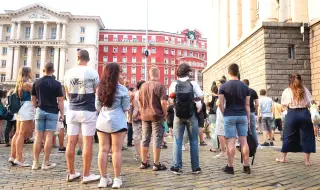
In front of the State Gazette he spoke about democratic representation and its alienation from the electorate, about the inability of the Center to listen to the Periphery.
State Gazette: Square democracy is an urban phenomenon. But if in its Athenian version this corresponded to the idea of participation in government, today - especially in the current August timelessness of the year - it is an expression of self-deception that we can count ourselves, talk, take adequate action against the conquest of the state. From whom do you expect useful action at the moment?
Boyan Kolarov: It is easy to say from whom I do NOT expect useful action. These are the parties that I do not vote for. But those that I vote for have not taken any adequate action for a long time, so that thinking people become more active. I vote for the small parties that we call the democratic community. And which the majority of Bulgarians laugh at. And I get to the point that I do not expect useful action from them either.
For 20 years now, these parties, except for swarming and complaining about others. They do not try to arouse sympathy in more people, to make them actively want to work together with them. And working together is the main meaning of democracy - from its Athenian version to today. Unfortunately, my elected officials communicate with "me" by giving orders.
Here we are on the periphery of the peripheries and we do not see an attempt by the "Center" to talk to us. And this is a necessity. When I, the citizen, have participated in meetings with some of the leaders, the meetings have always taken the form of some condescension from on high and uttering soothing words. And when we try to say that this is not what we expect, they simply interrupt us and the meeting ends.
What happens next?
The Periphery loses trust in the Center. The center rushes into elections with lists that are not clearly set up, people in the places are indignant, but they have no say, and the result is "whatever comes".
Even in larger cities, active people who are ready to do public work are a handful and they know each other. We all know whose motives are. We know who sees power only as personal gain. And when it is precisely such people who are nominated and elected, the result is always the same.
I was not surprised by the secession of municipal councilors from the PP (four councilors from the PP-DB in Dobrich switched to GERB in June - editor's note). These people are always on the side of big business, and this is the side of GERB. "Our" The Center may not want to turn politics into commerce, but due to the lack of communication with the Periphery, it gets involved in this scheme itself.
How is quality selection made?
By involving citizens in governance. Not directly - there can't be fifty finance ministers at the same time. But civic activism must be stimulated by those in power (and by candidate-governors) in order to constantly increase the intellectual capacity of the government and make it a shared responsibility.
I am a member of a civil society association. I represented it twice in very well-organized strategic planning at the national level - to clarify pressing issues, the solution of which requires specific changes to legal texts. The process was long - working meetings by district, then by region and finally at the national level. After each stage, the number of participants decreased. In the end, we were left with about 20 people. We had summarized on one page 20 problems, for the solution of which we had indicated some urgent changes in legal texts. For half a year we met with representatives of the legislative and executive branches and tried to defend our position.
Such forms of strategic planning are very convenient for political parties to have meaningful conversations with citizens - to check their time and identify personnel for their structures. People who have been verified in the field. And it is clear who is who.
Let's assume that the right people have been identified on the ground. What is the next step?
To create communities.
If parties find a way to create communities of people who trust each other, these communities will gain enough self-confidence to become agitators and thus raise the results of these parties.
When I was taking an art class, it always happened that someone was late in the morning and the excuse was always "I missed the tram". To which the professor once said: "Why didn't you take the previous one?". If you didn't get up earlier to take the previous tram, what if you missed the last possible one? You expected things to happen by themselves at the last moment, without you having made any effort. Events don't happen. Someone has to work and achieve them. That's the only way it happens systematically. The rest is just that - chaotic probabilities.
What will you answer when they tell you that from the periphery you can't see the whole? And the most important problems don't fall into the focus of your field of vision.
It is undeniable that the last word has the one who is able to bear responsibility. But the final decision cannot be adequate if we have not discussed all the possible options. Although in a different context, John Locke says that whatever the grounds for absolute power, the absolute monarch is the most ordinary man. No matter how clever the Center is, it includes a limited number of people. Great successes can come when ideas work together.
This is the conversation I expect, but it never happens. And so it happens that I already vote for these people even with the conviction that I am voting for the wind. I already know that they will not do what I expect. The only reason I vote for them is that I still optimistically believe that they do not steal. I have no evidence that this is the case. If I lose this optimism too, my public behavior will lose its meaning.
There is one thing that I am linguistically convinced of - the word "politician" is a linguistic transcription of the Greek word "polίtis", which means citizen. In ancient times, politicians were all free citizens, but then they were a minority. Today, in the conditions of liberal democracy, it is much more difficult, because politicians are all of us.
You don't become a politician when you are elected to government. The elected person is neither smarter nor more important than the one who elects. And he has no reason to command. In order to be able to take something from me - and I will give it to you with a happy heart - you must act as Socrates teaches us. His favorite method of philosophical research is dialogue. And the most important factor in dialogue is that both parties perceive each other as equals. If there is no equality, this is not philosophical dialogue.
What kind of philosophical dialogue can we talk about when we are in a situation of emergency. We are at 12 to 5…
Well, at least at the last minute they should try to have some kind of conversation with the periphery. Even if they are convinced that there is no need to talk with the hard-line electorate, and this is not true, they should realize that we are melting too.
How do you imagine this conversation?
I will refer to Aristotle: Politics is the ability of citizens together, without killing each other, to define problems and find a solution. Political parties are rightly worried that if they directly intervene in this process, people will distrust and will not participate. Therefore, let them find some communities, non-governmental organizations for example, that will trust them and organize various civil meetings to discuss small, large, medium-sized strategic planning, in which as many people as possible can participate.
The PP-DB deputies are only 36 people. How will they have the strength to travel the whole country and talk to people on the ground…
I would tell them: If you don't have enough strength for this, why should we vote for you? Will you govern on our behalf or on yours?
Man has always been small, but he has hunted mammoths. They hunted them by creating tactical hunting groups. There is no other way. It is obvious that a man alone cannot hunt a mammoth. Well, you will find a way to deceive a mammoth. No matter how corpulent it is, a mammoth can also be deceived. You have to find a way, and it won't fall from the sky. You'll figure it out together with the other hunters in the tribe.