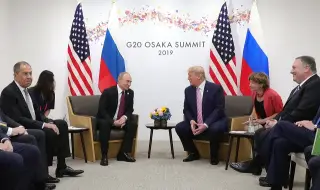
US President Donald Trump and his Russian counterpart Vladimir Putin will discuss a possible deal to end the war in Ukraine when they meet in Alaska on Friday for a summit that is also likely to have a wider impact on European security.
European leaders and Ukrainian President Volodymyr Zelensky plan to speak with Trump on Friday amid concerns that Washington, until now a leading arms supplier to Ukraine, could try to dictate terms unfavourable to Kiev for a peace deal.
What deal could be reached at the meeting?
Last Friday, Trump said there would be "some sort of swap of territory to the benefit of both sides".
That has sparked panic in Kiev and European capitals that Russia could be rewarded for 11 years of efforts - over the past three years, they have included a full-scale war - to seize Ukrainian land. It occupies about 19% of Ukraine. Kiev does not control Russian territory.
"It is reasonable to think that Trump will be fooled by Putin and make a terrible deal at the expense of Ukraine," said Daniel Fried - a former senior US diplomat who now works for the Atlantic Council think tank.
But a "better outcome" for Ukraine is also possible if Trump and his team "realize that Putin is still playing with them".
This could lead to the negotiation of a "truce line" rather than a transfer of territory, with only de facto but not legal recognition of Russia's current gains.
Any lasting peace agreement would also have to include such issues as future security guarantees for Ukraine, its aspirations to join NATO, limits demanded by Moscow on the size of its army, and the future of Western sanctions on Russia.
Trump has not commented on these issues since announcing his meeting with Putin, although his administration has said Ukraine cannot join NATO.
Diplomats have said there is little chance that Trump will strike a unilateral deal with Putin, prioritizing lucrative energy deals and potential arms control agreements. Trump himself has said he may conclude in Alaska that a peace deal for Ukraine is impossible.
The White House did not respond to requests for comment on the possibility of Trump making a unilateral deal with Putin.
What if Ukraine opposes a deal between Trump and Putin?
Trump will face strong opposition from Zelensky and his European allies if the deal includes Ukraine handing over territory to Russia.
Zelensky said the Ukrainian constitution prohibits such a decision without a referendum to change it.
Trump could try to force Kiev to accept such a deal by threatening to cut off arms supplies and intelligence sharing.
But analysts say Ukraine is more likely to accept a freeze on the front lines and an unstable, legally non-binding separation.
A European official told Reuters that even if Trump backs off on his recent promises to resume arms deliveries to Ukraine, he would likely continue to allow Europe to buy American weapons for Ukraine.
"Losing the ability to (share) American intelligence would be the hardest thing to replace. Europe cannot even come close to providing that support," the European official said.
How could the deal affect Trump's support in the United States?
There would be major political risks for Trump in the United States if he abandoned Ukraine, said John Herbst, a former U.S. ambassador to Kiev who now works for the "Atlantic Council".
Such a decision could cast him in the light of "an accomplice in Putin's rape of Ukraine." "I certainly don't think Trump wants to be perceived that way," he added.
Despite his strong political position in the United States, Trump will face criticism even from parts of the American right if he is perceived to be pandering to Russia.
"Rewarding Putin would send the exact opposite message to the one we need to send to dictators and would-be dictators around the world," said Brian Fitzpatrick, a Republican lawmaker and former FBI agent.
How can Ukraine's European allies respond?
European member states said yesterday that Ukraine should be free to decide its own future and that they were ready to contribute to future guarantees for Kiev's security.
Oana Lungescu, a former NATO spokeswoman and now an official at the think tank "Rusi" (RUSI), said that European countries should arm Ukraine more quickly and start EU accession talks in September.
Yana Kobzova – senior fellow at the European Council on Foreign Relations, said that "if an unacceptable deal emerges from Alaska, European capitals will engage in yet another diplomatic and goodwill offensive against Trump".
"European leaders are increasingly realizing that the future of Ukrainian security is inseparable from that of the rest of Europe – and they cannot allow Putin to decide its future form alone," she added.
Translation from English: Valeria Dinkova, BTA