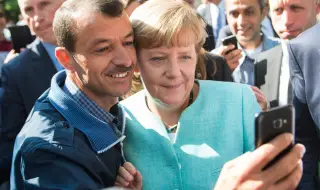
"We will manage" - these words, spoken by then-Chancellor Angela Merkel in the summer of 2015, when hundreds of thousands of people, mainly from Syria, Afghanistan and Iraq, were trying to reach Germany, have become a symbol of the country's open policy towards refugees.
The asylum seekers were greeted with a wave of solidarity and a willingness to help. Many remember the scenes from Munich Central Station, where thousands of refugees were greeted by locals with small gifts. But ten years later, it is clear that the mood in Germany has changed - the original culture of hospitality has given way to skepticism and rejection. Because Germany has not been able to cope with everything: many of the newcomers have not yet found work, and crimes committed by and against refugees are the subject of heated discussions. Migration has become an emotionally charged topic.
Here we answer 10 questions, the answers to which show how successful the integration of these people has been and how it has changed Germany.
1. How many refugees have arrived in the country?
In total, 1.2 million people seeking protection arrived in Germany in 2015 and 2016 and filed asylum applications. In the following years, the number of asylum seekers decreased significantly.
No other country in the European Union has received such a large number of asylum seekers. After Germany, the largest number of people applied for asylum in Italy (204,000), Hungary (203,000) and Sweden (178,000).
But applying for asylum does not automatically mean receiving a right of residence. On average, Germany has approved more than half (56%) of the asylum applications submitted over the past ten years, thus granting a right of residence to 1.5 million people.
In addition to those who are politically persecuted, people who are considered refugees under the Geneva Convention or who are entitled to subsidiary protection, for example because there is a war in their home country, can also stay in Germany. In total, around 3.5 million people seeking protection live in Germany today.
2. Where do people who sought asylum in Germany come from?
In 2015 and 2016, the majority of people who sought asylum in Germany came from Syria, Afghanistan and Iraq - countries that have been scarred by war and conflict for years. Around a fifth of the Syrians living in Germany today already hold German citizenship, and a tenth were born in the country. After Russia invaded Ukraine in 2022, many Ukrainians also sought protection in Germany. Currently, almost 1.3 million refugees in Germany are from Ukraine.
3. Men, women, children: who are the asylum seekers in Germany?
Of the 1.2 million people who sought asylum in Germany in 2015 and 2016, almost half (564,400) were between the ages of 18 and 34, with three-quarters of them being men.
If an asylum seeker is recognized as in need of protection and therefore a refugee, this right to protection also applies to his or her spouse and minor children. Under the family reunification rule, they can also come to Germany. According to the Association of German Cities and Municipalities, 230,000 such applications for the reunification of separated families were approved between 2015 and mid-2017. For refugees with limited protection status, however, this rule was suspended for two years in July 2025.
4. How well are refugees integrated today?
One of the most important indicators of how successful the integration of these people is is their participation in the labor market. According to Yulia Kosyakova from the University of Bamberg, who is intensively involved in the topic of refugees on the labor market, Germany has only partially succeeded. “There is a lot to be desired in terms of female refugees and older refugees“, she tells DW.
Data shows that the longer refugees stay in the country, the easier it is for them to find work. Of those who arrived in Germany in 2015, over 60% found work seven years after their arrival. Younger people under the age of 45 are more easily integrated into the job market.
The majority of those arriving in Germany are relatively unskilled. "There are doctors among them, but the majority have no university or vocational education," says Daniel Timm, a migration researcher at the University of Konstanz. "People arrive, they don't know German, they have to be housed in state housing, they live on welfare. It takes several years to find a job, and even then they often work at a level that requires low qualifications."
Compared to their work in their home country, refugees in Germany work significantly more often as low-skilled helpers and less often as experts and specialists, a 2017 refugee survey showed. The reasons for this are not only lower qualifications and lack of language skills, but also the refusal to recognize their diplomas or their placement in areas with fewer job opportunities.
This also affects their income. The gross monthly salary of people who arrived in Germany in 2015 was an average of 1,600 euros for full-time employment, while the average salary of all refugees, regardless of their type of activity, was 800 euros per person. For comparison: the average gross monthly salary of fully employed people in Germany in the same year was 3,771 euros.
5. How well do refugees speak the language?
Another indicator that is often used to assess integration is language skills. This is also due to the fact that for many professions in Germany, proficiency in German is essential.
However, there are significant gender differences when learning a new language. According to a 2020 refugee survey, 34% of women had advanced language skills (a B1 level certificate). Among male refugees, this share is 54%. This is also reflected in labor market data: although they are often well educated, women are less likely to find work. One reason for this is that younger women often have children to care for, points out Yulia Kosyakova.
6. How many of the refugees have been granted German citizenship?
Since 2016, around 414,000 people have become German citizens. More than half of them (244,000) are from Syria.
“We are now in a period in which many of the refugees from 2015 are being granted German citizenship. Some of the Syrians are considering returning to Syria because the Assad regime has been overthrown. However, they often decide to stay here anyway because they have started a business, are already settled here and their children go to school,“ says migration researcher Hannes Schamann from the University of Hildesheim.
7. How much is it costing Germany to take in so many refugees?
Estimates of how much it costs Germany to take in refugees vary, as the media service Integration shows. Depending on the calculation methodology used, the costs amount to 5.8 trillion euros (5,800 billion), but the expected savings in the future could amount to 95 billion euros per year. The explanation: accepting people seeking protection initially incurs costs before the country begins to benefit from the economic power of immigrants.
For example, the federal budget for 2023 included almost 30 billion euros in costs for refugees, the largest item of which was social benefits.
8. How have attitudes changed in Germany?
While in January 2015 the majority of Germans were more open to accepting refugees, ten years later 68% of voters surveyed believe that Germany should accept fewer refugees.
In 2023, a study commissioned by the “Bertelsmann“ Foundation showed that immigration is now perceived more negatively: 78% of respondents see immigration primarily as an additional burden on the welfare state, 73% argue with conflicts between locals and immigrants, and 63% of respondents agree that immigration is important for the economy.
9. Is there an increased risk of crime associated with refugees?
Some cases of violence committed by refugees have contributed to the change in sentiment. The 2016 Berlin Christmas market attack by a Tunisian or the 2024 knife attack at a city festival in Solingen by a Syrian have fueled fears of refugee-related terrorism. The right-wing populist party “Alternative for Germany“ (AfD) has been able to capitalize on these fears and is now the second largest party in the German Bundestag.
But what about crime in general? A look at police crime statistics shows that in 35% of all cases, the suspects are foreigners. However, they only make up around 15% of the population. According to experts, this does not mean that refugees generally commit more crimes than Germans.
10. How has migration policy changed since 2015?
Since Merkel's famous "We'll manage" speech on August 31, 2015, German migration policy has undergone significant changes. This trend is also reflected in the mood of refugees: while 57% of them felt welcome in the year they arrived, seven years later (in 2022) their share had already dropped to 28%, a report by the Institute for Labor Market and Occupational Research showed.
Germany "has clearly failed," says current Chancellor Friedrich Merz. Migration researcher Schamann, however, counters: "I think we have largely fulfilled the task of 2015." He says that smart political decisions are now needed to enable Germany to cope with the latest challenges.
Authors: Lisa Haenel | Peter Hille | Jana Grün