Comment by Evgeny Dainov:
Dictators communicate with the democratic world through provocations. They do something wrong or outrageous and thus send a message to the civilized world: "Come and see what you will do, weaklings". Sometimes this leads to success and becomes a sign of strength. Examples are the annexation (Anschluss) of Austria to Germany, carried out by Hitler, and the annexation of Crimea, carried out by Putin. In both cases, no civilized country did anything truly substantial to stop these blatant violations of legality and international order. Thus, Hitler and Putin began to appear strong and attract support, allies, and sycophants.
Sometimes, however, provocative behavior is a sign of weakness and could mark the beginning of the end of the dictatorship in question. In order to deal with dictators, we need to be able to capture and evaluate precisely these moments. Because we would have one behavior towards a rising dictatorship (we stand on the defensive), and another - towards a setting one (we move to offensive behavior).
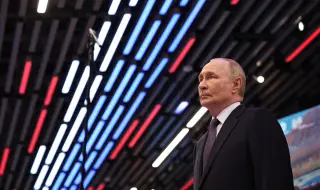
Putin's visit to Beijing may turn out to be not so much a signal of his participation in creating a new dictatorial world, but a sign of the beginning of the end. In this sense, the event would resemble the construction of the Berlin Wall in 1961 by his communist predecessors.
When Communism Showed Its Weakness
Let's start with the Wall. Until 1961, the doctrine of Soviet communism was expansionist: that it would grow, conquer more and more territories until it took over the whole world. The main opponent, the West, was perceived as doomed, perishing, rotting, inevitably falling apart. According to the doctrine, it was in a defensive position, doomed by the indestructible power of rising communism. It was a matter of time before it would fall apart and be subdued.
However, with the advent of the Wall, the game changed completely. It was a blatant violation of the international treaties in force at that time, but it betrayed not strength, but weakness. The one who built walls against the other was in a defensive position. The West never built walls against the USSR, because it was never weak. The USSR, after all, built a wall to hide behind.
In the following months, the weakness of Soviet communism was revealed in two more incidents. In early June 1962, a completely unprecedented rebellion broke out in Novocherkassk for the USSR. Although immediately crushed by Red Army tanks, this rebellion was a sign that the Soviet "establishment" was not at all as strong as it seemed from the outside. Months later, in October of that year, the world witnessed the so-called "Cuban Crisis". The Russians secretly (they thought) transferred missiles to Cuba, aimed at the United States, whose state of Florida was only 140 kilometers away. President Kennedy told Soviet leader Khrushchev to remove the missiles or there would be war. After several days of spitting and threats, the Soviet leader backed down and withdrew the missiles. Then the USSR quarreled with China and world communism split in two in the face of the unprecedented economic and political rise of the supposedly doomed West.
The victory of communist Vietnam over the USA in the Vietnam War did not change the big picture and in the early 1970s Soviet communism, together with its satellites (such as Bulgaria), found itself forced to ask the West for "guarantees" that the post-war borders in Europe would not be redrawn by force.
Up until this point, Soviet propaganda had nothing against such a redrawing, as long as it was in the USSR's favor. The suddenly bursting Soviet love for stable borders was a new sign of weakness, culminating in the signing of the Helsinki Accords of 1975. According to the communists, this was their victory - they would keep what they already had, without having to go to war with the West. But in their weakness they do not see the trap: that the price of the promise of inviolable borders is to sign a package of documents in which they undertake to respect human and civil rights on their territory. The regimes think that this is empty talk to deceive the enemy. But raising the issue of human rights turns out to be a ticking bomb that invalidates Soviet communism to such an extent that by the end of the next decade the European communist regimes fall, without anyone violating their state borders. In 1991 the USSR itself collapses, and the Americans send hundreds of cargo planes with food to save the Russians from starvation.
Let's see how the Russian president's visit to Beijing looks against this historical backdrop. Yes, visiting your southern neighbor is not as challenging as building the Wall in the heart of Europe. But there are familiar symbols and hidden meanings here too.
Signs of Russia's Weakening
Until recently, Putin's propaganda claimed that "Russia has no borders", i.e. that it will constantly seize more and more foreign territories. The "collective West" was described in communist terms: degraded, weak, decaying, doomed. In Beijing, however, Putin nodded approvingly to the thesis of his Chinese hosts that a new world order is about to be built around Beijing - but without the conquest of territories and without the expectation that the West will fall like a ripe pear. The Chinese vision is far more modest: a group of countries, led by China, to cease to respect the principles and documents of the established world order and, above all, human and civil rights and freedoms. The proposal is that a new regional world of oppression should be created next to the free world, which has remained locked in Europe, North America, Australia, etc.
If Putin has accepted this, then he has found himself in the position of Khrushchev in 1961. He has given up the dream of crushing and subjugating the "collective West" and has accepted to remain a regional power, subordinate to China, but still without having any particularly big problems with the West. By closing himself in the Asian fold, Putin is effectively announcing that he has neither the ambition nor the power to overthrow our world.
If the analogy with 1961-1962 is correct, we are about to see a cascade of other signs of Russia's weakening and the limitation of its ambitions. And perhaps they are already there. The West (with the exception of the chaotic Donald Trump) has resolutely stood by the victim of Russian aggression, Ukraine - and will obviously make more and more efforts to crush the Russian military machine for a generation to come. The Russian economy is visibly, albeit slowly, collapsing. The torrent of senior Russian leaders falling from balconies cannot hide the growing discontent among the Kremlin elite.
As in the previous example, however, the decisive factor is the delivery of the final, crushing blow. And this is a political task. In the 1970s and 1980s, it was carried out by the triumvirate Margaret Thatcher-Ronald Reagan-"Polish" Pope. They understood the weakness of the Soviet empire and, instead of resigning themselves to its slow demise, decided to inflict mortal wounds on it. We are waiting to see if there are such leaders among the current Western politicians.
In any case, as Churchill said in a similar situation: "This is not the end. This is not even the beginning of the end. But it may still turn out to be the end of the beginning".