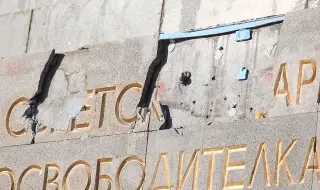
September 9th is the date of the coup in 1944 and the beginning of communist rule in Bulgaria. What follows is a gradual catastrophe that also eliminates the country's intellectual elite, writes Emi Baruch.
1. September 9th and the Artists
September 9th is present in Bulgarian historical, memoir, political and literary literature as a symbol of the “new beginning” - this is how ChatGPT will answer you if you ask him in an appropriate way the question about the aspects that unite the topic in all these researched fields. Nice answer. Because the parallels are self-evident.
The genre lexical characteristics of the way in which the “new beginning” is spoken of then and now are similar - declarativeness, pathos, categoricalness, epicness. As it was once spoken of the party:
….I know, I believe that you are right,
even when you sin!
The speaker's ego is always dominant. Unappealable. And the unforgiveness with which his choice is imposed is irrefutable.
2. The coup that led to catastrophe
September 9th is the date of the coup in 1944, which marked the beginning of communist rule in Bulgaria.
What followed was a gradual catastrophe for the country - political, economic and social change in society, elimination of the intellectual elite and establishment of sole power with all the resulting outrages - a wave of violence, judicial arbitrariness and elimination of civil rights.
After the coup of September 9th, Bulgaria changed its geopolitical orientation and finally fell into the Soviet sphere of influence.
Such is the law of our days:
whoever changes you, USSR,
-
changes your great truth.
3. The demonstrations, the hierarchies, the trumpeting
I remember the demonstrations of September 9th. In our childhood room there was a large desk under the window, from where we could watch how the special forces and military equipment were forming up before they set off for the square. The military parade was the culmination, the end of the festive ritual. It began after all the posters, portraits and people who were parading in front of the mausoleum had finished. My sister and I had fun imitating them: kneeling on both ends of the desk, we would slowly, “with the rhythm of the tanks”, start moving towards each other, raising our hands in greeting, like those on TV. My father didn't like this game, maybe because he didn't like the trumpeting, nor the military parade, nor the vertical hierarchy. He didn't like that those who say they do “everything for the people” have elevated themselves to that rostrum and think they are more human than other people. And below, under their feet, lay a dead body, turned into a symbol of the socialist revolution. What a macabre metaphor!
But we would understand this later. Back then, for our children's heads, the march of those with epaulettes, cannons, army units and the rumble of all the polished metal that resounded in the center of Sofia was an impressive spectacle.
All military parades are spectacles. Some of them are designed to shock the world, like the one on Tiananmen Square a few days ago, others are simply for internal use. In Bulgaria, theater is of the second kind.
4. There are always cronies of power
How the date September 9th is thought of today is a long topic that continues to stir up the swamps - somewhere it is praised, elsewhere it is experienced. Because the dregs of the communist propaganda machine continue to ferment in the minds of many. Its authors were protégés of the government. Every government has its protégés. Then and now. Behind the lyrics, melodies, poems, films, there are often gifted people.
Talented individuals once wrote about the “liberating army”, praised the “new day”, the “new beginning”. They composed odes about “the people who come down from the forests and enter the city as victors”, about “the peasant who throws down the plow and grabs the rifle”, about “the party - a wise helmsman”, about “the glory of Deveti, which will live forever”…
But Deveti did not create these gifts. In every historical era, the Bulgarian intelligentsia has gravitated around the centers of power. And today it feels more comfortable close to power. Talented people! But bent over...
September 9th can also be analyzed from this perspective - as a laboratory in which some of the national traits of the native educated elite are reflected.
5. "September 9th bought me sandals"
During those September 9th demonstrations, where my sister and I pretended to be tanks, a neighbor's child recited the following verse:
September 9th bought me a coat
And he said: Congratulations, congratulations, little boy!
September 9th bought me sandals.
- Let them squirm - he ordered - the little legs!
And then he put a bagel in my hand
- Eat it! - September 9th told me.
——
Well, I'm still chewing on this piece of junk…
This comment expresses the author's personal opinion and may not coincide with the positions of the Bulgarian editorial office and the State News Agency as a whole.
Excerpts are quoted from:
"To the Party" – Hristo Radevski
"Ode to the USSR" - Orlin Orlinov
"The Good Holiday" – Tsvetan Angelov