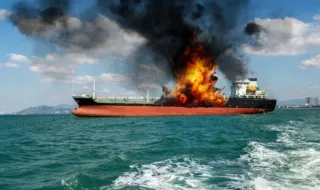
The attack on the two merchant ships about 70 nautical miles east of Byala placed Bulgaria in an unusual situation. The vessels were hit by sea and air drones, one sank, and the fate of part of its crew remained unknown.
Bulgarian institutions responded with a rescue operation, search and coordination between military and civilian structures.
But after the initial reaction, another question arises:
What could Bulgaria have done, other than establish that an attack had been carried out?
The answer is more complicated than the thesis that the country should have simply “retaliated“.
First: these are not Bulgarian territorial waters
The incident occurred in the Bulgarian exclusive economic zone – approximately 70 nautical miles from the coast.
This is fundamentally important.
The exclusive economic zone is not an extension of the territory of the state. Bulgaria has certain sovereign rights and jurisdiction in it, related primarily to natural resources, economic activity, protection of the marine environment and other issues explicitly defined by international law.
Other states retain freedom of navigation and overflight.
Therefore, it cannot be automatically assumed that any foreign military or intelligence apparatus that appears in the Bulgarian EEZ can be attacked by Bulgaria.
This is precisely the difference between an exclusive economic zone and a territorial sea.
However, this does not mean that Bulgaria was powerless.
The fact that the attack took place in the EEZ does not mean that Bulgaria could only observe the consequences.
First of all, the state had every reason to mobilize rescue forces, protect the crews, prevent pollution and to organize an operation to eliminate the consequences.
But in parallel with this, a much larger operation to collect and preserve evidence could have been carried out.
This includes:
recordings from radars and surveillance systems;
data from military and civilian sensors;
drone trajectories;
available electronic signals;
satellite images;
debris from the used devices;
records from the ships;
data from automatic identification systems;
witness testimony;
accurate data on the location and time of the impacts.
This is no longer just a rescue operation.
This is an investigation into an international maritime incident with a potential military dimension.
Could Bulgaria have sent warships and aircraft?
Yes – for surveillance, reconnaissance, rescue operations and protection of shipping.
However, a very important distinction must be made here.
One is:
„We send a ship or aircraft to monitor the area and protect civilian shipping.“
It is quite another:
„We send military assets to destroy the alleged perpetrator.“
The second already raises the question of the use of force.
And international law sets a much higher threshold for such an action.
Could Bulgaria have shot down a drone that was attacking a ship?
This is one of the most complex questions.
If a drone directly threatens people's lives and attacks a civilian ship, the state could take measures to protect human life.
But whether this involves the use of military force depends on the specific circumstances.
The following questions would be relevant:
What is the drone?
Who is flying it?
What is the immediate threat?
Is there another possibility of preventing the strike?
Are there sufficient grounds to assume that this is an armed attack against Bulgaria?
These are both operational and legal questions.
If it is established that a state armed apparatus carries out an attack and that it constitutes an armed attack against Bulgaria, then the question of the right of self-defense under international law may already arise. right.
But the very fact that the attack occurs in the Bulgarian EEZ does not automatically give such a right.
The greatest opportunity is actually prevention
This is where, in my opinion, the real question lies.
Not whether Bulgaria could have started a military conflict because of the two ships.
And could it have had a better system for monitoring and warning commercial shipping before the attack?
There has already been a series of incidents involving commercial ships in the Black Sea.
In a similar situation, Bulgaria could have developed a more systematic scheme for:
sea and air surveillance;
early warning to commercial ships;
exchange of intelligence information;
monitoring of risky routes;
coordination between the Navy, Air Force, Maritime Administration and services;
constant readiness to respond to an attack.
This would not guarantee the prevention of the strike.
But it would increase the likelihood that the ships would be warned and Bulgaria would have information in the first minutes.
NATO – could Bulgaria have asked for more?
A distinction must be made here too.
NATO membership does not mean automatic activation of collective defense in the event of any incident that occurs in the Bulgarian exclusive economic zone.
Article 5 refers to an armed attack against an ally under the terms of the North Atlantic Treaty.
But there is also Article 4.
It allows a member state to request consultations when, in its opinion, its territorial integrity, political independence or security is threatened.
This is a completely different instrument.
Bulgaria could say:
„We have a serious incident in our region. We need allied information, surveillance and coordination.“
This does not mean:
„NATO should go to war.“
The difference is huge.
Could Bulgaria have asked for an international mechanism to protect ships?
Yes - at least as a diplomatic and political initiative.
Bulgaria could have raised the issue with NATO, the European Union and the International Maritime Organization.
The goal could be to create a common mechanism:
surveillance – warning – coordination – rescue response – investigation.
This would be a significantly more defensible position than unilateral military action.
It is particularly important that the ships involved are foreign merchant vessels. In international shipping, the state under whose flag the ship is sailing also matters.
And who has the right to investigate?
There is a nuance here too.
International maritime law provides mechanisms for investigating and prosecuting certain illegal actions against the safety of shipping.
However, this does not mean that Bulgaria automatically receives the right to detain any ship or person it suspects.
International law sets rules for jurisdiction, flag state and international cooperation.
That is why evidence is so important.
The better an incident is documented, the stronger the state's position becomes in subsequent diplomatic or legal actions.
Could Bulgaria have retaliated?
Here we must be particularly careful.
If it is proven that a foreign state is behind the attack, this in itself does not automatically mean that Bulgaria has the right to launch a retaliatory military strike.
It must be established what exactly happened, who the perpetrator is and whether the attack can be legally qualified as an armed attack against Bulgaria.
In addition, in self-defense, the principles of necessity and proportionality exist.
Between:
„A foreign drone has hit a merchant ship in the Bulgarian EEZ“
and
„Bulgaria has the right to attack military facilities of the country it comes from the drone“
has a huge legal distance.
This distance is often missed in the public debate.
But the opposite is also wrong
The claim that Bulgaria could not do anything except save the sailors is also not correct.
The country had real opportunities in at least four directions.
First - surveillance.
Increase maritime and air surveillance in risk areas.
Second - warning.
Creating a mechanism for immediately informing merchant ships of potential danger.
Third - international coordination.
Using NATO and EU mechanisms for information exchange, surveillance and risk assessment.
Fourth – investigation.
Collecting evidence as quickly as possible – from radar records and satellite imagery to debris, ship records and witness statements.
These are real tools that do not require Bulgaria to undertake an unjustified military escalation.
The strongest move could have been the evidence
Paradoxically, the strongest response is not necessarily military.
If Bulgaria manages to establish who the perpetrator is, where the drones came from, how they moved and who controlled them, then the country will have a much stronger position for diplomatic, legal and allied actions.
This is exactly what is missing at the moment.
We have attacked ships, dead or missing sailors, material damage and an attack in the Bulgarian exclusive economic zone.
But no perpetrator has yet been publicly identified.
Ukraine claims that the attack was Russian. Russia denies it. The Bulgarian authorities have not confirmed either version.
And until that changes, any categorical statement about who should be attacked or punished would be ahead of the evidence.
The Conclusion
The case near Byala shows an unpleasant paradox.
The Bulgarian exclusive economic zone is Bulgarian from the point of view of certain rights and jurisdiction, but it is not Bulgarian territory in the sense of land territory or territorial sea.
Therefore, Bulgaria did not have an unlimited right to use force against any alleged attacker.
But this does not mean that the state was limited to the role of a rescue service.
It could observe, warn, collect evidence, request allied assistance, raise the issue in NATO and the EU, and insists on an international mechanism for the protection of civil shipping.
There is another important conclusion.
The question is not only what Bulgaria could have done after the first attack. The question is what it must do now so as not to find itself in the same situation again in the next one.
Because if the attacks on merchant ships in the Black Sea continue, the reaction “we saved the people and assessed the damage“ will gradually turn from a crisis response into a model.
And a country that claims to protect its maritime security must have not only a rescue plan, but also a plan for warning, deterrence, surveillance and proving the perpetrator.