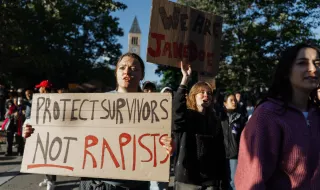
New York state prosecutors have reopened their investigation into an alleged gang rape at Cornell University after a woman filed a civil lawsuit accusing the university and law enforcement of not doing enough. According to court documents filed in the case on September 16, which include screenshots of a group chat allegedly between members of the university fraternity at the center of the allegations, the woman, identified as Jane Doe, claims she was drugged and raped in the fraternity building in 2024, safenews.bg reported.
The case has sparked anger on social media against “Cornell“ and the Tompkins County, New York, District Attorney's Office for the manner in which the charges were handled.
On Monday, District Attorney Matthew Van Houten said that while his office had determined at the time of the alleged assault that the evidence from the whistleblower's initial testimony did not meet the legal threshold for indictment, it would now leave the decision to a grand jury.
„Once we determine the appropriate charges, the case will be handled in the most objective and impartial manner available to us – "by presenting testimony before the Tompkins County Grand Jury," Van Houten said.
What's the matter?
According to the 101-page lawsuit, on Oct. 19, 2024, the whistleblower visited a friend at the Chi Phi fraternity building at Cornell University in Ithaca, New York. At the time, she was already intoxicated after drinking at a local off-campus bar.
She claims that two fraternity members offered her sex with both of them and later pressured her to use ketamine and smoke marijuana.
Doe, who was 20 at the time, claims that she was then raped by seven men in the Chi Phi fraternity building. for seven hours before passing out at around 5:45 a.m.
In the lawsuit, she claims that she was unable to consent due to the effects of the drugs.
Doe added that although she reported the incident to university police on November 8, 2024, prosecutors did not press criminal charges.
On Monday, Doe's attorney, Thomas Giuffra, told CBS News that she went to police because she believed she was "the victim of a crime."
„Besides her initial contact with Cornell police, she has not been contacted by investigators from the Tompkins County District Attorney's Office or other investigators trained to speak with victims of crime. rape," Giuffra said.
He added that Cornell expelled two fraternity members after an internal investigation into the allegations, while five others received lighter punishments, including suspension from classes, participation in training seminars and writing essays.
“None of these men were arrested. Not one. "I can tell you that for sure," Giuffra said.
He added that Dow left the university after the ordeal.
The lawsuit names Matthew Ingalls, Jonathan Newell, Winston Lee, Giglio Lopez, Diego Sarabia, Scott Norris and Scott Kretschmar as the men accused of the allegations.
The lawsuit also names Cornell University, the Chi Phi fraternity, the Delta Delta Delta sorority, the off-campus bar and the seven men as defendants. They are accused of breach of contract, negligence and violations of state law.
Dow is seeking monetary damages, including compensatory and punitive damages. The lawsuit does not specify a specific amount.
What was in the group chat?
The lawsuit includes images from a Snapchat group chat between fraternity members, in which one participant rudely tells the others that they can have sex with the victim “for free”.
An image from the chat shows a message from a man who writes:
“I fucking love “Chi Phi““.
Scott Kretschmar, who was a member of the fraternity at the time, allegedly sent two messages to the Snapchat group but denies any involvement.
Have any of the defendants responded?
Yes. Kretschmar's lawyer, Jeremy Saland, told CBS News that the messages were inappropriate but did not constitute evidence of sexual assault.
“This is a situation where there was a disgusting Snapchat – disgusting, period. But that doesn't make my client a rapist and it certainly doesn't make him a sex offender,” Saland said.
He added that his client briefly entered the room where Doe was, but did not touch her “in any way” and left shortly after.
Regarding the ketamine charge, Saland said Kretschmar had undergone a hair follicle test that showed the drug was not in his system. He said no one had contacted his client about the renewed investigation.
“We are prepared to present evidence that exonerates him. "I just hope that ultimately the right thing is done, that this case is closed and that my client can live his life without being subjected to this selfish, disgusting, vile claim made about him by this woman," he added.
Meanwhile, Andrew Miltenberg, Lopez's attorney, also told CBS New York that his client categorically denies the allegations against him.
What did the university say?
In a statement released Monday, Cornell said it supported the district attorney's decision to submit Doe's case to a grand jury.
The university said it initially conducted its own investigation into the allegations over several months before sending the case for a hearing. At the hearing, a specially trained panel of faculty and staff heard evidence presented by Doe and the accused.
„At the conclusion of the hearing, the panel imposed various sanctions, including expulsion and suspension from „Cornell“. None of the accused were offered essay writing as the sole consequence of their participation,“ the statement said.
The university added that the „Chi Phi“ fraternity was closed in 2024 and is still not allowed to operate on campus.
„Any claim that the university has not imposed significant penalties on those involved is false. “Continuing the false narrative that there were minimal consequences in this case is irresponsible, will make victims feel less safe and supported, and will contribute to the underreporting of sexual assault,” the statement added.
What did the district attorney say?
According to Van Houten’s statement on Monday, in Doe’s initial testimony from November 2024, she did not claim that she was drugged against her will or that she was the victim of a gang rape.
„To the contrary, in her testimony, Jane Doe described her participation in the drug use and sexual acts as voluntary, knowing, and consensual. It is clear that my office could not and did not make its decision in November 2024 based on allegations in a civil lawsuit that would have been filed almost two years later. I recognize the reality that victims of sexual assault may need years of therapy and recovery to fully process and understand what happened to them. “The pursuit of justice sometimes requires us to reexamine or reopen cases when additional evidence comes to light,” he said.
Van Houten said a prosecutor from his office, who has significant experience prosecuting sex crimes and has been involved in trials of sexual assault cases on campus, will prepare the case for the grand jury.
How prevalent is sexual assault on American universities?
According to the Association of American Universities’ 2019 College Climate Survey, 13% of women studying at U.S. colleges reported nonconsensual sexual contact that was carried out through physical force or in a situation where they were unable to consent.
Among women studying for undergraduate degrees, the rate was 26.4% – roughly one in four students. Among men studying for a bachelor's degree, the proportion was 6.9%.
Among women in graduate programs, 10.8% reported sexual contact that was carried out through physical force or in a situation where they were unable to consent.
Source: