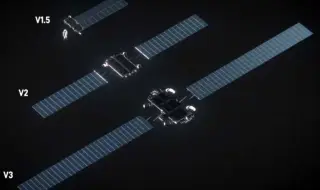
The infrastructure of artificial intelligence (AI) is growing at breakneck speed, and the bottlenecks on Earth are becoming more and more tangible. In this context, the idea of moving data centers to space is no longer science fiction, but a completely real plan. SpaceX is taking a leading role in this space invasion with an ambitious project that will use the Starlink V3 satellite network as a basis.
Elon Musk, the founder and head of SpaceX, attracted public attention after commenting on an article in Ars Technica about the possibility of robots building data centers in orbit. His response on the social network X was eloquent: "This can be achieved by simply scaling up the Starlink V3 satellites, which have high-speed laser connections. SpaceX will do it.
The competition is also not sleeping: Jeff Bezos, the founder of Blue Origin, predicted last month that data centers with a capacity of several gigawatts will appear in low-Earth orbit in the coming decades. Supporters of this futuristic idea point to several undeniable advantages:
Free, unlimited solar energy: A virtually endless energy source to power the massive centers.
Lack of environmental restrictions: Moving heavy equipment into orbit eliminates concerns about the impact on the Earth's ecosphere.
Of course, opponents point to the high cost and the lack of fully developed technologies as the main obstacles.
Starlink already has the most modern and profitable space communication infrastructure, and the third generation of satellites will be a real technological leap. Starlink V3 launches will begin in the next six months, with each Starship mission adding up to 60 new satellites.
While SpaceX’s CEO didn’t elaborate on how these satellites will scale to become “space data centers,” high-speed laser links are key to processing and transferring the vast amounts of information needed for AI applications. In this way, SpaceX is not just providing the internet, but building a fundamental infrastructure for the future of computing.