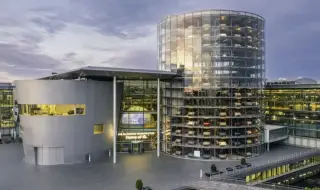
One of Volkswagen's most striking architectural and symbolic projects - the glass factory (Gläserne Manufaktur) in Dresden - is on the verge of a radical transformation. Opened in 2002 with the stellar ambition of producing the flagship Phaeton, the company is now facing the economic inexpediency of continuing traditional car production there. Despite a public commitment not to close factories in Germany, the Glass Factory in its original form will cease to exist, but will be given a new life as a large-scale innovation center.
The production of the Volkswagen ID.3, the last model assembled at the plant, will be completely stopped by the end of 2025. This puts an end to a colorful story in which the Phaeton, later the electric e-Golf and the first batches of the ID.3 were born in this unique building. It turned out that despite all its unique charm - glass walls, visible conveyor from the street and high-style architecture - the plant is not designed for high production volumes and does not meet modern requirements for cost optimization.
The factory was conceived by the architect of the Volkswagen empire, Ferdinand Piech, as a hybrid between a production and exhibition complex. It has become a real tourist attraction in Dresden, although its construction once caused resistance among the local population. After the sunset of the Phaeton era in 2016, it was converted into a demonstration center for the brand's electrification and digitalization. Alas, this proved insufficient to justify the huge annual maintenance costs, which amount to around 60 million euros.
Against the backdrop of the large-scale anti-crisis agreement between Volkswagen and the IG Metall union, signed at the end of 2024, it was decided to cut 35,000 jobs, reduce production capacity by 700,000 vehicles and stop production of the ID.3 in Dresden. At the same time, the concern officially committed that the plant would not be closed, but would be found a “next application”. It is this commitment that is now entering its decisive phase.
According to information from Handelsblatt, a preliminary agreement has already been signed between Volkswagen Sachsen, the government of Saxony and the Technical University of Dresden (TU Dresden) for the creation of a multidisciplinary Innovation Center on the territory of the factory. The project is designed for at least seven years and provides for close cooperation with TU Dresden in the field of scientific research, the development of microelectronics, the creation of closed recycling cycles and the formation of an ecosystem for startups. In this way, the Glass Factory will gradually transform from a production site into a scientific and technological platform, where Volkswagen will play the role not of a manufacturer, but of a partner-client for innovative projects.
As part of this new model, the concern is ready to invest 1.5 million euros each year in the center, significantly reducing its own maintenance costs compared to the previous period. Part of the premises will be leased to the Dresden University of Technology itself, which will attract students, scientists and innovation teams.
Despite the optimistic vision, some challenges remain. First of all, the nature of employment is changing dramatically. Of the 205 employees who assembled about 6,000 electric cars per year, only 135 managed to get potential positions in the new structure. While some employees voluntarily accept severance pay and early retirement, about 60 people still do not have a clearly defined position. With guaranteed employment until 2030, Volkswagen risks finding itself in a position where it has to pay salaries to employees without real work. Management is looking for a way out of this scenario, considering the possibility of transferring staff to other Volkswagen plants in the region.
The second key issue is the financing of the reconstruction itself. It is estimated that the transformation of the Glass Factory into an innovation center may require a one-time investment of about 50 million euros. The allocation of this amount has not yet been finalized, although the Saxony government has already expressed its willingness to support the project.